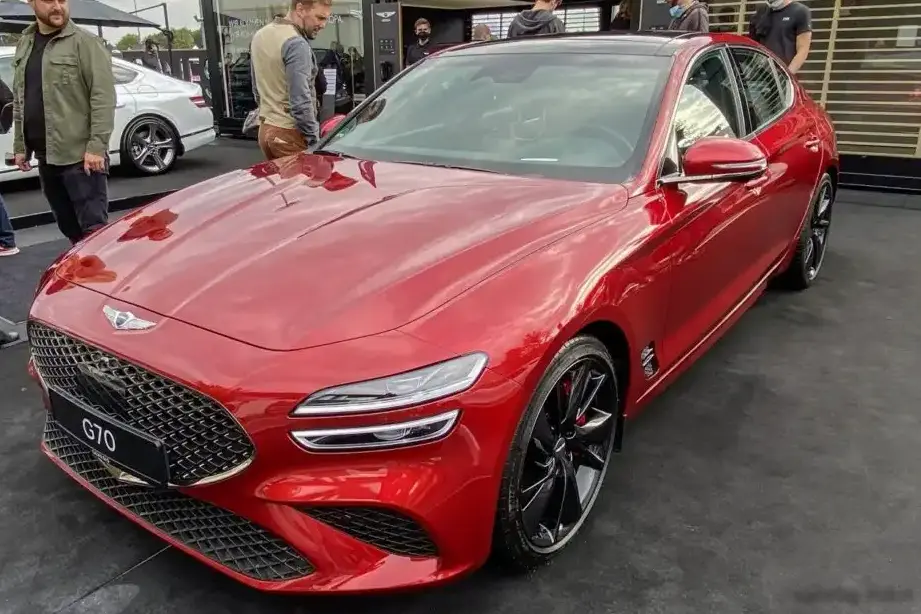
The Genesis G70, particularly the facelifted version introduced in October 2020, represents a significant entry for the Hyundai-backed luxury brand into the competitive sport sedan segment. This variant, equipped with the 2.2-liter e-VGT diesel engine producing 202 horsepower and paired with an 8-speed automatic transmission, was primarily aimed at the European and Asian markets where diesel engines maintain considerable popularity. Positioned as a mid-range offering within the G70 lineup, it provided a balance between performance, fuel efficiency, and refinement, appealing to buyers seeking a premium driving experience without the higher price tag of the more powerful gasoline options.
Technical Specifications
| Brand | Genesis |
| Model | G70 |
| Generation | G70 (facelift 2020) |
| Type (Engine) | 2.2 e-VGT (202 Hp) Automatic |
| Start of production | October, 2020 |
| Powertrain Architecture | Internal Combustion engine |
| Body type | Sedan |
| Seats | 5 |
| Doors | 4 |
| Fuel consumption (urban) | 7.5-7.8 l/100 km (31.4 – 30.2 US mpg) |
| Fuel consumption (extra urban) | 5.7-6.2 l/100 km (41.3 – 37.9 US mpg) |
| Fuel consumption (combined) | 6.7-7 l/100 km (35.1 – 33.6 US mpg) |
| CO2 emissions | 127-134 g/km |
| Fuel Type | Diesel |
| Weight-to-power ratio | 8.5 kg/Hp, 118.1 Hp/tonne |
| Weight-to-torque ratio | 3.9 kg/Nm, 257.9 Nm/tonne |
| Power | 202 Hp @ 3800 rpm |
| Power per litre | 91.9 Hp/l |
| Torque | 441 Nm @ 1750-2750 rpm (325.26 lb.-ft. @ 1750-2750 rpm) |
| Engine layout | Front, Longitudinal |
| Engine Model/Code | R II / D4HC |
| Engine displacement | 2199 cm3 (134.19 cu. in.) |
| Number of cylinders | 4 |
| Engine configuration | Inline |
| Fuel injection system | Diesel Commonrail |
| Engine aspiration | Turbocharger, Intercooler |
| Engine oil capacity | 6.3 l (6.66 US qt | 5.54 UK qt) |
| Coolant capacity | 9.82 l (10.38 US qt | 8.64 UK qt) |
| Kerb Weight | 1710-1735 kg (3769.9 – 3825.02 lbs.) |
| Fuel tank capacity | 60 l (15.85 US gal | 13.2 UK gal) |
| Length | 4685 mm (184.45 in.) |
| Width | 1850 mm (72.83 in.) |
| Height | 1400 mm (55.12 in.) |
| Wheelbase | 2835 mm (111.61 in.) |
| Front track | 1592-1596 mm (62.68 – 62.83 in.) |
| Rear track | 1604-1632 mm (63.15 – 64.25 in.) |
| Front overhang | 805 mm (31.69 in.) |
| Rear overhang | 1045 mm (41.14 in.) |
| Drivetrain | Rear wheel drive |
| Number of gears | 8 |
| Gearbox type | Automatic transmission |
| Front brakes | Ventilated discs |
| Rear brakes | Ventilated discs |
| Front tires | 225/40 R19 |
| Rear tires | 225/50 R17; 225/45 R18; 255/35 R19 |
Powertrain & Engine Architecture
At the heart of this G70 variant lies the Hyundai-Kia R II 2.2-liter inline-four diesel engine, designated with the code D4HC. This engine utilizes a cast iron block and aluminum cylinder head, incorporating a turbocharger with an intercooler to boost power and efficiency. The engine employs a common-rail direct injection system, delivering fuel at extremely high pressures for optimized combustion. The e-VGT (electronic Variable Geometry Turbocharger) technology allows for precise control of the turbocharger vanes, improving responsiveness across the rev range and minimizing turbo lag. The engine also features a diesel particulate filter (DPF) and selective catalytic reduction (SCR) system to meet stringent emissions standards. The 8-speed automatic transmission, sourced from Hyundai Powertech, is designed for smooth and efficient gear changes. It features a torque converter and electronically controlled shifting, adapting to driving conditions and driver input.
Driving Characteristics
The 202 horsepower and 325 lb-ft of torque produced by the 2.2-liter diesel engine provide a respectable level of performance for the G70. While not as overtly sporty as the gasoline-powered models, the diesel offers strong low-end and mid-range torque, making it well-suited for everyday driving and overtaking maneuvers. The 8-speed automatic transmission contributes to a relaxed driving experience, with well-spaced gear ratios. Compared to the manual transmission options, the automatic prioritizes comfort and ease of use over outright driver engagement. Against the higher-output 3.3-liter gasoline engine, the 2.2 diesel naturally lags in acceleration, but it compensates with significantly improved fuel economy.
Equipment & Trim Levels
The 2.2 e-VGT Automatic trim typically included a comprehensive suite of standard features. These generally encompassed leather upholstery, a touchscreen infotainment system with Apple CarPlay and Android Auto compatibility, a rearview camera, parking sensors, and a suite of advanced driver-assistance systems (ADAS) such as lane keeping assist, forward collision avoidance assist, and adaptive cruise control. Optional extras often included a premium sound system, a panoramic sunroof, ventilated front seats, and a head-up display. Interior trim levels varied, with options for different wood or metal accents.
Chassis & Braking
The G70 utilizes a multi-link suspension setup at all four corners, providing a balance between ride comfort and handling precision. The suspension is tuned to be slightly softer in the diesel variants compared to the more performance-focused gasoline models. Braking duties are handled by ventilated discs on all four wheels, providing ample stopping power. Anti-lock braking system (ABS) and electronic stability control (ESC) are standard features, enhancing safety and control. The steering system employs a rack-and-pinion setup, offering precise and responsive steering feel.
Market Reception & Comparison
The Genesis G70 2.2 e-VGT Automatic was generally well-received by automotive critics, particularly for its refined ride quality, comfortable interior, and strong fuel economy. Reviewers praised the engine’s torque delivery and the smooth operation of the automatic transmission. However, some noted that the diesel engine lacked the sporty character of the gasoline alternatives. Compared to rivals like the BMW 3 Series and Mercedes-Benz C-Class, the G70 offered a compelling value proposition, with a generous level of standard equipment and a competitive price point. In terms of reliability, the R II diesel engine has proven to be generally robust, although regular maintenance, including DPF regeneration, is crucial for long-term durability.
Legacy
The Genesis G70 2.2 e-VGT Automatic has established itself as a solid and dependable used car option. The powertrain, when properly maintained, is known for its longevity. The availability of parts and service is generally good, thanks to the growing Genesis dealer network. As a used vehicle, it represents a good balance of luxury, performance, and fuel efficiency, making it an attractive choice for buyers seeking a premium sport sedan at a more accessible price point. The model helped establish Genesis as a credible competitor in the luxury car market, demonstrating the brand’s commitment to quality and innovation.