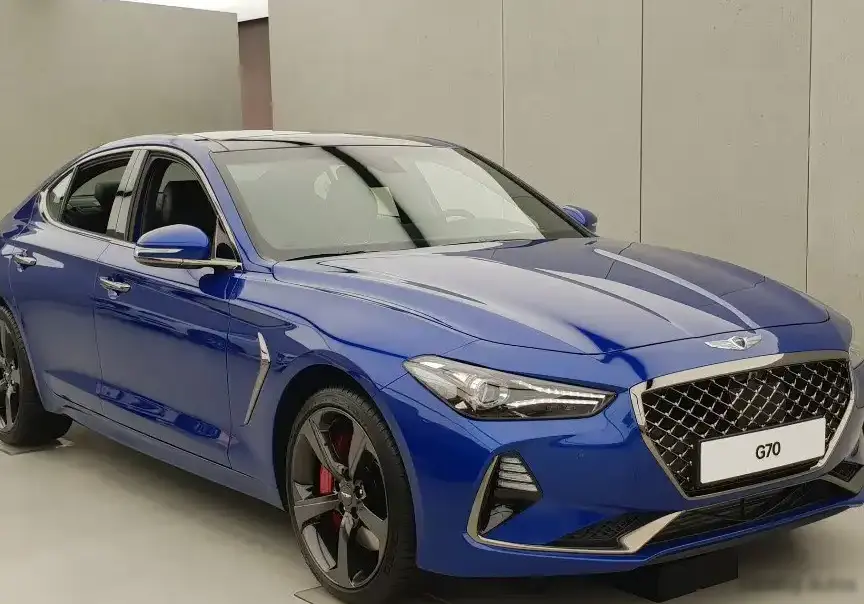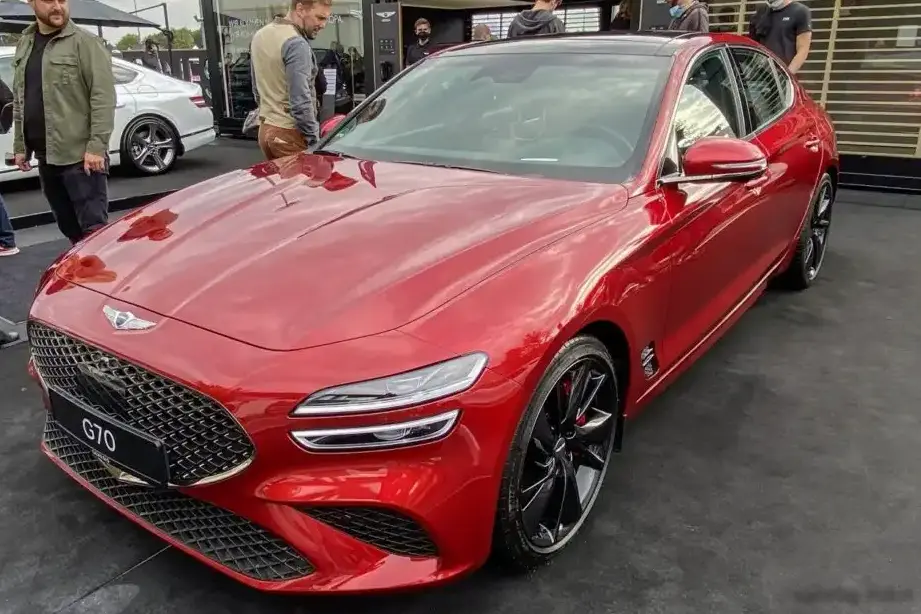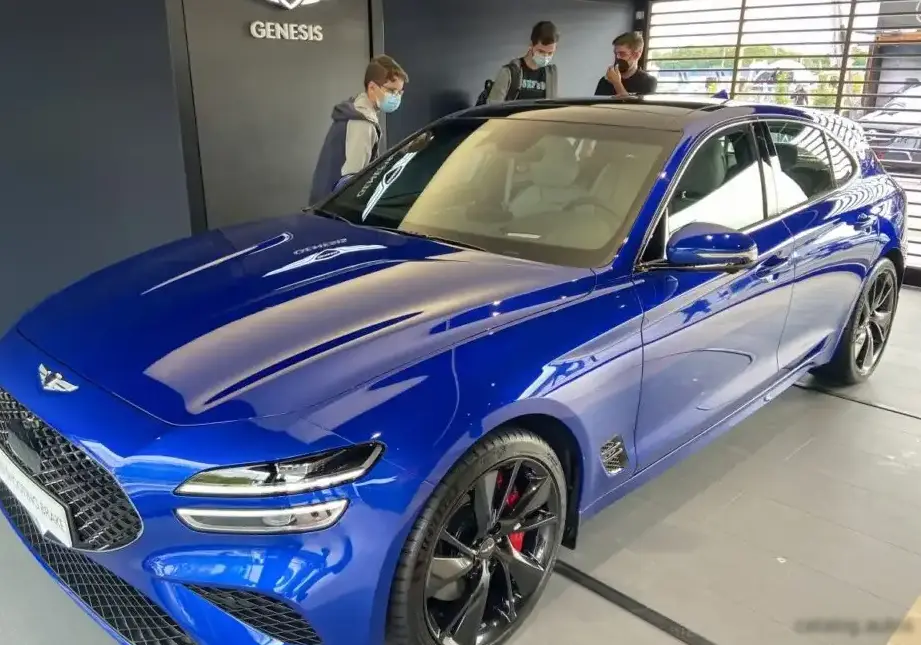
Technical Specifications
| Brand | Genesis |
| Model | G70 |
| Generation | G70 Shooting Brake (facelift 2021) |
| Type (Engine) | 2.0 T-GDi (197 Hp) Automatic |
| Start of production | November, 2021 |
| Powertrain Architecture | Internal Combustion engine |
| Body type | Station wagon (estate) |
| Seats | 5 |
| Doors | 5 |
| Fuel consumption at Low speed (WLTP) | 13.1-13.3 l/100 km (18 – 17.7 US mpg, 21.6 – 21.2 UK mpg, 7.6 – 7.5 km/l) |
| Fuel consumption at Medium speed (WLTP) | 8.2-8.7 l/100 km (28.7 – 27 US mpg, 34.4 – 32.5 UK mpg, 12.2 – 11.5 km/l) |
| Fuel consumption at high speed (WLTP) | 7.1-7.5 l/100 km (33.1 – 31.4 US mpg, 39.8 – 37.7 UK mpg, 14.1 – 13.3 km/l) |
| Fuel consumption at very high speed (WLTP) | 8.2-8.7 l/100 km (28.7 – 27 US mpg, 34.4 – 32.5 UK mpg, 12.2 – 11.5 km/l) |
| Combined fuel consumption (WLTP) | 8.5-8.9 l/100 km (27.7 – 26.4 US mpg, 33.2 – 31.7 UK mpg, 11.8 – 11.2 km/l) |
| CO2 emissions (WLTP) | 194-204 g/km |
| Fuel Type | Petrol (Gasoline) |
| Acceleration 0 – 100 km/h | 9.3 sec |
| Acceleration 0 – 62 mph | 9.3 sec |
| Acceleration 0 – 60 mph | 8.8 sec |
| Maximum speed | 218 km/h (135.46 mph) |
| Emission standard | Euro 6d |
| Weight-to-power ratio | 8.7 kg/Hp, 114.7 Hp/tonne |
| Weight-to-torque ratio | 4.9 kg/Nm, 205.6 Nm/tonne |
| Power | 197 Hp @ 4500-6200 rpm |
| Power per litre | 98.6 Hp/l |
| Torque | 353 Nm @ 1450-3500 rpm (260.36 lb.-ft. @ 1450-3500 rpm) |
| Engine layout | Front, Longitudinal |
| Engine Model/Code | Theta II / G4KL |
| Engine displacement | 1998 cm3 (121.93 cu. in.) |
| Number of cylinders | 4 |
| Engine configuration | Inline |
| Cylinder Bore | 86 mm (3.39 in.) |
| Piston Stroke | 86 mm (3.39 in.) |
| Number of valves per cylinder | 4 |
| Fuel injection system | Direct injection |
| Engine aspiration | Turbocharger, Intercooler |
| Engine oil capacity | 5.7 l (6.02 US qt | 5.02 UK qt) |
| Coolant | 7.27 l (7.68 US qt | 6.4 UK qt) |
| Engine systems | Start & Stop System, Particulate filter |
| Kerb Weight | 1717 kg (3785.34 lbs.) |
| Max. weight | 2175 kg (4795.05 lbs.) |
| Max load | 458 kg (1009.72 lbs.) |
| Trunk (boot) space – minimum | 403 l (14.23 cu. ft.) |
| Trunk (boot) space – maximum | 1535 l (54.21 cu. ft.) |
| Fuel tank capacity | 60 l (15.85 US gal | 13.2 UK gal) |
| Length | 4685 mm (184.45 in.) |
| Width | 1850 mm (72.83 in.) |
| Height | 1400 mm (55.12 in.) |
| Wheelbase | 2835 mm (111.61 in.) |
| Front track | 1592 mm (62.68 in.) |
| Rear (Back) track | 1596 mm (62.83 in.) |
| Front overhang | 805 mm (31.69 in.) |
| Rear overhang | 1045 mm (41.14 in.) |
| Ride height (ground clearance) | 130 mm (5.12 in.) |
| Drag coefficient (Cd) | 0.28 |
| Minimum turning circle (turning diameter) | 11 m (36.09 ft.) |
| Drivetrain Architecture | The Internal combustion engine (ICE) drives the rear wheels of the vehicle. |
| Drive wheel | Rear wheel drive |
| Number of gears and type of gearbox | 8 gears, automatic transmission |
| Front suspension | Independent type McPherson |
| Rear suspension | Independent multi-link suspension |
| Front brakes | Ventilated discs, 345-350 mm |
| Rear brakes | Ventilated discs, 330-340 mm |
| Assisting systems | ABS (Anti-lock braking system) |
| Steering type | Steering rack and pinion |
| Power steering | Electric Steering |
| Tires size | Front wheel tires: 225/45 R18; 225/40 ZR19 Rear wheel tires: 225/45 R18; 255/35 ZR19 |
| Wheel rims size | Front wheel rims: 8.0J x 18; 8.0J x 19 Rear wheel rims: 8.0J x 18; 8.5J x 19 |
The Genesis G70 Shooting Brake, introduced in November 2021 as part of the model’s facelift, marks Genesis’s entry into the premium compact executive wagon segment. The 2.0 T-GDi variant, paired with an 8-speed automatic transmission, offers a balance between performance and efficiency within the G70 lineup. This version aimed to broaden the G70’s appeal, offering a more practical body style alongside the established sedan. It’s built on the G70 platform (originally launched as a sedan in 2017) and shares its underpinnings with the Kia Stinger, though with a distinctly Genesis-focused design and interior refinement. The Shooting Brake is primarily marketed in Europe and select other markets where wagons remain popular.
Powertrain & Engine Architecture
The 2.0 T-GDi engine, designated the Theta II / G4KL, is a turbocharged, direct-injection four-cylinder gasoline engine. It produces 197 horsepower at 4500-6200 rpm and 353 Nm (260 lb-ft) of torque between 1450 and 3500 rpm. The engine utilizes a twin-scroll turbocharger to minimize turbo lag and improve responsiveness. Direct injection optimizes combustion efficiency and power output. The engine is longitudinally mounted in the front of the vehicle, driving the rear wheels. Paired with this engine is a smooth-shifting 8-speed automatic transmission, offering quick gear changes and contributing to a refined driving experience. This transmission is designed for both efficiency and performance, with close gear ratios to keep the engine in its optimal power band.
Driving Characteristics
The 2.0 T-GDi automatic G70 Shooting Brake delivers a comfortable and capable driving experience. While not as overtly sporty as the higher-output 3.3T models, it provides ample power for everyday driving and highway cruising. Acceleration from 0-60 mph takes approximately 8.8 seconds, and the car reaches a top speed of 135 mph. The automatic transmission is well-tuned, providing smooth shifts and responsive downshifts. Compared to the manual transmission version of the same engine, the automatic offers greater convenience, particularly in urban environments. However, it may slightly diminish the driver’s sense of control and engagement. The wagon body style adds a bit of weight compared to the sedan, but the difference is not significant enough to noticeably impact performance.
Equipment & Trim Levels
The 2.0 T-GDi Shooting Brake typically comes well-equipped as standard. Features generally include leather upholstery, a touchscreen infotainment system with Apple CarPlay and Android Auto compatibility, a suite of advanced driver-assistance systems (ADAS) such as lane-keeping assist, forward collision avoidance assist, and adaptive cruise control, and automatic climate control. Optional extras often include a premium sound system, a panoramic sunroof, ventilated front seats, and a head-up display. Trim levels vary by market, but generally offer increasing levels of luxury and technology. The base trim focuses on providing essential features, while higher trims add more premium materials and advanced technology.
Chassis & Braking
The G70 Shooting Brake utilizes a sophisticated chassis design. The front suspension employs a McPherson strut setup, while the rear features a multi-link suspension. This configuration provides a good balance between ride comfort and handling precision. The car is equipped with ventilated disc brakes on all four wheels, providing ample stopping power. ABS (Anti-lock Braking System) is standard, enhancing safety and control during emergency braking situations. The steering is electrically assisted, offering a precise and responsive feel. Stabilizer bars are fitted front and rear to reduce body roll during cornering.
Market Reception & Comparison
The Genesis G70 Shooting Brake 2.0 T-GDi was generally well-received by automotive critics. It was praised for its stylish design, comfortable ride, and well-equipped interior. However, some reviewers noted that the 2.0T engine, while adequate, lacked the outright performance of the 3.3T V6. Fuel economy is respectable, with combined WLTP figures ranging from 8.5 to 8.9 l/100km. Compared to rivals like the Audi A4 Avant and BMW 3 Series Touring, the G70 Shooting Brake offers a compelling value proposition, often undercutting its German competitors in price while providing a similar level of luxury and technology. Reliability reports are still emerging, but early indications suggest that the G70 is a relatively reliable vehicle.
Legacy
The Genesis G70 Shooting Brake, particularly the 2.0 T-GDi automatic variant, represents a significant step forward for the Genesis brand. It demonstrates the brand’s commitment to offering a diverse range of premium vehicles. The Theta II engine has proven to be a durable and reliable powerplant in other Hyundai and Kia vehicles, suggesting that the G70’s powertrain should offer long-term dependability. On the used car market, these models are expected to hold their value reasonably well, appealing to buyers seeking a stylish, practical, and well-equipped premium wagon.