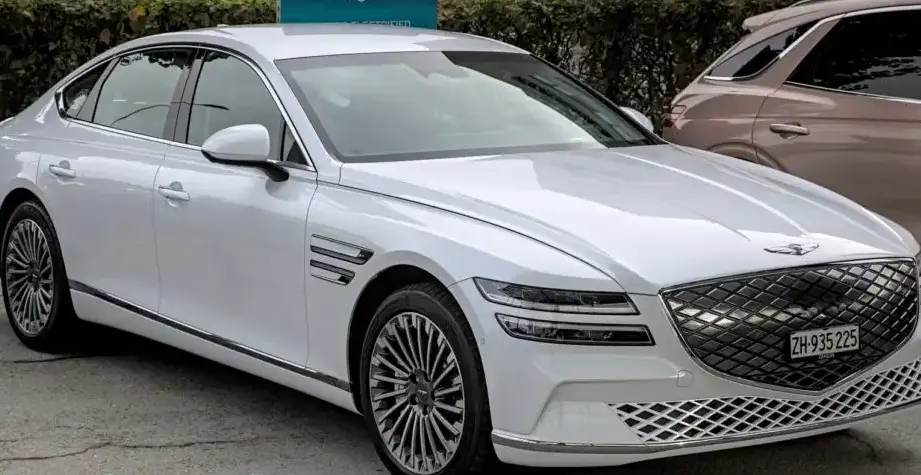
The Genesis G80 II 2.5 T-GDi Automatic, produced from April 2020 through 2024, represents the entry point into the second generation of Genesis’s mid-size luxury sedan. Positioned below the 3.5 T models, this variant offered a compelling blend of performance, luxury, and technology, aimed at buyers seeking a sophisticated driving experience without the higher price tag of the flagship trims. It’s built on the G80’s (RH) platform, sharing its core structure with the Kia Stinger, but distinguished by Genesis’s unique styling and focus on refined comfort. This model played a crucial role in establishing Genesis as a legitimate competitor in the luxury automotive market, particularly in North America where the brand sought to gain traction against established German and Japanese rivals.
Technical Specifications
| Brand | Genesis |
| Model | G80 |
| Generation | G80 II |
| Type (Engine) | 2.5 T-GDi (304 Hp) Automatic |
| Start of production | April, 2020 |
| End of production | 2024 |
| Powertrain Architecture | Internal Combustion engine |
| Body type | Sedan |
| Seats | 5 |
| Doors | 4 |
| Fuel consumption at Low speed (WLTP) | 13.3-13.5 l/100 km (17.7 – 17.4 US mpg, 21.2 – 20.9 UK mpg, 7.5 – 7.4 km/l) |
| Fuel consumption at Medium speed (WLTP) | 8.2-8.5 l/100 km (28.7 – 27.7 US mpg, 34.4 – 33.2 UK mpg, 12.2 – 11.8 km/l) |
| Fuel consumption at high speed (WLTP) | 7-7.2 l/100 km (33.6 – 32.7 US mpg, 40.4 – 39.2 UK mpg, 14.3 – 13.9 km/l) |
| Fuel consumption at very high speed (WLTP) | 7.7-8 l/100 km (30.5 – 29.4 US mpg, 36.7 – 35.3 UK mpg, 13 – 12.5 km/l) |
| Combined fuel consumption (WLTP) | 8.3-8.6 l/100 km (28.3 – 27.4 US mpg, 34 – 32.8 UK mpg, 12 – 11.6 km/l) |
| CO2 emissions (WLTP) | 189-195 g/km |
| Fuel consumption (economy) – urban | 10.5-10.8 l/100 km (22.4 – 21.8 US mpg, 26.9 – 26.2 UK mpg, 9.5 – 9.3 km/l) |
| Fuel consumption (economy) – extra urban | 7.7-7.8 l/100 km (30.5 – 30.2 US mpg, 36.7 – 36.2 UK mpg, 13 – 12.8 km/l) |
| Fuel consumption (economy) – combined | 9.2-9.4 l/100 km (25.6 – 25 US mpg, 30.7 – 30.1 UK mpg, 10.9 – 10.6 km/l) |
| CO2 emissions | 157-160 g/km |
| Fuel Type | Petrol (Gasoline) |
| Acceleration 0 – 100 km/h | 6 sec |
| Acceleration 0 – 62 mph | 6 sec |
| Acceleration 0 – 60 mph | 5.7 sec |
| Maximum speed | 250 km/h (155.34 mph) |
| Weight-to-power ratio | 5.9 kg/Hp, 170.3 Hp/tonne |
| Weight-to-torque ratio | 4.2 kg/Nm, 236.4 Nm/tonne |
| Power | 304 Hp @ 5800 rpm |
| Power per litre | 121.7 Hp/l |
| Torque | 422 Nm @ 1650-4000 rpm (311.25 lb.-ft. @ 1650-4000 rpm) |
| Engine layout | Front, Longitudinal |
| Engine Model/Code | Smartstream / G4KR |
| Engine displacement | 2497 cm3 (152.38 cu. in.) |
| Number of cylinders | 4 |
| Engine configuration | Inline |
| Cylinder Bore | 88.5 mm (3.48 in.) |
| Piston Stroke | 101.5 mm (4 in.) |
| Compression ratio | 10.5:1 |
| Number of valves per cylinder | 4 |
| Fuel injection system | Direct injection and Multi-port manifold injection |
| Engine aspiration | Turbocharger, Intercooler |
| Valvetrain | DOHC |
| Engine oil capacity | 6.2 l (6.55 US qt | 5.46 UK qt) |
| Coolant | 9.6 l (10.14 US qt | 8.45 UK qt) |
| Kerb Weight | 1785-1810 kg (3935.25 – 3990.37 lbs.) |
| Max. weight | 2380 kg (5247 lbs.) |
| Max load | 570-595 kg (1256.63 – 1311.75 lbs.) |
| Trunk (boot) space – minimum | 424 l (14.97 cu. ft.) |
| Fuel tank capacity | 65 l (17.17 US gal | 14.3 UK gal) |
| Max. roof load | 100 kg (220.46 lbs.) |
| Length | 4995 mm (196.65 in.) |
| Width | 1925 mm (75.79 in.) |
| Width with mirrors folded | 1970 mm (77.56 in.) |
| Width including mirrors | 2115 mm (83.27 in.) |
| Height | 1465 mm (57.68 in.) |
| Wheelbase | 3010 mm (118.5 in.) |
| Front track | 1627-1630 mm (64.06 – 64.17 in.) |
| Rear (Back) track | 1637-1659 mm (64.45 – 65.31 in.) |
| Front overhang | 845 mm (33.27 in.) |
| Rear overhang | 1140 mm (44.88 in.) |
| Ride height (ground clearance) | 140 mm (5.51 in.) |
| Drag coefficient (Cd) | 0.27 |
| Minimum turning circle (turning diameter) | 11.62 m (38.12 ft.) |
| Drive wheel | Rear wheel drive |
| Number of gears and type of gearbox | 8 gears, automatic transmission |
| Front suspension | Coil spring, Independent multi-link suspension, Transverse stabilizer |
| Rear suspension | Independent multi-link spring suspension with stabilizer |
| Front brakes | Ventilated discs, 360 mm |
| Rear brakes | Ventilated discs, 345 mm |
Powertrain & Engine Architecture
The G80 II 2.5 T-GDi utilizes Hyundai’s Smartstream engine family, specifically the G4KR 2.5-liter turbocharged inline-four cylinder engine. This engine is a modern design featuring direct injection combined with multi-port fuel injection, optimizing both power delivery and fuel efficiency. The engine produces 304 horsepower at 5800 rpm and 311 lb-ft of torque between 1650 and 4000 rpm. The turbocharger, coupled with an intercooler, provides a broad torque curve, contributing to responsive acceleration. The engine employs a dual continuously variable valve timing (CVVT) system for improved engine breathing and efficiency. Paired with the engine is a smooth-shifting 8-speed automatic transmission, designed to provide seamless gear changes and contribute to the overall refined driving experience. This transmission is a torque-converter automatic, prioritizing comfort and refinement over outright performance.
Driving Characteristics
The 2.5 T-GDi powertrain delivers a comfortable and capable driving experience. While not as overtly sporty as the 3.5T models, the 304 hp and 311 lb-ft of torque provide ample power for everyday driving and highway passing. The 8-speed automatic transmission is well-tuned, offering smooth and predictable shifts. The gear ratios are optimized for both fuel economy and responsiveness. Compared to a hypothetical manual transmission version (not offered in this configuration), the automatic prioritizes ease of use and refinement. The rear-wheel-drive configuration contributes to a balanced feel, although all-wheel drive was available as an option. The engine’s peak torque arriving at a relatively low 1650 rpm ensures strong off-the-line acceleration, making it well-suited for urban driving conditions.
Equipment & Trim Levels
The 2.5 T-GDi typically came standard with a generous array of features, including leather upholstery, a 12.3-inch touchscreen infotainment system, Apple CarPlay and Android Auto integration, a suite of advanced driver-assistance systems (ADAS) such as lane keeping assist, forward collision avoidance assist, and adaptive cruise control, and LED headlights. Optional extras included a larger touchscreen display, a premium Lexicon audio system, ventilated and heated front seats, a panoramic sunroof, and Nappa leather upholstery. Trim levels often included ‘Standard’, ‘Advanced’, and ‘Prestige’ packages, with each successive tier adding more luxury and convenience features.
Chassis & Braking
The G80 II features a robust chassis with a multi-link suspension system at both the front and rear. The front suspension utilizes coil springs and a transverse stabilizer bar, while the rear suspension employs a similar setup. This configuration provides a comfortable ride while maintaining good handling characteristics. Braking duties are handled by ventilated disc brakes on all four wheels, with larger rotors at the front (360mm) compared to the rear (345mm). The braking system is augmented by ABS, electronic stability control, and brake assist systems. The suspension tuning is geared towards comfort, prioritizing a smooth ride over aggressive cornering.
Market Reception & Comparison
The Genesis G80 II 2.5 T-GDi was generally well-received by automotive critics. It was praised for its luxurious interior, comfortable ride, and strong value proposition. Compared to its competitors, such as the BMW 5 Series, Mercedes-Benz E-Class, and Audi A6, the G80 offered a similar level of luxury and technology at a lower price point. Fuel economy was competitive within its class, with combined WLTP figures ranging from 8.3 to 8.6 l/100 km. Reliability reports have been generally positive, although long-term data is still accumulating. Some reviewers noted that the 2.5T engine, while capable, lacked the outright performance of the 3.5T models.
Legacy
The Genesis G80 II 2.5 T-GDi has established itself as a popular choice in the used car market. Its combination of luxury, technology, and value has made it an attractive option for buyers seeking a premium sedan. The Smartstream engine and 8-speed automatic transmission have proven to be relatively reliable, with few widespread issues reported. As Genesis continues to build its brand reputation, the G80 II 2.5 T-GDi is likely to remain a desirable and well-regarded vehicle for years to come, representing a significant step forward for the Korean luxury brand.