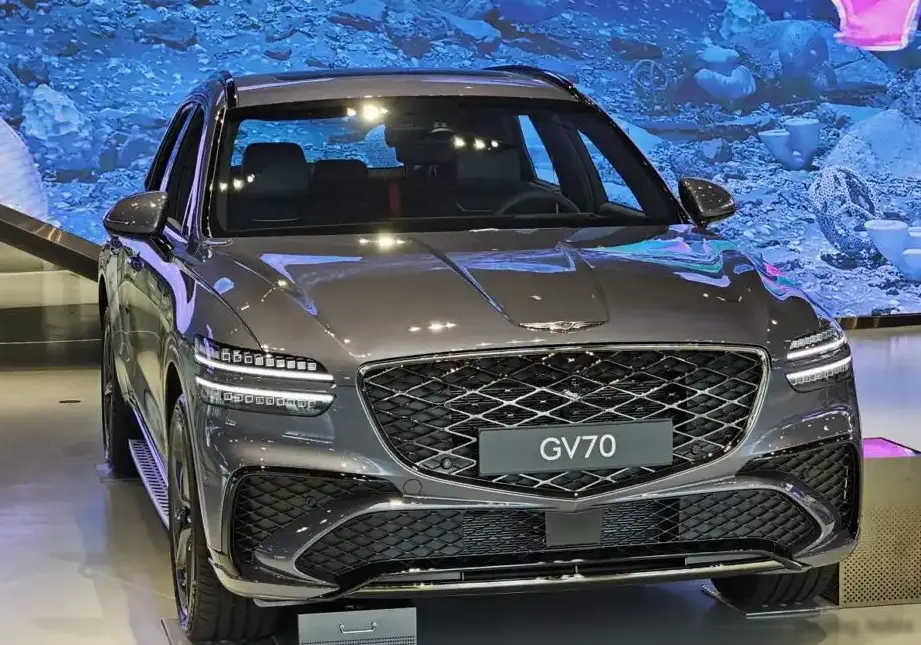
Technical Specifications
| Brand | Genesis |
| Model | GV70 |
| Generation | GV70 |
| Type (Engine) | 2.5 T-GDi (304 Hp) Automatic |
| Start of production | October, 2020 |
| End of production | 2025 |
| Powertrain Architecture | Internal Combustion engine |
| Body type | SUV |
| Seats | 5 |
| Doors | 5 |
| Fuel consumption (urban) | 10.4-11.4 l/100 km (22.6 – 20.6 US mpg) |
| Fuel consumption (extra urban) | 8.1-8.8 l/100 km (29 – 26.7 US mpg) |
| Fuel consumption (combined) | 9.3-10.2 l/100 km (25.3 – 23.1 US mpg) |
| CO2 emissions | 173-158 g/km |
| Fuel Type | Petrol (Gasoline) |
| Weight-to-power ratio | 6 kg/Hp, 167 Hp/tonne |
| Weight-to-torque ratio | 4.3 kg/Nm, 231.9 Nm/tonne |
| Power | 304 Hp @ 5800 rpm |
| Power per litre | 121.7 Hp/l |
| Torque | 422 Nm @ 1650-4000 rpm (311.25 lb.-ft. @ 1650-4000 rpm) |
| Engine layout | Front, Longitudinal |
| Engine Model/Code | Smartstream / G4KR |
| Engine displacement | 2497 cm3 (152.38 cu. in.) |
| Number of cylinders | 4 |
| Engine configuration | Inline |
| Number of valves per cylinder | 4 |
| Fuel injection system | Direct injection |
| Engine aspiration | Turbocharger, Intercooler |
| Engine oil capacity | 6.2 l (6.55 US qt | 5.46 UK qt) |
| Coolant capacity | 8.6 l (9.09 US qt | 7.57 UK qt) |
| Kerb Weight | 1820-1865 kg (4012.41 – 4111.62 lbs.) |
| Fuel tank capacity | 66 l (17.44 US gal | 14.52 UK gal) |
| Length | 4715 mm (185.63 in.) |
| Width | 1910 mm (75.2 in.) |
| Height | 1630 mm (64.17 in.) |
| Wheelbase | 2875 mm (113.19 in.) |
| Front track | 1641-1651 mm (64.61 – 65 in.) |
| Rear track | 1657-1667 mm (65.24 – 65.63 in.) |
| Front overhang | 845 mm (33.27 in.) |
| Rear overhang | 995 mm (39.17 in.) |
| Drivetrain | Rear wheel drive |
| Number of gears | 8 |
| Gearbox type | Automatic transmission |
| Front brakes | Ventilated discs |
| Rear brakes | Ventilated discs |
The Genesis GV70 2.5 T-GDi is a five-passenger luxury SUV that debuted as Genesis’s second SUV model, following the larger GX80. Positioned as the more accessible option in the GV70 range, it slots below the higher-performance 3.5T variant. The GV70 aims to compete with established players like the Acura RDX, BMW X3, and Audi Q5, offering a compelling blend of style, technology, and value. The “T-GDi” designation signifies a turbocharged gasoline direct injection engine, a key component of its powertrain. Production ran from 2020 through 2025, with minor updates occurring throughout its lifespan.
Powertrain & Engine Architecture
At the heart of the GV70 2.5 T-GDi lies the Smartstream G4KR 2.5-liter inline-four cylinder engine. This engine utilizes direct injection and a single twin-scroll turbocharger to deliver 304 horsepower and 311 lb-ft of torque. The engine benefits from cooled exhaust gas recirculation (EGR) and a comprehensive thermal management system to optimize efficiency and reduce emissions. The engine’s architecture is longitudinally mounted, contributing to the rear-wheel-drive bias of the vehicle. The standard transmission is an eight-speed automatic, developed in-house by Hyundai. This transmission features shift-by-wire technology, eliminating the traditional mechanical linkage and contributing to a smoother, more refined driving experience. The transmission is tuned for both comfort and responsiveness, with quick shifts and a wide gear ratio spread.
Driving Characteristics
The GV70 2.5 T-GDi offers a comfortable and composed driving experience. While not as overtly sporty as the 3.5T model, the 2.5-liter engine provides ample power for everyday driving and highway passing. The eight-speed automatic transmission is well-matched to the engine, providing smooth and timely shifts. The rear-wheel-drive configuration contributes to a balanced feel, and the optional all-wheel-drive system enhances traction in inclement weather. Steering is precise and well-weighted, providing a confident feel on the road. The suspension is tuned for comfort, absorbing bumps and imperfections with ease, but it also maintains good body control in corners. Compared to the 3.5T, the 2.5T feels less urgent in its acceleration, but the difference is often negligible in typical driving scenarios. The gear ratios are optimized for fuel efficiency and relaxed cruising, with a relatively tall final drive.
Equipment & Trim Levels
The GV70 2.5 T-GDi came standard with a generous array of features, including a 14.5-inch touchscreen infotainment system, a digital instrument cluster, leather upholstery, heated front seats, and a suite of advanced driver-assistance systems (ADAS) such as lane-keeping assist, adaptive cruise control, and automatic emergency braking. Higher trim levels added features like ventilated front seats, a panoramic sunroof, premium audio systems (Lexicon), and Nappa leather upholstery. Optional extras included a power-adjustable steering column, a head-up display, and a surround-view monitor. Interior color options ranged from black and gray to more vibrant hues, allowing buyers to personalize their vehicles. The dashboard layout is modern and minimalist, with a focus on intuitive controls and a premium feel.
Chassis & Braking
The GV70 utilizes a multi-link suspension system at both the front and rear, providing a comfortable ride and good handling characteristics. The suspension is tuned to balance comfort and control, offering a compliant ride without sacrificing stability. The chassis is constructed with high-strength steel, contributing to its rigidity and safety. Braking duties are handled by ventilated discs at all four corners. The braking system is responsive and provides ample stopping power. ABS (Anti-lock Braking System) and electronic stability control are standard features. The GV70’s weight distribution is nearly 50/50, contributing to its balanced handling. Stabilizer bars are fitted to both the front and rear axles to reduce body roll during cornering.
Market Reception & Comparison
The Genesis GV70 2.5 T-GDi was generally well-received by automotive critics. It was praised for its stylish design, luxurious interior, and competitive pricing. Reviewers noted that the 2.5-liter engine provided sufficient power for most drivers, and the eight-speed automatic transmission was smooth and responsive. Fuel economy was considered competitive for its class, with combined ratings ranging from 23.1 to 25.3 US mpg. Compared to the 3.5T variant, the 2.5T offered a more affordable entry point into the GV70 lineup, making it accessible to a wider range of buyers. However, some critics noted that the 2.5T lacked the outright performance of its more powerful sibling. Reliability reports have been generally positive, with few major issues reported.
Legacy
The Genesis GV70 2.5 T-GDi has established itself as a strong contender in the luxury SUV segment. Its combination of style, features, and value has resonated with buyers, and it has helped to elevate the Genesis brand’s reputation. On the used car market, the GV70 2.5 T-GDi holds its value well, reflecting its desirability and reliability. The Smartstream engine and eight-speed automatic transmission have proven to be durable and dependable, with few widespread mechanical issues reported. As Genesis continues to expand its lineup, the GV70 2.5 T-GDi will likely be remembered as a pivotal model that helped to establish the brand as a serious player in the luxury automotive market.