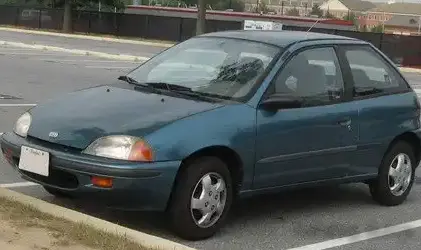
The Geo Metro 1.0, produced from 1989 to 1996, represents a significant chapter in the history of fuel-efficient subcompact cars in the United States. A product of the joint venture between General Motors and Suzuki, the Metro was primarily marketed as an economy car, appealing to buyers seeking low running costs and basic transportation. This particular variant, powered by a 1.0-liter, 55 horsepower engine, served as the entry-level offering within the Metro lineup, and was a key player in a market segment increasingly focused on fuel economy in the late 1980s and early 1990s. The Metro was based on the Suzuki Cultus platform, and was sold under various names globally, including the Suzuki Swift and Holden Barina.
Technical Specifications
| Brand | Geo |
| Model | Metro |
| Generation | Metro |
| Type (Engine) | 1.0 (55 Hp) |
| Start of production | 1989 year |
| End of production | 1996 year |
| Powertrain Architecture | Internal Combustion engine |
| Body type | Hatchback |
| Seats | 4 |
| Doors | 2 |
| Fuel consumption (economy) – combined | 4.9 l/100 km |
| Fuel consumption (economy) – combined | 48 US mpg |
| Fuel consumption (economy) – combined | 57.6 UK mpg |
| Fuel consumption (economy) – combined | 20.4 km/l |
| Fuel Type | Petrol (Gasoline) |
| Acceleration 0 – 100 km/h | 20 sec |
| Acceleration 0 – 62 mph | 20 sec |
| Acceleration 0 – 60 mph | 19 sec |
| Maximum speed | 140 km/h |
| Maximum speed | 86.99 mph |
| Weight-to-power ratio | 13.6 kg/Hp |
| Weight-to-power ratio | 73.3 Hp/tonne |
| Weight-to-torque ratio | 9.5 kg/Nm |
| Weight-to-torque ratio | 105.3 Nm/tonne |
| Power | 55 Hp @ 5700 rpm |
| Power per litre | 55.4 Hp/l |
| Torque | 79 Nm @ 3300 rpm |
| Torque | 58.27 lb.-ft. @ 3300 rpm |
| Engine layout | Front, Transverse |
| Engine Model/Code | LP2 |
| Engine displacement | 993 cm3 |
| Engine displacement | 60.6 cu. in. |
| Number of cylinders | 3 |
| Engine configuration | Inline |
| Cylinder Bore | 74 mm |
| Cylinder Bore | 2.91 in. |
| Piston Stroke | 77 mm |
| Piston Stroke | 3.03 in. |
| Compression ratio | 9:1 |
| Number of valves per cylinder | 2 |
| Fuel injection system | Single-point injection |
| Engine aspiration | Naturally aspirated engine |
| Engine oil capacity | 3.5 l |
| Engine oil capacity | 3.7 US qt | 3.08 UK qt |
| Coolant | 4 l |
| Coolant | 4.23 US qt | 3.52 UK qt |
| Kerb Weight | 750 kg |
| Kerb Weight | 1653.47 lbs |
| Trunk (boot) space – maximum | 159 l |
| Trunk (boot) space – maximum | 5.62 cu. ft. |
| Fuel tank capacity | 40 l |
| Fuel tank capacity | 10.57 US gal | 8.8 UK gal |
| Length | 3745 mm |
| Length | 147.44 in. |
| Width | 1575 mm |
| Width | 62.01 in. |
| Height | 1330 mm |
| Height | 52.36 in. |
| Wheelbase | 2265 mm |
| Wheelbase | 89.17 in. |
| Front track | 1365 mm |
| Front track | 53.74 in. |
| Rear (Back) track | 1340 mm |
| Rear (Back) track | 52.76 in. |
| Drivetrain Architecture | The Internal combustion engine (ICE) drives the front wheels of the vehicle. |
| Drive wheel | Front wheel drive |
| Number of gears and type of gearbox | 5 gears, manual transmission |
| Front suspension | Wishbone |
| Rear suspension | Spring-loaded rack |
| Front brakes | Disc |
| Rear brakes | Drum |
| Tires size | 145/80 R12 |
| Wheel rims size | 12 |
Powertrain & Engine Architecture
The heart of the Geo Metro 1.0 was the Suzuki LP2 engine, a 993cc inline-three cylinder powerplant. This engine utilized a single overhead camshaft and two valves per cylinder. Fuel delivery was managed by a single-point fuel injection system, a relatively simple setup contributing to the engine’s affordability and ease of maintenance. The LP2 engine was known for its simplicity and durability, though it wasn’t a powerhouse. Its 55 horsepower at 5700 rpm and 79 Nm (58.27 lb-ft) of torque at 3300 rpm were sufficient for basic city driving, but limited its capabilities on highways or when fully loaded. The engine’s compression ratio was 9:1. The standard transmission for this variant was a five-speed manual, optimized for maximizing fuel efficiency. The engine was transversely mounted, driving the front wheels.
Driving Characteristics
The 1.0-liter Metro offered a decidedly utilitarian driving experience. Acceleration was slow, taking approximately 20 seconds to reach 60 mph. The five-speed manual transmission helped to keep the engine in its optimal power band, but even with careful shifting, the car felt underpowered in many situations. The gear ratios were relatively tall, prioritizing fuel economy over outright performance. Compared to the slightly more powerful (and often more expensive) 1.3-liter Metro variants, the 1.0-liter model felt noticeably sluggish. However, its lightweight construction (around 1653 lbs) did help to mitigate some of the power deficit. Handling was basic, with a focus on stability rather than sporty dynamics.
Equipment & Trim Levels
The Geo Metro 1.0 was typically offered in a very basic trim level, reflecting its position as the entry point to the Metro range. Standard features generally included cloth upholstery, a basic AM/FM radio, and manual windows and locks. Air conditioning was often an optional extra, as were power steering and upgraded audio systems. Interior plastics were durable but lacked refinement. The dashboard layout was simple and functional, prioritizing ease of use over aesthetics. The focus was on providing essential transportation at the lowest possible cost.
Chassis & Braking
The Metro’s chassis was a simple, body-on-frame design, contributing to its low weight and affordability. Front suspension utilized a wishbone setup, while the rear employed a spring-loaded rack. Braking was equally straightforward, with disc brakes on the front wheels and drum brakes on the rear. The braking system was adequate for the car’s weight and performance, but lacked the stopping power of more modern vehicles. Tire size was typically 145/80 R12, mounted on 12-inch steel wheels. Stabilizer bars were generally absent on the base 1.0-liter model, further emphasizing its focus on cost savings.
Market Reception & Comparison
The Geo Metro 1.0 was generally well-received by consumers seeking an affordable and fuel-efficient vehicle. Critics praised its exceptional gas mileage (around 48 US mpg combined) and low purchase price. However, it was often criticized for its lack of power, basic interior, and limited features. Compared to other subcompact cars of the era, such as the Ford Festiva and the Toyota Tercel, the Metro offered a compelling combination of price and fuel economy. The 1.3-liter Metro offered a noticeable performance improvement, but at a higher cost. The Metro’s simplicity also translated to relatively low maintenance costs, making it an attractive option for budget-conscious buyers.
Legacy
The Geo Metro 1.0 has developed a cult following among enthusiasts who appreciate its simplicity, fuel efficiency, and affordability. While not known for its performance or luxury, the Metro remains a reliable and economical choice for basic transportation. The LP2 engine, while not particularly sophisticated, proved to be durable and long-lasting. Today, well-maintained examples of the Metro 1.0 are relatively rare, but can be found in the used car market at very affordable prices. Its legacy lies in its contribution to the development of fuel-efficient vehicles and its appeal to a generation of drivers seeking practical and economical transportation.