
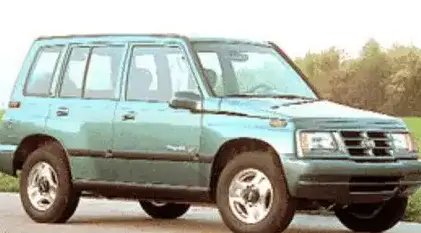
The Geo Tracker 1.6 16V Convertible, produced between 1994 and 1996, represented a unique offering in the compact SUV segment. Built by Suzuki and rebadged for sale under the Geo brand (a General Motors division), it was a lightweight, affordable, and surprisingly capable vehicle, particularly noted for its standard four-wheel drive. This specific 1.6L 16-valve variant with a five-speed manual transmission occupied a middle ground in the Tracker lineup, offering a balance between fuel economy and performance compared to the base 8-valve engine. It was primarily marketed towards buyers seeking a versatile, open-air vehicle for recreational use and light-duty transportation.
Technical Specifications
| Brand | Geo |
| Model | Tracker |
| Generation | Tracker |
| Type (Engine) | 1.6 16V (95 Hp) Convertible |
| Start of production | 1994 |
| End of production | 1996 |
| Powertrain Architecture | Internal Combustion engine |
| Body type | SUV |
| Seats | 4 |
| Doors | 2 |
| Fuel consumption (combined) | 9.4 l/100 km (25 US mpg, 30.1 UK mpg, 10.6 km/l) |
| Fuel Type | Petrol (Gasoline) |
| Weight-to-power ratio | 11.3 kg/Hp, 88.4 Hp/tonne |
| Weight-to-torque ratio | 8.1 kg/Nm, 122.8 Nm/tonne |
| Power | 95 Hp @ 5600 rpm |
| Power per litre | 59.7 Hp/l |
| Torque | 132 Nm (97.36 lb.-ft.) |
| Engine layout | Front, Longitudinal |
| Engine Model/Code | L01 |
| Engine displacement | 1590 cm3 (97.03 cu. in.) |
| Number of cylinders | 4 |
| Engine configuration | Inline |
| Cylinder Bore | 75 mm (2.95 in.) |
| Piston Stroke | 90 mm (3.54 in.) |
| Compression ratio | 9:1 |
| Fuel injection system | Multi-port manifold injection |
| Engine aspiration | Naturally aspirated engine |
| Engine oil capacity | 4.2 l (4.44 US qt | 3.7 UK qt) |
| Coolant | 5.2 l (5.49 US qt | 4.58 UK qt) |
| Kerb Weight | 1075 kg (2369.97 lbs.) |
| Trunk (boot) space – maximum | 134 l (4.73 cu. ft.) |
| Fuel tank capacity | 42 l (11.1 US gal | 9.24 UK gal) |
| Length | 3620 mm (142.52 in.) |
| Width | 1630 mm (64.17 in.) |
| Height | 1654 mm (65.12 in.) |
| Wheelbase | 2200 mm (86.61 in.) |
| Front track | 1395 mm (54.92 in.) |
| Rear (Back) track | 1400 mm (55.12 in.) |
| Drive wheel | All wheel drive (4×4) |
| Number of gears and type of gearbox | 5 gears, manual transmission |
| Front brakes | Disc |
| Rear brakes | Drum |
| Assisting systems | ABS (Anti-lock braking system) |
| Tires size | 205/75 R15 |
| Wheel rims size | 15 |
Powertrain & Engine Architecture
The heart of the 1.6L 16V Tracker is the G16B engine, a Suzuki-designed, naturally aspirated inline-four cylinder. This engine, designated as the L01 in some markets, featured a multi-port fuel injection system and a 9:1 compression ratio. The 16-valve cylinder head, a key upgrade over the earlier 8-valve version, allowed for improved breathing and higher engine speeds, contributing to the 95 horsepower output at 5600 rpm and 132 Nm (97.36 lb.-ft.) of torque. The engine’s longitudinal mounting within the chassis was a common layout for four-wheel-drive vehicles, allowing for a more direct connection to the transfer case. The five-speed manual transmission provided a relatively direct driving experience, although gear ratios were tuned for fuel efficiency and off-road capability rather than outright acceleration.
Driving Characteristics
The 1.6L 16V Tracker, while not a performance machine, offered a surprisingly enjoyable driving experience. The 95 horsepower was adequate for everyday driving, and the four-wheel-drive system provided excellent traction in various conditions. The five-speed manual transmission allowed drivers to keep the engine in its optimal power band. Acceleration was modest, but the lightweight nature of the vehicle (approximately 2370 lbs) helped to mitigate the lack of raw power. Compared to the base 8-valve engine, the 16V version felt noticeably more responsive, especially at higher RPMs. The manual transmission provided more driver engagement than the optional three-speed automatic, which further reduced performance.
Equipment & Trim Levels
The 1994-1996 Geo Tracker 1.6 16V Convertible was generally equipped with basic, functional features. Standard equipment typically included manual windows and door locks, a basic AM/FM radio, and cloth upholstery. The convertible top was manually operated. Optional extras included air conditioning, a cassette player, and upgraded interior trim. The trim level was relatively consistent across the 1.6L 16V models, with most variations stemming from the addition of optional packages. The interior was characterized by its utilitarian design, prioritizing durability and ease of cleaning over luxury.
Chassis & Braking
The Tracker utilized a body-on-frame construction, a relatively traditional approach for a compact SUV. This contributed to its durability and off-road capability. The suspension consisted of coil springs and shock absorbers all around, providing a comfortable ride on paved roads while still offering sufficient articulation for off-road excursions. Front brakes were discs, while the rear brakes were drums. An anti-lock braking system (ABS) was available as an option, enhancing safety. The relatively narrow tires (205/75 R15) were a compromise between on-road comfort and off-road traction.
Market Reception & Comparison
The Geo Tracker 1.6 16V Convertible was generally well-received by critics as an affordable and capable small SUV. It was praised for its four-wheel-drive system, fuel efficiency, and open-air driving experience. However, it was also criticized for its basic interior, modest performance, and relatively small size. Compared to other trims in the Tracker lineup, the 1.6L 16V offered a better balance of power and fuel economy than the base 8-valve engine, while remaining more affordable than potential upgrades. It competed with other small SUVs like the Suzuki Sidekick (which it was mechanically very similar to) and the Isuzu Trooper.
Legacy
The Geo Tracker 1.6 16V Convertible has developed a cult following among enthusiasts, particularly those who appreciate its simplicity, affordability, and off-road capability. The G16B engine is known for its reliability, although regular maintenance is essential. Parts availability is generally good, thanks to the Tracker’s popularity and the shared components with other Suzuki models. Today, well-maintained examples command a reasonable price in the used car market, and the Tracker remains a popular choice for those seeking a fun, versatile, and affordable vehicle. The Tracker’s legacy lies in its ability to provide a unique combination of practicality, affordability, and open-air enjoyment.
