
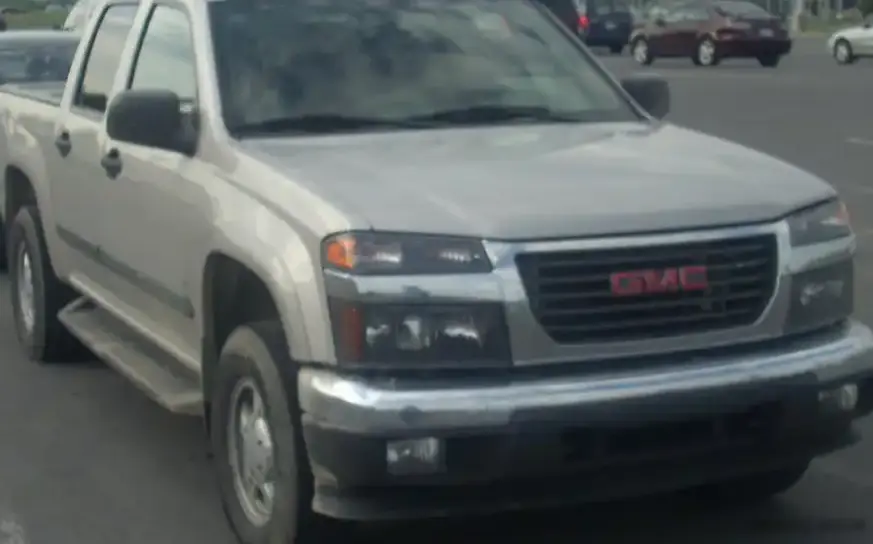
The GMC Canyon I Crew Cab, produced from 2009 to 2012, represented GMC’s entry into the mid-size pickup truck market in the United States. Positioned as a smaller, more manageable alternative to full-size trucks like the Sierra, the Canyon aimed to appeal to buyers who didn’t require the immense capability of a larger vehicle but still desired truck functionality. The 5.3L V8 engine paired with an automatic transmission was a significant offering within the Canyon lineup, representing a step up in power and refinement compared to the base four-cylinder engine. This configuration targeted buyers who needed towing capacity and robust performance for both work and recreational activities. It was built on the GMT900 platform, shared with the Chevrolet Colorado.
Technical Specifications
| Brand | GMC |
| Model | Canyon |
| Generation | Canyon I Crew Cab |
| Type (Engine) | 5.3 V8 (300 Hp) Automatic |
| Start of production | 2009 |
| End of production | 2012 |
| Powertrain Architecture | Internal Combustion engine |
| Body type | Pick-up |
| Seats | 5-6 |
| Doors | 4 |
| Fuel consumption (urban) | 15.6 l/100 km (15.1 US mpg, 18.1 UK mpg, 6.4 km/l) |
| Fuel consumption (extra urban) | 11.2 l/100 km (21 US mpg, 25.2 UK mpg, 8.9 km/l) |
| Fuel Type | Petrol (Gasoline) |
| Weight-to-power ratio | 6.1 kg/Hp, 164.8 Hp/tonne |
| Weight-to-torque ratio | 4.2 kg/Nm, 238.5 Nm/tonne |
| Power | 300 Hp @ 5200 rpm |
| Power per litre | 56.3 Hp/l |
| Torque | 434 Nm @ 4000 rpm (320.1 lb.-ft. @ 4000 rpm) |
| Maximum engine speed | 6000 rpm |
| Engine layout | Front, Longitudinal |
| Engine Model/Code | LH8 |
| Engine displacement | 5328 cm3 (325.13 cu. in.) |
| Number of cylinders | 8 |
| Engine configuration | V-engine |
| Cylinder Bore | 96 mm (3.78 in.) |
| Piston Stroke | 92 mm (3.62 in.) |
| Compression ratio | 9.9:1 |
| Number of valves per cylinder | 2 |
| Fuel injection system | Multi-port manifold injection |
| Engine aspiration | Naturally aspirated engine |
| Valvetrain | OHV |
| Engine oil capacity | 5.7 l (6.02 US qt | 5.02 UK qt) |
| Coolant | 13 l (13.74 US qt | 11.44 UK qt) |
| Kerb Weight | 1820 kg (4012.41 lbs.) |
| Max. weight | 2268 kg (5000.08 lbs.) |
| Max load | 448 kg (987.67 lbs.) |
| Trunk (boot) space – minimum | 1040 l (36.73 cu. ft.) |
| Fuel tank capacity | 74.2 l (19.6 US gal | 16.32 UK gal) |
| Length | 5260 mm (207.09 in.) |
| Width | 1717 mm (67.6 in.) |
| Height | 1656 mm (65.2 in.) |
| Wheelbase | 3200 mm (125.98 in.) |
| Front track | 1460 mm (57.48 in.) |
| Rear (Back) track | 1460 mm (57.48 in.) |
| Ride height (ground clearance) | 167 mm (6.57 in.) |
| Minimum turning circle (turning diameter) | 13.5 m (44.29 ft.) |
| Drivetrain Architecture | The Internal combustion engine (ICE) drives the rear wheels of the vehicle. |
| Drive wheel | Rear wheel drive |
| Number of gears and type of gearbox | 4 gears, automatic transmission Hydra-Matic |
| Front suspension | Independent coil spring |
| Rear suspension | Leaf spring |
| Front brakes | Ventilated discs |
| Rear brakes | Drum |
| Assisting systems | ABS (Anti-lock braking system) |
| Steering type | Steering rack and pinion |
| Power steering | Hydraulic Steering |
| Tires size | 235/50 R18 |
| Wheel rims size | 18 |
Powertrain & Engine Architecture
The heart of this Canyon variant was the 5.3-liter LH8 V8 engine. This engine, a member of GM’s Small-Block family, was a robust and well-proven design. It featured a cast iron block with aluminum cylinder heads, and utilized a traditional overhead valve (OHV) valvetrain. Fuel delivery was handled by a multi-port fuel injection system, providing precise fuel metering for optimal combustion. The engine produced 300 horsepower at 5200 rpm and 320 lb-ft of torque at 4000 rpm. The engine’s longitudinal mounting allowed for a rear-wheel-drive configuration. Paired with the 5.3L V8 was the Hydra-Matic 4L60-E four-speed automatic transmission. This transmission was known for its durability and smooth shifting characteristics, although it lacked the efficiency of more modern transmissions with higher gear counts.
Driving Characteristics
The 5.3L V8 significantly altered the driving experience compared to the base four-cylinder Canyon. Acceleration was noticeably quicker, making merging onto highways and passing maneuvers much easier. While not a sports truck, the V8 provided ample power for everyday driving and towing. The four-speed automatic transmission, while reliable, did have relatively wide gear ratios. This meant that the engine could feel somewhat busy at highway speeds, and fuel economy suffered compared to the manual transmission or the smaller engine options. The rear-wheel-drive configuration provided a traditional truck feel, with good traction in most conditions, but requiring caution in slippery environments.
Equipment & Trim Levels
The 5.3L V8 was typically offered on the SLT and LT trim levels of the Canyon Crew Cab. Standard features included air conditioning, power windows and locks, a CD player, and cloth upholstery. The SLT trim added features like leather upholstery, heated front seats, and a premium sound system. Optional extras included a navigation system, a sunroof, and a trailering package, which added a trailer hitch, wiring harness, and upgraded cooling system. The interior design was functional and straightforward, prioritizing durability and ease of use over luxury.
Chassis & Braking
The Canyon’s chassis featured an independent coil spring front suspension and a leaf spring rear suspension. This setup provided a comfortable ride for a pickup truck, but also allowed for reasonable payload capacity. The front brakes were ventilated discs, providing good stopping power, while the rear brakes were drums. ABS (Anti-lock Braking System) was standard, enhancing safety during emergency braking situations. The steering was a hydraulic rack-and-pinion system, offering responsive and precise handling. The suspension was tuned to balance ride comfort with load-carrying capability.
Market Reception & Comparison
Critics generally praised the Canyon’s 5.3L V8 engine for its power and refinement. However, the four-speed automatic transmission was often criticized for its lack of efficiency and limited gear ratios. Compared to the base four-cylinder engine, the V8 offered a significant performance upgrade, but at the cost of fuel economy. The V8 Canyon was also more expensive than the four-cylinder models. Compared to the Chevrolet Colorado, which shared the same platform and powertrain options, the Canyon offered a slightly more upscale interior and exterior styling. The Ford Ranger and Toyota Tacoma were the Canyon’s primary competitors, and both offered a wider range of engine and transmission options.
Legacy
The 5.3L V8 in the GMC Canyon I Crew Cab has proven to be a relatively reliable powertrain. The LH8 engine is known for its durability, and the 4L60-E transmission, while not the most efficient, is also generally dependable. Today, these trucks are often found with relatively high mileage, and well-maintained examples can still provide years of service. The Canyon I Crew Cab with the 5.3L V8 holds a modest position in the used truck market, appealing to buyers who want a capable and affordable mid-size pickup with a proven V8 engine. Common issues reported by owners include oil leaks, sensor failures, and wear and tear on suspension components, typical for vehicles of this age and mileage.
