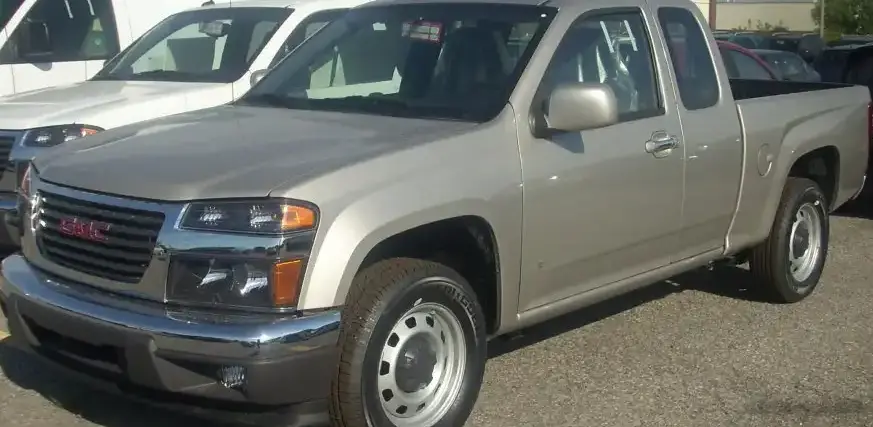
The GMC Canyon I Extended Cab, produced from 2007 to 2012, represented GMC’s entry into the mid-size pickup truck market in North America. Positioned below the full-size Sierra, the Canyon aimed to provide a more manageable and fuel-efficient option for buyers who didn’t require the larger capacity of a full-size truck. The Extended Cab configuration offered additional passenger space compared to the standard cab, making it a versatile choice for both work and family use. This particular variant, equipped with the 2.9-liter inline-four engine producing 185 horsepower, served as the base engine option for the Canyon, targeting buyers prioritizing affordability and practicality over outright performance.
Technical Specifications
| Brand | GMC |
| Model | Canyon |
| Generation | Canyon I Extended Cab |
| Type (Engine) | 2.9 (185 Hp) |
| Start of production | 2007 |
| End of production | 2012 |
| Powertrain Architecture | Internal Combustion engine |
| Body type | Pick-up |
| Seats | 4-5 |
| Doors | 4 |
| Fuel consumption (urban) | 11.7 l/100 km (20.1 US mpg) |
| Fuel consumption (extra urban) | 9 l/100 km (26.1 US mpg) |
| Fuel Type | Petrol (Gasoline) |
| Weight-to-power ratio | 8.5 kg/Hp |
| Weight-to-torque ratio | 6.1 kg/Nm |
| Power | 185 Hp @ 5600 rpm |
| Power per litre | 63.3 Hp/l |
| Torque | 258 Nm @ 2800 rpm (190.29 lb.-ft. @ 2800 rpm) |
| Maximum engine speed | 6300 rpm |
| Engine layout | Front, Longitudinal |
| Engine Model/Code | LLV |
| Engine displacement | 2921 cm3 (178.25 cu. in.) |
| Number of cylinders | 4 |
| Engine configuration | Inline |
| Cylinder Bore | 95.5 mm (3.76 in.) |
| Piston Stroke | 102 mm (4.02 in.) |
| Compression ratio | 10:1 |
| Number of valves per cylinder | 4 |
| Fuel injection system | Multi-port manifold injection |
| Engine aspiration | Naturally aspirated engine |
| Valvetrain | DOHC, CVVT |
| Engine oil capacity | 4.7 l (4.97 US qt | 4.14 UK qt) |
| Coolant | 9.8 l (10.36 US qt | 8.62 UK qt) |
| Kerb Weight | 1570 kg (3461.26 lbs.) |
| Max. weight | 2268 kg (5000.08 lbs.) |
| Max load | 698 kg (1538.83 lbs.) |
| Trunk (boot) space – minimum | 1245 l (43.97 cu. ft.) |
| Fuel tank capacity | 74.2 l (19.6 US gal | 16.32 UK gal) |
| Length | 5260 mm (207.09 in.) |
| Width | 1717 mm (67.6 in.) |
| Height | 1649 mm (64.92 in.) |
| Wheelbase | 3200 mm (125.98 in.) |
| Front track | 1460 mm (57.48 in.) |
| Rear (Back) track | 1460 mm (57.48 in.) |
| Ride height (ground clearance) | 185.7 mm (7.31 in.) |
| Minimum turning circle (turning diameter) | 13.5 m (44.29 ft.) |
| Drivetrain Architecture | Rear wheel drive |
| Drive wheel | Rear wheel drive |
| Number of gears and type of gearbox | 5 gears, manual transmission |
| Front suspension | Independent coil spring |
| Rear suspension | Leaf spring |
| Front brakes | Ventilated discs |
| Rear brakes | Drum |
| Assisting systems | ABS (Anti-lock braking system) |
| Steering type | Steering rack and pinion |
| Power steering | Hydraulic Steering |
| Tires size | 205/75 R15; 225/70 R15 |
| Wheel rims size | 6J x 15; 6.5J x 15 |
Introduction
The 2.9-liter engine variant of the GMC Canyon I Extended Cab was introduced in 2007 as part of the initial launch of the Canyon model. Built on the GMT900 platform, shared with the Chevrolet Colorado, the Canyon aimed to offer a mid-size truck option to a market increasingly dominated by larger vehicles. The Extended Cab body style provided a compromise between the practicality of a pickup bed and the need for occasional passenger space. This 2.9L engine/manual transmission combination was positioned as the entry-level offering, appealing to budget-conscious buyers and those who didn’t require the increased performance of the available V6 engine.
Powertrain & Engine Architecture
The heart of this Canyon variant is the LLV 2.9-liter inline-four cylinder engine. This engine is a naturally aspirated, four-stroke engine featuring a cast iron block and aluminum cylinder head. It utilizes a multi-port fuel injection system, delivering fuel directly into the intake ports. The engine also incorporates a Double Overhead Camshaft (DOHC) valvetrain with Continuously Variable Valve Timing (CVVT) on both intake and exhaust valves, optimizing engine performance and efficiency across a wider RPM range. The 2.9L engine produced 185 horsepower at 5600 rpm and 190 lb-ft of torque at 2800 rpm. The engine is paired with a five-speed manual transmission, sending power to the rear wheels. This transmission was chosen for its durability and relative simplicity, contributing to the overall affordability of the vehicle.
Driving Characteristics
The 2.9-liter Canyon, with its five-speed manual transmission, offered a relatively basic driving experience. Acceleration was adequate for everyday driving, but it wasn’t particularly quick. The engine felt strained when fully loaded or climbing steep hills. The manual transmission provided drivers with more control over gear selection, allowing them to optimize engine performance for different driving conditions. Compared to the optional 4.3-liter V6, the 2.9L engine delivered significantly less power and torque, resulting in slower acceleration and reduced towing capacity. However, the 2.9L engine’s lighter weight contributed to slightly better fuel economy and handling.
Equipment & Trim Levels
The base Canyon Extended Cab 2.9L typically came standard with features such as air conditioning, a basic audio system, and cloth upholstery. Power windows and locks were often optional extras. The interior was functional but lacked the refinement of higher trim levels. Optional packages could add features like cruise control, upgraded audio systems, and alloy wheels. The interior design was focused on durability and ease of use, rather than luxury.
Chassis & Braking
The Canyon I utilized a body-on-frame construction, providing a robust and durable platform. The front suspension consisted of independent coil springs, while the rear suspension employed leaf springs. This setup was designed to provide a comfortable ride while maintaining adequate load-carrying capacity. Braking duties were handled by ventilated discs at the front and drum brakes at the rear. An Anti-lock Braking System (ABS) was standard, enhancing safety during emergency braking situations. The rear drum brakes were a cost-saving measure common in base model pickups of this era.
Market Reception & Comparison
Critics generally viewed the 2.9-liter Canyon as a competent but unremarkable truck. The engine was often criticized for its lack of power, particularly when compared to the V6 option. However, the 2.9L engine’s fuel economy was praised, making it an attractive option for buyers prioritizing efficiency. Compared to the Chevrolet Colorado, which shared the same platform and engine options, the Canyon offered a slightly more upscale interior and exterior styling. The Ford Ranger, a long-standing competitor in the mid-size truck segment, offered a similar level of performance and affordability.
Legacy
The 2.9-liter LLV engine, while not known for its exceptional performance, proved to be a relatively reliable powertrain. Common issues included oil leaks and occasional sensor failures, but these were generally not major concerns. Today, the Canyon I Extended Cab 2.9L can be found on the used car market at relatively affordable prices. These trucks are often sought after by buyers looking for a simple, durable, and practical pickup truck for light-duty tasks. While not a collector’s item, the 2.9L Canyon represents a significant entry in GMC’s history, marking their return to the mid-size truck segment.