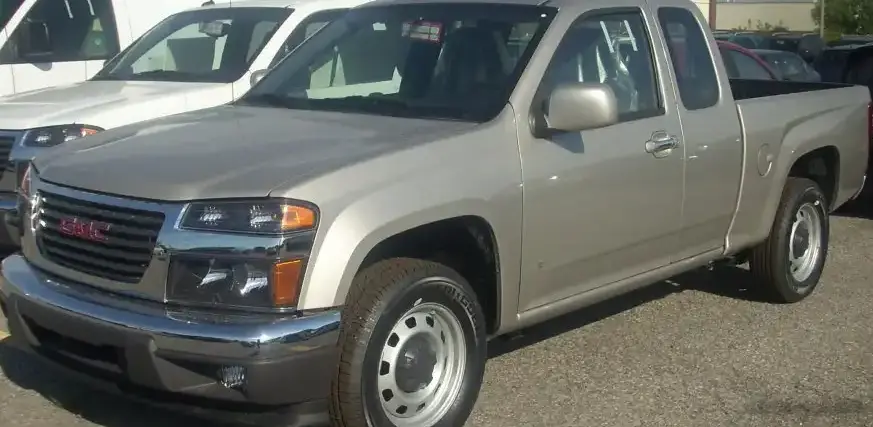
The GMC Canyon I Extended Cab, specifically the 3.5-liter (220 hp) 4WD variant, was a mid-size pickup truck produced from 2004 to 2006. It represented GMC’s entry into the increasingly popular compact pickup segment, sharing a platform with the Chevrolet Colorado. This generation Canyon aimed to offer a blend of capability, comfort, and value, positioned as a more refined alternative to full-size trucks while providing more space and versatility than smaller, car-based pickups. The Extended Cab configuration added rear seating, increasing its practicality for families and those needing occasional passenger capacity. This particular 3.5L 4WD trim sat in the middle of the Canyon lineup, offering a step up in power and capability from the base 2.8L engine, but remaining more accessible than the higher-end trims.
Technical Specifications
| Brand | GMC |
| Model | Canyon |
| Generation | Canyon I Extended Cab |
| Type (Engine) | 3.5 (220 Hp) 4WD |
| Start of production | 2004 |
| End of production | 2006 |
| Powertrain Architecture | Internal Combustion engine |
| Body type | Pick-up |
| Seats | 4-5 |
| Doors | 4 |
| Fuel Type | Petrol (Gasoline) |
| Weight-to-power ratio | 8.1 kg/Hp, 123.6 Hp/tonne |
| Weight-to-torque ratio | 5.8 kg/Nm, 171.3 Nm/tonne |
| Power | 220 Hp @ 5600 rpm |
| Power per litre | 63.6 Hp/l |
| Torque | 305 Nm @ 2800 rpm (224.96 lb.-ft. @ 2800 rpm) |
| Maximum engine speed | 6300 rpm |
| Engine layout | Front, Transverse |
| Engine Model/Code | L52 Vortec 3500 |
| Engine displacement | 3460 cm3 (211.14 cu. in.) |
| Number of cylinders | 5 |
| Engine configuration | Inline |
| Cylinder Bore | 93 mm (3.66 in.) |
| Piston Stroke | 102 mm (4.02 in.) |
| Compression ratio | 10:1 |
| Number of valves per cylinder | 4 |
| Fuel injection system | Multi-port manifold injection |
| Engine aspiration | Naturally aspirated engine |
| Valvetrain | DOHC, CVVT |
| Engine oil capacity | 5.6 l (5.92 US qt | 4.93 UK qt) |
| Coolant | 10 l (10.57 US qt | 8.8 UK qt) |
| Kerb Weight | 1780 kg (3924.23 lbs.) |
| Max. weight | 2404 kg (5299.91 lbs.) |
| Max load | 624 kg (1375.68 lbs.) |
| Trunk (boot) space – minimum | 1243 l (43.9 cu. ft.) |
| Fuel tank capacity | 74.2 l (19.6 US gal | 16.32 UK gal) |
| Length | 5260 mm (207.09 in.) |
| Width | 1742 mm (68.58 in.) |
| Height | 1646 mm (64.8 in.) |
| Wheelbase | 3198 mm (125.91 in.) |
| Front track | 1514 mm (59.61 in.) |
| Rear (Back) track | 1460 mm (57.48 in.) |
| Minimum turning circle | 13.6 m (44.62 ft.) |
| Drive wheel | All wheel drive (4×4) |
| Number of gears and type of gearbox | 5 gears, manual transmission |
| Front suspension | Independent coil spring |
| Rear suspension | Leaf spring |
| Front brakes | Ventilated discs |
| Rear brakes | Drum |
| Assisting systems | ABS (Anti-lock braking system) |
| Steering type | Steering rack and pinion |
| Power steering | Hydraulic Steering |
| Tires size | 205/75 R15; 225/70 R15 |
| Wheel rims size | 15 |
Powertrain & Engine Architecture
The heart of this Canyon variant is the 3.5-liter L52 Vortec 3500 inline five-cylinder engine. This engine, part of GM’s Vortec family, featured a cast iron block and aluminum cylinder heads. It utilized a multi-port fuel injection system for precise fuel delivery and a double overhead camshaft (DOHC) design with variable valve timing (CVVT) to optimize performance and efficiency across the rev range. The 3.5L engine produced 220 horsepower at 5600 rpm and 225 lb-ft of torque at 2800 rpm. The engine’s transverse mounting configuration, common in front-wheel-drive and all-wheel-drive applications, contributed to a more compact engine bay. The standard transmission for this trim was a 5-speed manual transmission, providing drivers with direct control over gear selection. An optional 4-speed automatic transmission was also available, offering convenience at the expense of some responsiveness.
Driving Characteristics
The 3.5L engine, paired with the 5-speed manual transmission, provided adequate performance for everyday driving and light-duty hauling. While not a performance-oriented pickup, it offered sufficient power for merging onto highways and maintaining speed on inclines. The manual transmission allowed for precise control and maximized engine braking. The automatic transmission, while convenient, resulted in slightly slower acceleration and a less engaging driving experience. The 4WD system provided enhanced traction in slippery conditions, making it suitable for off-road use and inclement weather. The Canyon’s suspension, featuring independent coil springs in the front and leaf springs in the rear, offered a reasonable balance between ride comfort and load-carrying capability. However, the leaf spring rear suspension could sometimes feel stiff when unloaded.
Equipment & Trim Levels
The Extended Cab configuration added a second row of seating, albeit somewhat cramped, increasing the Canyon’s passenger capacity. Standard features typically included air conditioning, power windows and locks, and an AM/FM stereo. The interior typically featured cloth upholstery and a relatively basic dashboard layout. Optional extras included a premium sound system, cruise control, and alloy wheels. The 3.5L 4WD trim often came with upgraded interior trim compared to the base models. The Extended Cab also offered a small storage area behind the rear seats.
Chassis & Braking
The Canyon I utilized a body-on-frame construction, providing a robust and durable platform. The front suspension employed independent coil springs, while the rear suspension utilized leaf springs. This configuration allowed for a reasonable payload capacity. Braking duties were handled by ventilated discs in the front and drum brakes in the rear. An Anti-lock Braking System (ABS) was standard, enhancing braking performance and stability. The steering system was a rack-and-pinion setup with hydraulic power assist, providing responsive and precise steering feel.
Market Reception & Comparison
The GMC Canyon I, and specifically the 3.5L 4WD variant, was generally well-received by critics as a competent and versatile mid-size pickup. It was praised for its comfortable ride, spacious interior (for its class), and available features. However, some reviewers noted that the 3.5L engine could feel strained when towing heavy loads. Compared to the base 2.8L engine, the 3.5L offered a significant performance boost. Compared to the higher-end trims with the more powerful inline-6 engine, the 3.5L provided a more affordable option with acceptable performance for most buyers. Fuel economy was average for the segment, typically ranging from 16-19 mpg city and 20-23 mpg highway.
Legacy
The GMC Canyon I, including the 3.5L 4WD variant, established GMC as a player in the mid-size pickup market. While the first generation had some shortcomings, it laid the foundation for future Canyon models. The 3.5L Vortec engine, while not known for exceptional longevity, proved to be reasonably reliable with proper maintenance. Today, these trucks can be found on the used car market at relatively affordable prices. Common issues include oil leaks, corrosion in areas prone to salt exposure, and wear and tear on suspension components. However, with diligent maintenance, these Canyons can still provide years of reliable service as a capable and versatile pickup truck.