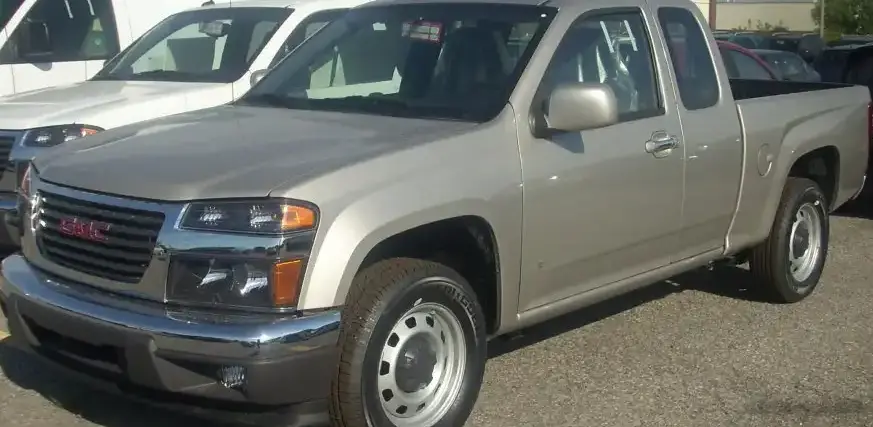
The GMC Canyon I Extended Cab, produced from 2004 to 2006, represented GMC’s entry into the burgeoning mid-size pickup truck market in North America. Positioned below the full-size Sierra, the Canyon aimed to offer a more manageable and fuel-efficient alternative without sacrificing the utility expected of a truck. The 3.5-liter (220 hp) automatic variant occupied a middle ground in the Canyon lineup, offering a balance of power and convenience for buyers who didn’t require the capabilities of the more powerful inline-six engine, but desired the ease of an automatic transmission. This model was part of the first generation Canyon (code name: WT), sharing its platform with the Chevrolet Colorado.
Technical Specifications
| Brand | GMC |
| Model | Canyon |
| Generation | Canyon I Extended Cab |
| Type (Engine) | 3.5 (220 Hp) Automatic |
| Start of production | 2004 |
| End of production | 2006 |
| Powertrain Architecture | Internal Combustion engine |
| Body type | Pick-up |
| Seats | 4-5 |
| Doors | 4 |
| Fuel Type | Petrol (Gasoline) |
| Weight-to-power ratio | 7.6 kg/Hp, 131.2 Hp/tonne |
| Weight-to-torque ratio | 5.5 kg/Nm, 181.9 Nm/tonne |
| Power | 220 Hp @ 5600 rpm |
| Power per litre | 63.6 Hp/l |
| Torque | 305 Nm @ 2800 rpm, 224.96 lb.-ft. @ 2800 rpm |
| Maximum engine speed | 6300 rpm |
| Engine layout | Front, Longitudinal |
| Engine Model/Code | L52 Vortec 3500 |
| Engine displacement | 3460 cm3, 211.14 cu. in. |
| Number of cylinders | 5 |
| Engine configuration | Inline |
| Cylinder Bore | 93 mm, 3.66 in. |
| Piston Stroke | 102 mm, 4.02 in. |
| Compression ratio | 10:1 |
| Number of valves per cylinder | 4 |
| Fuel injection system | Multi-port manifold injection |
| Engine aspiration | Naturally aspirated engine |
| Valvetrain | DOHC, CVVT |
| Engine oil capacity | 5.6 l, 5.92 US qt | 4.93 UK qt |
| Coolant | 10 l, 10.57 US qt | 8.8 UK qt |
| Kerb Weight | 1677 kg, 3697.15 lbs |
| Max. weight | 2268 kg, 5000.08 lbs |
| Max load | 591 kg, 1302.93 lbs |
| Trunk (boot) space – minimum | 1243 l, 43.9 cu. ft |
| Fuel tank capacity | 74.2 l, 19.6 US gal | 16.32 UK gal |
| Length | 5260 mm, 207.09 in |
| Width | 1717 mm, 67.6 in |
| Height | 1646 mm, 64.8 in |
| Wheelbase | 3198 mm, 125.91 in |
| Front track | 1460 mm, 57.48 in |
| Rear (Back) track | 1460 mm, 57.48 in |
| Ride height (ground clearance) | 216 mm, 8.5 in |
| Minimum turning circle (turning diameter) | 13.6 m, 44.62 ft |
| Drivetrain Architecture | The Internal combustion engine (ICE) drives the rear wheels of the vehicle. |
| Drive wheel | Rear wheel drive |
| Number of gears and type of gearbox | 4 gears, automatic transmission Hydra-Matic |
| Front suspension | Independent coil spring |
| Rear suspension | Leaf spring |
| Front brakes | Ventilated discs |
| Rear brakes | Drum |
| Assisting systems | ABS (Anti-lock braking system) |
| Steering type | Steering rack and pinion |
| Power steering | Hydraulic Steering |
| Tires size | 205/75 R15; 225/70 R15 |
| Wheel rims size | 15 |
INTRODUCTION
The GMC Canyon I Extended Cab 3.5 Automatic, produced between 2004 and 2006, was a mid-size pickup truck designed to appeal to buyers seeking a versatile vehicle for both work and personal use. It was built on the GMT325 platform, shared with the Chevrolet Colorado, and represented GMC’s attempt to capture a segment of the market previously dominated by larger, full-size trucks. The Extended Cab configuration offered a small rear seating area, increasing passenger capacity and utility. The 3.5-liter engine and four-speed automatic transmission combination was a popular choice, providing a balance between performance, fuel economy, and ease of driving.
Powertrain & Engine Architecture
At the heart of the Canyon 3.5 Automatic lies the L52 Vortec 3500 inline-five cylinder engine. This engine, a member of GM’s Vortec family, displaced 3.5 liters (3460 cc or 211.14 cubic inches) and produced 220 horsepower at 5600 rpm and 305 Nm (224.96 lb-ft) of torque at 2800 rpm. The engine featured multi-port fuel injection and a double overhead camshaft (DOHC) valvetrain with variable valve timing (CVVT) to optimize performance and efficiency. The inline-five configuration was somewhat unusual for the American market, offering a compromise between the smoothness of a V6 and the efficiency of a four-cylinder. The engine’s longitudinal mounting allowed for a rear-wheel-drive configuration, which was standard. The Hydra-Matic 4L60-E four-speed automatic transmission was paired with the engine, providing smooth and reliable shifting. This transmission was known for its durability and relatively simple design.
Driving Characteristics
The 3.5-liter engine and automatic transmission combination in the Canyon delivered adequate, but not exhilarating, performance. Acceleration was reasonable for everyday driving, but the truck wasn’t particularly quick. The automatic transmission’s gear ratios were tuned for fuel economy and drivability rather than outright performance. Compared to the available 2.8-liter four-cylinder engine, the 3.5-liter offered significantly more power and torque, making it better suited for towing and hauling. However, it lacked the higher performance of the optional 4.2-liter inline-six. The rear-wheel-drive configuration provided a traditional truck feel, with good traction in dry conditions. The suspension, while adequate, was tuned for comfort rather than sporty handling. The automatic transmission made the Canyon easy to drive in urban environments, eliminating the need for constant shifting.
Equipment & Trim Levels
The Canyon I Extended Cab 3.5 Automatic was available in several trim levels, including SLE and SLT. Standard equipment typically included air conditioning, power windows and locks, an AM/FM stereo, and cloth upholstery. The SLT trim added features such as alloy wheels, a premium sound system, and upgraded interior trim. Optional extras included a power sunroof, leather upholstery, and a navigation system. The Extended Cab configuration featured a small rear seat, suitable for occasional passengers or extra storage. The interior design was functional and straightforward, with a focus on durability and ease of use.
Chassis & Braking
The Canyon I featured a body-on-frame construction, providing a robust and durable chassis. The front suspension consisted of independent coil springs, while the rear suspension utilized leaf springs. This setup provided a comfortable ride and adequate load-carrying capacity. Braking duties were handled by ventilated discs at the front and drum brakes at the rear. An anti-lock braking system (ABS) was standard, enhancing safety and control. The steering system was a rack-and-pinion setup with hydraulic power assist, providing responsive and precise steering. The Canyon’s relatively modest weight, compared to full-size trucks, contributed to its manageable handling characteristics.
Market Reception & Comparison
The GMC Canyon I was generally well-received by critics as a competent and versatile mid-size pickup truck. The 3.5-liter engine and automatic transmission combination was praised for its smooth operation and adequate power. However, some reviewers noted that the engine lacked the refinement of some competitors. Fuel economy was considered average for its class. Compared to the four-cylinder Canyon, the 3.5-liter offered a noticeable improvement in performance, but at the cost of slightly lower fuel efficiency. The inline-six offered more power but was significantly more expensive. The Canyon competed with other mid-size trucks such as the Toyota Tacoma, Nissan Frontier, and Ford Ranger.
Legacy
The GMC Canyon I, particularly the 3.5-liter automatic variant, has proven to be a relatively reliable vehicle in the used car market. The L52 Vortec engine is known for its durability, and the Hydra-Matic transmission is generally dependable. Common issues include minor oil leaks and occasional sensor failures. The Canyon’s relatively simple design and readily available parts make it relatively easy and affordable to maintain. Today, these trucks are often sought after by buyers looking for a capable and affordable pickup truck for light-duty work or recreational use. While not a collector’s item, the Canyon I represents a significant step in GMC’s history, marking its entry into the competitive mid-size truck segment.