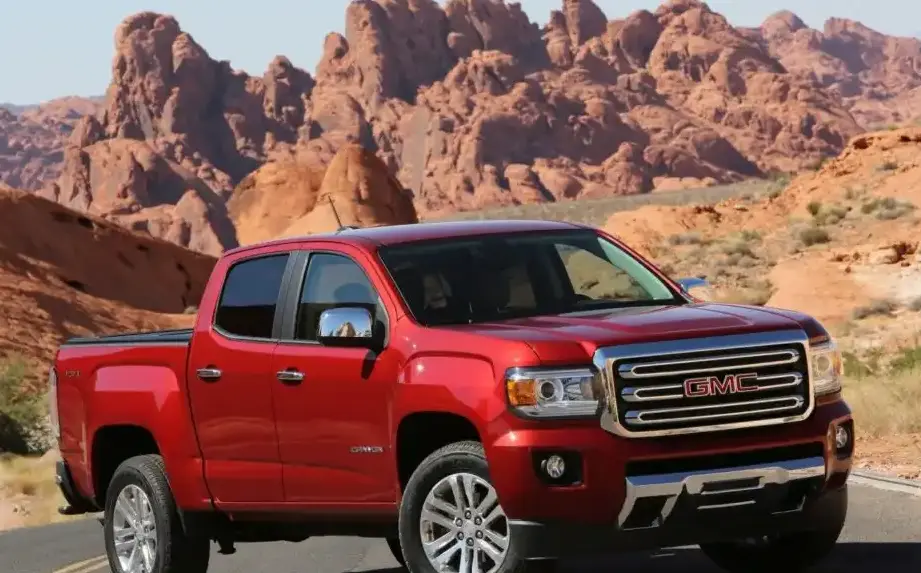
The GMC Canyon II Crew Cab, specifically the variant equipped with the 3.6-liter V6 engine producing 305 horsepower and paired with a four-wheel-drive system and automatic transmission, was a mid-size pickup truck produced from 2015 to 2016. This generation represented GMC’s re-entry into the competitive mid-size truck segment after a hiatus, aiming to offer a more refined and capable alternative to offerings from Toyota and Nissan. The Crew Cab configuration, denoting a four-door layout with ample rear passenger space, was a key selling point for families and those needing both passenger and cargo capacity. This particular 3.6L V6 Automatic 4WD trim occupied a position in the middle of the Canyon II lineup, offering a balance between capability, comfort, and price.
Technical Specifications
| Brand | GMC |
| Model | Canyon |
| Generation | Canyon II Crew Cab |
| Type (Engine) | 3.6 V6 (305 Hp) 4WD Automatic |
| Start of production | 2015 |
| End of production | 2016 |
| Powertrain Architecture | Internal Combustion engine |
| Body type | Pick-up |
| Seats | 5 |
| Doors | 4 |
| Fuel consumption (urban) | 13.8 l/100 km (17 US mpg, 20.5 UK mpg, 7.2 km/l) |
| Fuel consumption (extra urban) | 9.8 l/100 km (24 US mpg, 28.8 UK mpg, 10.2 km/l) |
| Fuel Type | Petrol (Gasoline) |
| Weight-to-power ratio | 6.6 kg/Hp, 152.1 Hp/tonne |
| Weight-to-torque ratio | 5.5 kg/Nm, 182 Nm/tonne |
| Power | 305 Hp @ 6800 rpm |
| Power per litre | 85.6 Hp/l |
| Torque | 365 Nm @ 4000 rpm (269.21 lb.-ft. @ 4000 rpm) |
| Engine layout | Front, Longitudinal |
| Engine Model/Code | LFX |
| Engine displacement | 3564 cm3 (217.49 cu. in.) |
| Number of cylinders | 6 |
| Engine configuration | V-engine |
| Cylinder Bore | 94 mm (3.7 in.) |
| Piston Stroke | 85.6 mm (3.37 in.) |
| Compression ratio | 11.5:1 |
| Number of valves per cylinder | 4 |
| Fuel injection system | Direct injection |
| Engine aspiration | Naturally aspirated engine |
| Valvetrain | DOHC, CVVT |
| Engine oil capacity | 5.7 l (6.02 US qt | 5.02 UK qt) |
| Coolant | 12.4 l (13.1 US qt | 10.91 UK qt) |
| Kerb Weight | 2005 kg (4420.27 lbs.) |
| Max. weight | 2722 kg (6000.98 lbs.) |
| Max load | 717 kg (1580.71 lbs.) |
| Trunk (boot) space – minimum | 1169 l (41.28 cu. ft.) |
| Fuel tank capacity | 79.5 l (21 US gal | 17.49 UK gal) |
| Permitted trailer load with brakes (12%) | 1588 kg (3500.94 lbs.) |
| Length | 5395 mm (212.4 in.) |
| Width | 1886 mm (74.25 in.) |
| Height | 1794 mm (70.63 in.) |
| Wheelbase | 3258 mm (128.27 in.) |
| Front track | 1586 mm (62.44 in.) |
| Rear (Back) track | 1586 mm (62.44 in.) |
| Ride height (ground clearance) | 214 mm (8.43 in.) |
| Minimum turning circle (turning diameter) | 12.6 m (41.34 ft.) |
| Approach angle | 17.3° |
| Departure angle | 22.1° |
| Ramp-over (brakeover) angle | 19.8° |
| Drivetrain Architecture | The Internal combustion engine (ICE) drives the rear wheels permanently, and the front wheels are driven through an electrically or mechanically operated clutch if necessary. |
| Drive wheel | All wheel drive (4×4) |
| Number of gears and type of gearbox | 6 gears, automatic transmission Hydra-Matic |
| Front suspension | Independent coil spring |
| Rear suspension | Rigid axle suspension, Leaf spring |
| Front brakes | Disc, 310×27 mm |
| Rear brakes | Disc, 324×18 mm |
| Assisting systems | ABS (Anti-lock braking system) |
| Steering type | Steering rack and pinion |
| Power steering | Electric Steering |
| Tires size | 265/70 R16; 255/65 R17; 265/60 R18 |
| Wheel rims size | 7J x 16; 8J x 17; 8.5J x 18 |
Powertrain & Engine Architecture
The heart of this Canyon variant is the 3.6-liter LFX V6 engine. This engine is a naturally aspirated, 24-valve (DOHC) powerplant featuring direct fuel injection and variable valve timing (CVVT). The LFX engine was a staple in General Motors’ lineup, known for its relatively smooth operation and adequate power delivery. The direct injection system contributes to improved fuel efficiency and reduced emissions. The Hydra-Matic 6L80 six-speed automatic transmission was the sole transmission option for this configuration. This transmission is known for its smooth shifts and durability. The 4WD system is an electronically controlled, on-demand system, automatically engaging the front axle when wheel slip is detected.
Driving Characteristics
The 305-horsepower V6 and six-speed automatic provided a competent, if not exhilarating, driving experience. Acceleration was adequate for everyday driving and highway merging, but it wasn’t as quick as some of the turbocharged competitors. The automatic transmission was well-tuned, offering smooth shifts and responsive downshifts. The 4WD system provided enhanced traction in inclement weather and on unpaved surfaces. The gear ratios were optimized for a balance of fuel economy and towing capability. Compared to the base 2.5-liter four-cylinder engine, the V6 offered significantly more power and torque, making it a better choice for those who frequently tow or haul heavy loads. However, it came at the cost of slightly lower fuel economy.
Equipment & Trim Levels
The Canyon II Crew Cab 3.6L V6 4WD typically came standard with features such as air conditioning, power windows and locks, a basic infotainment system with a touchscreen display, and a rearview camera. Higher trim levels, such as the SLT and Denali, added features like leather upholstery, heated front seats, a premium audio system, and advanced safety technologies. Optional extras included a navigation system, a trailering package, and various appearance upgrades. The interior design was functional and relatively modern, with a focus on durability and ease of use.
Chassis & Braking
The Canyon II utilized a body-on-frame construction, providing a robust and durable platform. The front suspension consisted of independent coil springs, while the rear suspension employed a traditional leaf spring setup. This configuration was chosen for its load-carrying capacity and durability. The braking system featured disc brakes on all four wheels, with ABS (Anti-lock Braking System) as standard equipment. The brake rotors measured 310mm in the front and 324mm in the rear, providing adequate stopping power for the vehicle’s weight class.
Market Reception & Comparison
Critics generally praised the Canyon II for its comfortable ride, spacious interior, and capable powertrain. However, some reviewers noted that the interior materials weren’t as upscale as those found in some competitors. The 3.6L V6 Automatic 4WD configuration was considered a good all-around choice, offering a balance of performance, fuel economy, and capability. Fuel economy was rated at around 17 mpg city and 24 mpg highway, which was competitive for its class. Reliability was generally good, although some owners reported minor issues with the infotainment system.
Legacy
The GMC Canyon II, including the 3.6L V6 Automatic 4WD variant, helped re-establish GMC as a player in the mid-size truck market. The LFX V6 engine proved to be a reliable and durable powerplant, and the Hydra-Matic 6L80 transmission is known for its longevity. On the used car market, these Canyons are generally well-regarded for their value and capability. While not the most fuel-efficient or technologically advanced trucks available, they offer a solid combination of practicality, comfort, and dependability, making them a popular choice for buyers seeking a capable mid-size pickup.