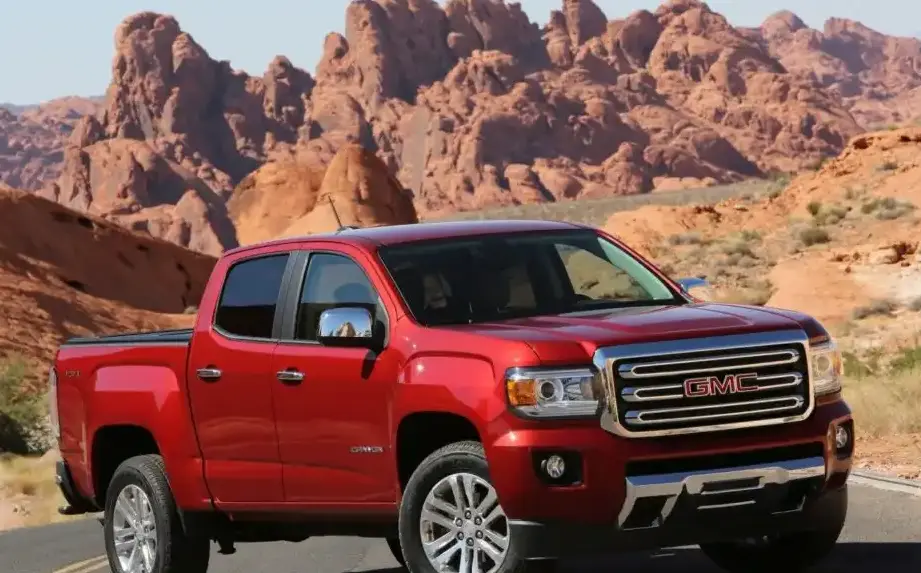
The GMC Canyon II Crew Cab, specifically the variant equipped with the 3.6-liter V6 engine producing 308 horsepower and paired with a four-wheel-drive system and an eight-speed automatic transmission, was a mid-size pickup truck produced from 2017 to 2020. This configuration represented a significant offering within the Canyon II lineup, positioned as a balance between capability, comfort, and price. It was part of the second generation of the Canyon, which itself was a rebadged version of the Chevrolet Colorado, sharing its platform and many components. The Canyon II aimed to fill a gap in the GMC lineup, offering a smaller, more manageable pickup truck option compared to the full-size Sierra.
Technical Specifications
| Brand | GMC |
| Model | Canyon |
| Generation | Canyon II Crew cab |
| Type (Engine) | 3.6 V6 (308 Hp) 4WD Automatic |
| Start of production | 2017 |
| End of production | 2020 |
| Powertrain Architecture | Internal Combustion engine |
| Body type | Pick-up |
| Seats | 5 |
| Doors | 4 |
| Fuel consumption (urban) | 13.8 l/100 km (17 US mpg, 20.5 UK mpg, 7.2 km/l) |
| Fuel consumption (extra urban) | 9.8 l/100 km (24 US mpg, 28.8 UK mpg, 10.2 km/l) |
| Fuel Type | Petrol (Gasoline) |
| Weight-to-power ratio | 6.1 kg/Hp, 163.7 Hp/tonne |
| Weight-to-torque ratio | 5 kg/Nm, 198.2 Nm/tonne |
| Power | 308 Hp @ 6800 rpm |
| Power per litre | 86.4 Hp/l |
| Torque | 373 Nm @ 4000 rpm (275.11 lb.-ft. @ 4000 rpm) |
| Engine layout | Front, Longitudinal |
| Engine Model/Code | LFX |
| Engine displacement | 3564 cm3 (217.49 cu. in.) |
| Number of cylinders | 6 |
| Engine configuration | V-engine |
| Cylinder Bore | 94 mm (3.7 in.) |
| Piston Stroke | 85.6 mm (3.37 in.) |
| Compression ratio | 11.5:1 |
| Number of valves per cylinder | 4 |
| Fuel injection system | Direct injection |
| Engine aspiration | Naturally aspirated engine |
| Valvetrain | DOHC, CVVT |
| Engine oil capacity | 5.7 l (6.02 US qt | 5.02 UK qt) |
| Coolant | 10.6 l (11.2 US qt | 9.33 UK qt) |
| Kerb Weight | 1882 kg (4149.1 lbs.) |
| Max. weight | 2812 kg (6199.4 lbs.) |
| Max load | 930 kg (2050.3 lbs.) |
| Trunk (boot) space – maximum | 1169 l (41.28 cu. ft.) |
| Fuel tank capacity | 79.5 l (21 US gal | 17.49 UK gal) |
| Permitted trailer load with brakes (12%) | 3175 kg (6999.68 lbs.) |
| Length | 5395 mm (212.4 in.) |
| Width | 1886 mm (74.25 in.) |
| Height | 1795 mm (70.67 in.) |
| Wheelbase | 3258 mm (128.27 in.) |
| Front track | 1586 mm (62.44 in.) |
| Rear (Back) track | 1586 mm (62.44 in.) |
| Ride height (ground clearance) | 208 mm (8.19 in.) |
| Minimum turning circle (turning diameter) | 12.6 m (41.34 ft.) |
| Drivetrain Architecture | The Internal combustion engine (ICE) drives the rear wheels permanently, and the front wheels are driven through an electrically or mechanically operated clutch if necessary. |
| Drive wheel | All wheel drive (4×4) |
| Number of gears and type of gearbox | 8 gears, automatic transmission Hydra-Matic |
| Front suspension | Independent coil spring |
| Rear suspension | Rigid axle suspension, Leaf spring |
| Front brakes | Disc, 310×27 mm |
| Rear brakes | Disc, 324×18 mm |
| Assisting systems | ABS (Anti-lock braking system) |
| Steering type | Steering rack and pinion |
| Power steering | Electric Steering |
| Tires size | 265/70 R16; 255/65 R17; 265/60 R18 |
| Wheel rims size | 7J x 16; 8J x 17; 8.5J x 18 |
Powertrain & Engine Architecture
At the heart of this Canyon variant lies the 3.6-liter LFX V6 engine. This engine is a naturally aspirated, 24-valve, dual overhead camshaft (DOHC) engine featuring variable valve timing (CVVT). The LFX utilizes direct fuel injection, contributing to improved fuel efficiency and power output. The engine’s architecture is a 60-degree V-configuration, designed for smoothness and balance. The eight-speed Hydra-Matic automatic transmission was a key component, offering a wide range of gear ratios to optimize both acceleration and fuel economy. This transmission was known for its relatively smooth shifts and responsiveness. The transmission’s gear ratios were tuned to provide adequate torque for towing and hauling, while also maintaining comfortable highway cruising.
Driving Characteristics
The 308-horsepower V6 and eight-speed automatic combination provided a noticeable step up in performance compared to the base four-cylinder engine option. While not a performance-oriented truck, the Canyon II Crew Cab 3.6L 4WD offered ample power for everyday driving and typical pickup truck tasks. Acceleration from 0 to 60 mph was typically in the 7.5-8.5 second range, depending on load and conditions. The automatic transmission generally shifted smoothly, although some drivers noted a slight hesitation during downshifts. The four-wheel-drive system provided enhanced traction in inclement weather and off-road situations. The overall driving experience was comfortable, with the suspension tuned to balance ride quality and load-carrying capability.
Equipment & Trim Levels
The Canyon II Crew Cab 3.6L 4WD was available in several trim levels, including SLE and SLT. The SLE trim typically included standard features such as air conditioning, power windows and locks, a basic infotainment system with a touchscreen display, and a rearview camera. The SLT trim added features like leather upholstery, heated front seats, a more advanced infotainment system with navigation, and additional safety features. Optional extras included a trailering package, a premium audio system, and various appearance upgrades. Interior upholstery was typically cloth on the SLE and leather on the SLT. The dashboard layout was functional and straightforward, with easy-to-reach controls.
Chassis & Braking
The Canyon II utilized a body-on-frame construction, providing a robust and durable platform. The front suspension consisted of independent coil springs, while the rear suspension employed a rigid axle with leaf springs. This configuration was chosen for its load-carrying capacity and durability. Braking duties were handled by disc brakes on all four wheels, with ABS (Anti-lock Braking System) standard. The front brakes measured 310x27mm, while the rear brakes were 324x18mm. The steering system was a rack-and-pinion setup with electric power steering, providing responsive and precise handling.
Market Reception & Comparison
The GMC Canyon II Crew Cab 3.6L 4WD was generally well-received by critics and consumers. It was praised for its comfortable ride, capable engine, and well-appointed interior. Compared to the base four-cylinder models, the V6 offered a significant improvement in performance. Fuel economy was average for its class, with EPA estimates around 17 mpg city and 24 mpg highway. Reliability was generally good, although some owners reported minor issues with the infotainment system. Compared to competitors like the Toyota Tacoma and Ford Ranger, the Canyon II offered a more refined interior and a smoother ride, but it often came at a slightly higher price point.
Legacy
The 3.6L V6 engine and eight-speed automatic transmission combination proved to be a reliable and durable powertrain. In the used car market, Canyon II models equipped with this powertrain continue to be sought after for their balance of capability and comfort. While not known for exceptional fuel economy, the powertrain’s overall reliability and relatively low maintenance costs have contributed to its enduring appeal. The Canyon II, and this specific variant, helped establish GMC as a viable competitor in the mid-size pickup truck segment, offering a compelling alternative to established players like Toyota and Ford.