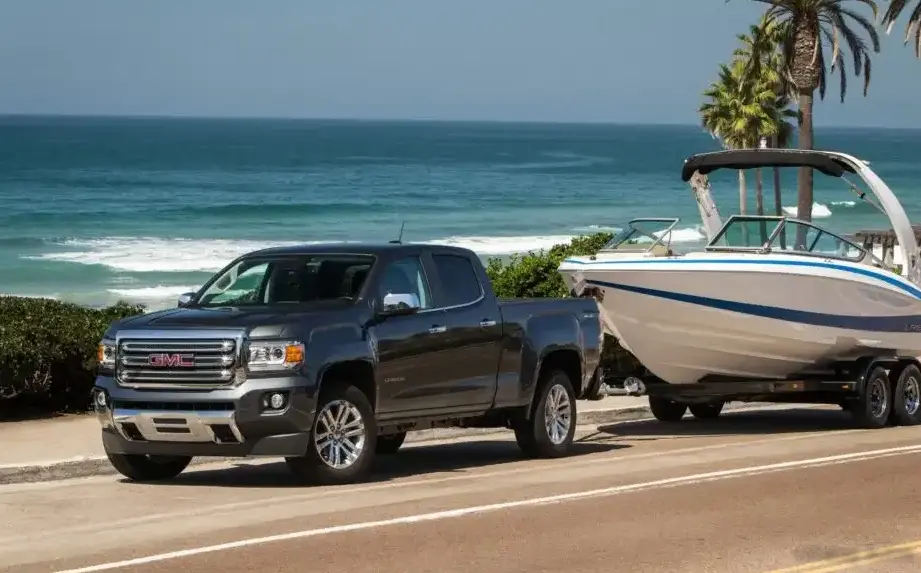
The GMC Canyon II Crew Cab Long Box, specifically equipped with the 2.8-liter Duramax TD engine producing 186 horsepower and paired with a 4WD automatic transmission, was a mid-size pickup truck produced from 2018 to 2020. This variant occupied a significant position within the Canyon II lineup, offering a balance between capability, fuel efficiency, and everyday usability. It represented GMC’s entry into the increasingly popular mid-size truck segment, aiming to provide a more refined and versatile alternative to full-size pickups.
Technical Specifications
| Brand | GMC |
| Model | Canyon |
| Generation | Canyon II Crew Cab Long Box |
| Type (Engine) | 2.8 Duramax TD (186 Hp) 4WD Automatic |
| Start of production | 2018 |
| End of production | 2020 |
| Powertrain Architecture | Internal Combustion engine |
| Body type | Pick-up |
| Seats | 5 |
| Doors | 4 |
| Fuel consumption (urban) | 12.4 l/100 km (19 US mpg, 22.8 UK mpg, 8.1 km/l) |
| Fuel consumption (extra urban) | 8.4 l/100 km (28 US mpg, 33.6 UK mpg, 11.9 km/l) |
| Fuel Type | Diesel |
| Power | 186 Hp @ 3400 rpm |
| Power per litre | 67 Hp/l |
| Torque | 500 Nm @ 2000 rpm (368.78 lb.-ft. @ 2000 rpm) |
| Maximum engine speed | 5000 rpm |
| Engine layout | Front, Longitudinal |
| Engine Model/Code | LWN |
| Engine displacement | 2776 cm3 (169.4 cu. in.) |
| Number of cylinders | 4 |
| Engine configuration | Inline |
| Cylinder Bore | 94 mm (3.7 in.) |
| Piston Stroke | 100 mm (3.94 in.) |
| Compression ratio | 16.5:1 |
| Number of valves per cylinder | 4 |
| Fuel injection system | Diesel Commonrail |
| Engine aspiration | Turbocharger, Intercooler |
| Valvetrain | DOHC |
| Engine oil capacity | 5.6 l (5.92 US qt | 4.93 UK qt) |
| Coolant capacity | 10.5 l (11.1 US qt | 9.24 UK qt) |
| Trunk (boot) space – maximum | 1414 l (49.93 cu. ft.) |
| Fuel tank capacity | 79.5 l (21 US gal | 17.49 UK gal) |
| Permitted trailer load with brakes (12%) | 3447 kg (7599.33 lbs.) |
| Length | 5705 mm (224.61 in.) |
| Width | 1886 mm (74.25 in.) |
| Height | 1791 mm (70.51 in.) |
| Wheelbase | 3569 mm (140.51 in.) |
| Front track | 1586 mm (62.44 in.) |
| Rear track | 1586 mm (62.44 in.) |
| Ride height (ground clearance) | 206 mm (8.11 in.) |
| Minimum turning circle | 13.6 m (44.62 ft.) |
| Drivetrain Architecture | The Internal combustion engine (ICE) drives the rear wheels permanently, and the front wheels are driven through an electrically or mechanically operated clutch if necessary. |
| Drive wheel | All wheel drive (4×4) |
| Number of gears and type of gearbox | 6 gears, automatic transmission Hydra-Matic |
| Front suspension | Independent coil spring |
| Rear suspension | Rigid axle suspension, Leaf spring |
| Front brakes | Disc, 324×18 mm |
| Rear brakes | Disc, 324×18 mm |
| Assisting systems | ABS (Anti-lock braking system) |
| Steering type | Steering rack and pinion |
| Power steering | Electric Steering |
| Tires size | 265/70 R16; 255/65 R17; 265/60 R18 |
| Wheel rims size | 7J x 16; 8J x 17; 8.5J x 18 |
INTRODUCTION
The GMC Canyon II, launched in 2015, represented GMC’s second attempt at a modern mid-size pickup. The 2018-2020 model years saw a refresh, and the 2.8-liter Duramax turbodiesel engine paired with a six-speed automatic transmission and four-wheel drive became a popular configuration. This particular variant aimed to deliver a blend of diesel torque for towing and hauling, combined with the convenience of an automatic transmission and the added security of four-wheel drive. It was positioned as a step up from the base 2.5-liter gasoline engine, offering more power and capability, but remained more accessible than the higher-trim gasoline V6 options.
Powertrain & Engine Architecture
The heart of this Canyon variant is the 2.8-liter (2776 cc) inline-four cylinder Duramax turbodiesel engine, designated with the engine code LWN. This engine utilizes a common-rail direct fuel injection system, delivering fuel at extremely high pressures for optimized combustion. The engine features a double overhead camshaft (DOHC) valvetrain with four valves per cylinder, enhancing breathing and efficiency. A turbocharger with an intercooler further boosts power output. The Duramax engine is known for its robust construction and durability. The six-speed Hydra-Matic automatic transmission was chosen for its smooth shifting and ability to handle the engine’s torque output. This transmission features electronically controlled shifting and overdrive for improved fuel economy at highway speeds. The transmission was calibrated to provide responsive acceleration while maintaining comfortable cruising.
Driving Characteristics
The 2.8-liter Duramax in the Canyon II provided a noticeable increase in torque compared to the gasoline engines, making it well-suited for towing and hauling. While 186 horsepower isn’t a massive figure, the 368 lb-ft of torque available at 2000 rpm provided strong low-end grunt. The automatic transmission, while smooth, wasn’t particularly sporty. Shifts were geared towards efficiency and comfort rather than aggressive acceleration. Compared to the manual transmission options available on other Canyon trims, the automatic offered greater convenience, especially in city driving and stop-and-go traffic. However, the manual transmission generally provided slightly better fuel economy and a more engaging driving experience. The 4WD system offered enhanced traction in slippery conditions, making it a capable choice for those living in areas with inclement weather or needing to traverse off-road terrain.
Equipment & Trim Levels
The 2.8-liter Duramax automatic typically came standard with features like air conditioning, power windows and locks, a basic infotainment system with a touchscreen display, and a rearview camera. Higher trim levels, such as the SLE and SLT, added features like leather upholstery, heated front seats, a premium audio system, and advanced safety technologies such as lane departure warning and forward collision alert. Optional extras included a trailering package, off-road suspension, and a navigation system. Interior materials were generally durable and functional, reflecting the truck’s work-oriented nature. The Crew Cab configuration provided ample space for five passengers, making it a practical choice for families.
Chassis & Braking
The Canyon II utilized a body-on-frame construction, providing a robust and durable platform. The front suspension featured independent coil springs, while the rear suspension employed a traditional leaf spring setup. This configuration balanced ride comfort with load-carrying capacity. The braking system consisted of disc brakes on all four wheels, providing adequate stopping power for the truck’s weight. An Anti-lock Braking System (ABS) was standard, enhancing safety during emergency braking maneuvers. The Canyon II’s chassis was tuned to provide a comfortable ride while maintaining good handling characteristics. Stabilizer bars were used to reduce body roll during cornering.
Market Reception & Comparison
Critics generally praised the Canyon II’s 2.8-liter Duramax engine for its fuel efficiency and towing capability. The automatic transmission received mixed reviews, with some finding it smooth and responsive, while others criticized its lack of sportiness. Compared to the gasoline-powered Canyon trims, the Duramax offered significantly better fuel economy, especially during highway driving. However, the Duramax engine carried a higher price tag. In comparison to competitors like the Toyota Tacoma and Ford Ranger, the Canyon II offered a more refined interior and a more comfortable ride, but some found its styling less aggressive. The Tacoma, in particular, held a strong reputation for reliability and resale value.
Legacy
The 2.8-liter Duramax engine in the Canyon II has proven to be a relatively reliable powertrain. While some owners have reported issues with the diesel particulate filter (DPF) system, these issues are not uncommon in modern diesel engines. Overall, the engine has a good reputation for longevity and durability. On the used car market, Canyon II models equipped with the 2.8-liter Duramax and automatic transmission hold their value reasonably well, particularly those in good condition with low mileage. They remain a popular choice for buyers seeking a capable and fuel-efficient mid-size pickup truck.