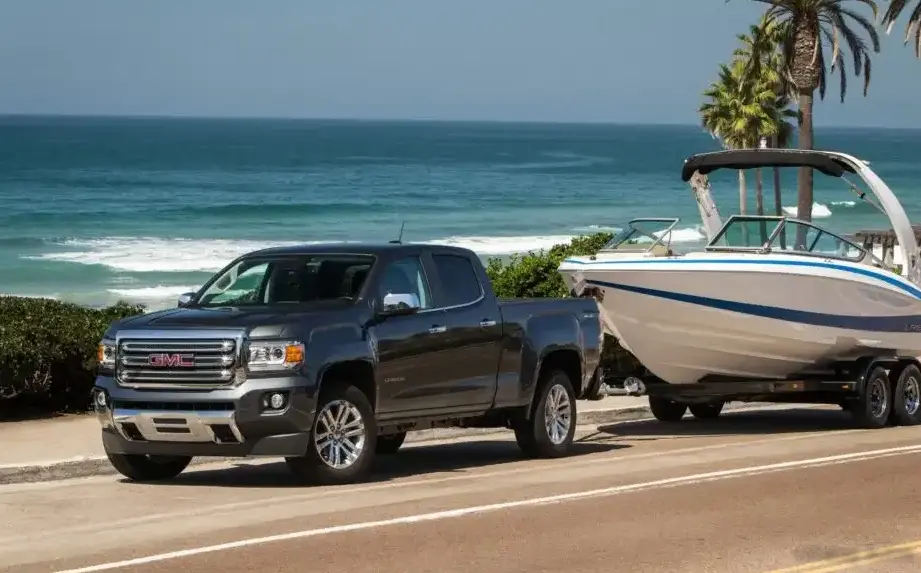
The GMC Canyon II Crew Cab Long Box, specifically equipped with the 2.8-liter Duramax turbodiesel engine producing 186 horsepower and paired with a six-speed Hydra-Matic automatic transmission, was a mid-range offering in GMC’s lineup of mid-size pickup trucks. Produced from 2018 to 2020, this configuration aimed to balance fuel efficiency, towing capability, and everyday usability for truck buyers. It occupied a space between the base gasoline engine options and the more powerful diesel variants, targeting customers who needed diesel torque but didn’t require the highest output.
Technical Specifications
| Brand | GMC |
| Model | Canyon |
| Generation | Canyon II Crew Cab Long Box |
| Type (Engine) | 2.8 Duramax TD (186 Hp) Automatic |
| Start of production | 2018 |
| End of production | 2020 |
| Powertrain Architecture | Internal Combustion engine |
| Body type | Pick-up |
| Seats | 5 |
| Doors | 4 |
| Fuel consumption (urban) | 10.7 l/100 km (22 US mpg) |
| Fuel consumption (extra urban) | 7.8 l/100 km (30.2 US mpg) |
| Fuel Type | Diesel |
| Power | 186 Hp @ 3400 rpm |
| Torque | 500 Nm @ 2000 rpm (368.78 lb.-ft. @ 2000 rpm) |
| Maximum engine speed | 5000 rpm |
| Engine layout | Front, Longitudinal |
| Engine Model/Code | LWN |
| Engine displacement | 2776 cm3 (169.4 cu. in.) |
| Number of cylinders | 4 |
| Engine configuration | Inline |
| Cylinder Bore | 94 mm (3.7 in.) |
| Piston Stroke | 100 mm (3.94 in.) |
| Compression ratio | 16.5:1 |
| Number of valves per cylinder | 4 |
| Fuel injection system | Diesel Commonrail |
| Engine aspiration | Turbocharger, Intercooler |
| Valvetrain | DOHC |
| Engine oil capacity | 5.6 l (5.92 US qt | 4.93 UK qt) |
| Coolant | 10.5 l (11.1 US qt | 9.24 UK qt) |
| Trunk (boot) space – maximum | 1414 l (49.93 cu. ft.) |
| Fuel tank capacity | 79.5 l (21 US gal | 17.49 UK gal) |
| Permitted trailer load with brakes (12%) | 3493 kg (7700.75 lbs.) |
| Length | 5705 mm (224.61 in.) |
| Width | 1886 mm (74.25 in.) |
| Height | 1793 mm (70.59 in.) |
| Wheelbase | 3569 mm (140.51 in.) |
| Front track | 1586 mm (62.44 in.) |
| Rear (Back) track | 1586 mm (62.44 in.) |
| Ride height (ground clearance) | 206 mm (8.11 in.) |
| Minimum turning circle (turning diameter) | 13.6 m (44.62 ft.) |
| Drivetrain Architecture | Rear wheel drive |
| Drive wheel | Rear wheel drive |
| Number of gears and type of gearbox | 6 gears, automatic transmission Hydra-Matic |
| Front suspension | Independent coil spring |
| Rear suspension | Rigid axle suspension, Leaf spring |
| Front brakes | Disc, 324×18 mm |
| Rear brakes | Disc, 324×18 mm |
| Assisting systems | ABS (Anti-lock braking system) |
| Steering type | Steering rack and pinion |
| Power steering | Electric Steering |
| Tires size | 265/70 R16; 255/65 R17; 265/60 R18 |
| Wheel rims size | 7J x 16; 8J x 17; 8.5J x 18 |
INTRODUCTION
The GMC Canyon II, launched in 2015, represented GMC’s entry into the increasingly popular mid-size truck segment. The 2018-2020 model years saw a refresh of the Canyon, and the 2.8-liter Duramax turbodiesel engine with the six-speed automatic transmission became a significant part of the lineup. This variant was positioned as a step up from the base 2.5-liter four-cylinder and the 3.6-liter V6 gasoline engines, offering improved fuel economy and torque for towing and hauling. The Crew Cab configuration, combined with the long bed, provided a practical balance of passenger space and cargo capacity, making it suitable for both work and family use.
Powertrain & Engine Architecture
The heart of this Canyon variant is the 2.8-liter (2776 cc) inline-four cylinder Duramax turbodiesel engine, designated with the engine code LWN. This engine utilizes a common-rail direct fuel injection system, delivering fuel at extremely high pressure for efficient combustion. The engine features a double overhead camshaft (DOHC) valvetrain with four valves per cylinder, optimizing airflow for increased power and efficiency. A turbocharger with an intercooler further enhances performance by forcing more air into the cylinders. The 186 horsepower peak is reached at 3400 rpm, while the substantial 500 Nm (368.78 lb-ft) of torque is available from just 2000 rpm, providing strong low-end pulling power. The six-speed Hydra-Matic automatic transmission was specifically calibrated to work with the diesel engine’s torque curve, offering smooth shifts and efficient operation. The transmission’s gear ratios were optimized for both on-road cruising and off-road crawling.
Driving Characteristics
The 2.8-liter Duramax automatic Canyon delivers a noticeably different driving experience compared to its gasoline-powered siblings. While not as quick off the line as the V6, the diesel engine’s abundant low-end torque makes it feel strong and capable, especially when towing or hauling a load. The automatic transmission generally shifts smoothly, although some drivers noted a slight hesitation during downshifts. The gear ratios are well-suited for highway cruising, maintaining comfortable engine speeds at typical interstate velocities. Compared to the manual transmission versions of the 2.8L Duramax, the automatic sacrifices some driver control but offers greater convenience, particularly in stop-and-go traffic. The overall driving experience is refined for a pickup truck, with a focus on comfort and usability.
Equipment & Trim Levels
The 2.8-liter Duramax automatic Canyon was typically offered in SLE and SLT trim levels. The SLE trim included standard features such as a touchscreen infotainment system with Apple CarPlay and Android Auto compatibility, a rearview camera, and keyless entry. The SLT trim added features like leather upholstery, heated front seats, a Bose premium audio system, and automatic climate control. Optional extras included a navigation system, a trailering package (including a trailer brake controller), and various appearance packages. Interior upholstery was typically cloth on the SLE and leather on the SLT. Dashboard configurations were consistent across trims, with a focus on functionality and ease of use.
Chassis & Braking
The Canyon II utilizes a body-on-frame construction, providing a robust and durable platform. The front suspension features independent coil springs, while the rear suspension employs a traditional leaf spring setup. This configuration balances ride comfort with load-carrying capacity. Braking duties are handled by disc brakes on all four wheels, measuring 324x18mm. An Anti-lock Braking System (ABS) is standard. The chassis was tuned to handle the increased weight and torque of the diesel engine, with slightly stiffer spring rates compared to the gasoline models. The rear axle was also reinforced to accommodate heavier loads.
Market Reception & Comparison
Critics generally praised the 2.8-liter Duramax Canyon for its fuel efficiency and towing capability. Fuel economy figures averaged around 22 mpg in the city and 30 mpg on the highway, significantly better than the V6 gasoline engine. However, some reviewers noted that the diesel engine was somewhat noisy compared to its gasoline counterparts. Compared to the 3.6L V6, the Duramax offered superior torque for towing, but less overall horsepower. The 2.8L Duramax automatic was often seen as a sweet spot in the Canyon lineup, offering a good balance of performance, efficiency, and capability. Reliability reports were generally positive, with the Duramax engine proving to be a durable and long-lasting powertrain.
Legacy
The 2.8-liter Duramax engine in the GMC Canyon II has proven to be a relatively reliable powertrain. While diesel engines generally require more diligent maintenance than gasoline engines (including regular diesel exhaust fluid refills and potential particulate filter maintenance), the Duramax has a reputation for longevity. On the used car market, these Canyon models hold their value reasonably well, particularly those that have been well-maintained. The combination of fuel efficiency, towing capacity, and the GMC brand’s reputation for dependability makes the 2.8-liter Duramax automatic Canyon a desirable option for buyers seeking a capable and practical mid-size pickup truck.