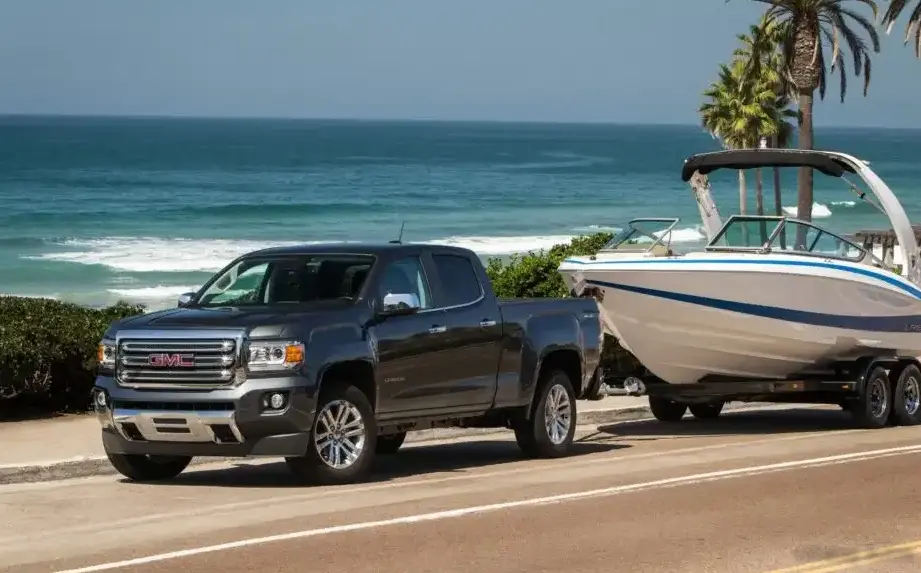
The GMC Canyon II Crew Cab Long Box, specifically equipped with the 3.6-liter V6 engine producing 305 horsepower and paired with a four-wheel-drive system and automatic transmission, was a mid-size pickup truck produced from 2015 to 2016. It represented GMC’s entry into the increasingly popular segment of smaller, more fuel-efficient trucks, offering a blend of capability and comfort. This variant occupied a middle ground in the Canyon II lineup, positioned above the base 2.5-liter four-cylinder models and below the available Duramax diesel option. It was designed to appeal to buyers needing a versatile truck for both work and personal use.
Technical Specifications
| Brand | GMC |
| Model | Canyon |
| Generation | Canyon II Crew cab Long box |
| Type (Engine) | 3.6 V6 (305 Hp) 4WD Automatic |
| Start of production | 2015 |
| End of production | 2016 |
| Powertrain Architecture | Internal Combustion engine |
| Body type | Pick-up |
| Seats | 5 |
| Doors | 4 |
| Fuel consumption (economy) – urban | 13.8 l/100 km (17 US mpg, 20.5 UK mpg, 7.2 km/l) |
| Fuel consumption (economy) – extra urban | 9.8 l/100 km (24 US mpg, 28.8 UK mpg, 10.2 km/l) |
| Fuel Type | Petrol (Gasoline) |
| Weight-to-power ratio | 6.7 kg/Hp, 149.4 Hp/tonne |
| Weight-to-torque ratio | 5.6 kg/Nm, 178.8 Nm/tonne |
| Power | 305 Hp @ 6800 rpm |
| Power per litre | 85.6 Hp/l |
| Torque | 365 Nm @ 4000 rpm (269.21 lb.-ft. @ 4000 rpm) |
| Engine layout | Front, Longitudinal |
| Engine Model/Code | LFX |
| Engine displacement | 3564 cm3 (217.49 cu. in.) |
| Number of cylinders | 6 |
| Engine configuration | V-engine |
| Cylinder Bore | 94 mm (3.7 in.) |
| Piston Stroke | 85.6 mm (3.37 in.) |
| Compression ratio | 11.5:1 |
| Number of valves per cylinder | 4 |
| Fuel injection system | Direct injection |
| Engine aspiration | Naturally aspirated engine |
| Valvetrain | DOHC, CVVT |
| Engine oil capacity | 5.7 l (6.02 US qt | 5.02 UK qt) |
| Coolant | 12.4 l (13.1 US qt | 10.91 UK qt) |
| Kerb Weight | 2041 kg (4499.63 lbs.) |
| Max. weight | 2722 kg (6000.98 lbs.) |
| Max load | 681 kg (1501.35 lbs.) |
| Trunk (boot) space – maximum | 1414 l (49.93 cu. ft.) |
| Fuel tank capacity | 79.5 l (21 US gal | 17.49 UK gal) |
| Permitted trailer load with brakes (12%) | 1588 kg (3500.94 lbs.) |
| Length | 5705 mm (224.61 in.) |
| Width | 1886 mm (74.25 in.) |
| Height | 1791 mm (70.51 in.) |
| Wheelbase | 3569 mm (140.51 in.) |
| Front track | 1586 mm (62.44 in.) |
| Rear (Back) track | 1586 mm (62.44 in.) |
| Ride height (ground clearance) | 214 mm (8.43 in.) |
| Minimum turning circle (turning diameter) | 13.6 m (44.62 ft.) |
| Approach angle | 17.1° |
| Departure angle | 22.2° |
| Ramp-over (brakeover) angle | 18.6° |
| Drivetrain Architecture | The Internal combustion engine (ICE) drives the rear wheels permanently, and the front wheels are driven through an electrically or mechanically operated clutch if necessary. |
| Drive wheel | All wheel drive (4×4) |
| Number of gears and type of gearbox | 6 gears, automatic transmission Hydra-Matic |
| Front suspension | Independent coil spring |
| Rear suspension | Rigid axle suspension, Leaf spring |
| Front brakes | Disc, 310×27 mm |
| Rear brakes | Disc, 324×18 mm |
| Assisting systems | ABS (Anti-lock braking system) |
| Steering type | Steering rack and pinion |
| Power steering | Electric Steering |
| Tires size | 265/70 R16; 255/65 R17; 265/60 R18 |
| Wheel rims size | 7J x 16; 8J x 17; 8.5J x 18 |
Powertrain & Engine Architecture
The heart of this Canyon variant is the 3.6-liter LFX V6 engine. This engine is a naturally aspirated, 24-valve DOHC (Double Overhead Camshaft) engine featuring variable valve timing (CVVT) on both intake and exhaust valves. Direct fuel injection is employed to enhance efficiency and power output. The LFX engine is known for its relatively smooth operation and respectable power delivery. The engine’s longitudinal mounting allowed for a traditional rear-wheel-drive layout, with the four-wheel-drive system engaging the front axle as needed. The transmission is a six-speed Hydra-Matic automatic, chosen for its balance of responsiveness and fuel economy. This transmission features electronically controlled shifting and is designed to handle the engine’s 305 horsepower and 269 lb-ft of torque.
Driving Characteristics
The 3.6L V6 and six-speed automatic combination in the Canyon II provided a noticeable step up in performance compared to the base four-cylinder engine. While not a performance truck, it offered adequate acceleration for everyday driving and highway merging. The automatic transmission generally shifted smoothly, although some drivers noted a slight hesitation during downshifts. The four-wheel-drive system provided enhanced traction in inclement weather and on unpaved surfaces. Compared to the manual transmission versions, the automatic offered greater convenience, particularly in urban environments, but at the expense of some driver engagement and potentially slightly lower fuel economy. The gear ratios were tuned for a balance between towing capability and on-road drivability.
Equipment & Trim Levels
The Canyon II Crew Cab Long Box 3.6L V6 4WD Automatic was typically offered in SLE and SLT trim levels. The SLE trim included standard features such as air conditioning, power windows and locks, a basic infotainment system with a touchscreen display, and cloth upholstery. The SLT trim added features like leather upholstery, heated front seats, a more advanced infotainment system with navigation, and additional chrome exterior trim. Optional extras included a trailering package, a sunroof, and upgraded audio systems. Interior materials were generally considered to be of good quality for the segment, offering a comfortable and functional cabin environment.
Chassis & Braking
The Canyon II utilized a body-on-frame construction, providing a robust platform for hauling and towing. The front suspension consisted of independent coil springs, while the rear suspension employed a traditional leaf spring setup. This configuration prioritized load-carrying capacity and durability. Braking duties were handled by disc brakes on all four wheels, with ABS (Anti-lock Braking System) standard. The braking system was adequate for the truck’s weight and performance, but not particularly noteworthy. The truck’s relatively high ride height provided good ground clearance for off-road use.
Market Reception & Comparison
Critics generally praised the Canyon II for its comfortable ride, spacious cabin, and available features. The 3.6L V6 engine was considered a good compromise between power and fuel economy. However, some reviewers noted that the interior design was somewhat dated compared to newer competitors. Compared to the diesel-powered Canyon, the 3.6L V6 offered lower initial cost but less torque for heavy towing. Fuel economy was competitive within the mid-size truck segment, but not class-leading. Reliability reports were generally positive, with few major issues reported for the LFX engine and Hydra-Matic transmission.
Legacy
The GMC Canyon II, particularly the 3.6L V6 4WD Automatic variant, has proven to be a relatively reliable and durable truck in the used car market. The LFX engine is known for its longevity, and the Hydra-Matic transmission is generally considered to be robust. These trucks continue to be popular choices for buyers seeking a capable and affordable mid-size pickup. While not as fuel-efficient as some newer trucks, the Canyon II offers a good balance of capability, comfort, and value, making it a solid choice for those needing a versatile work and lifestyle vehicle.