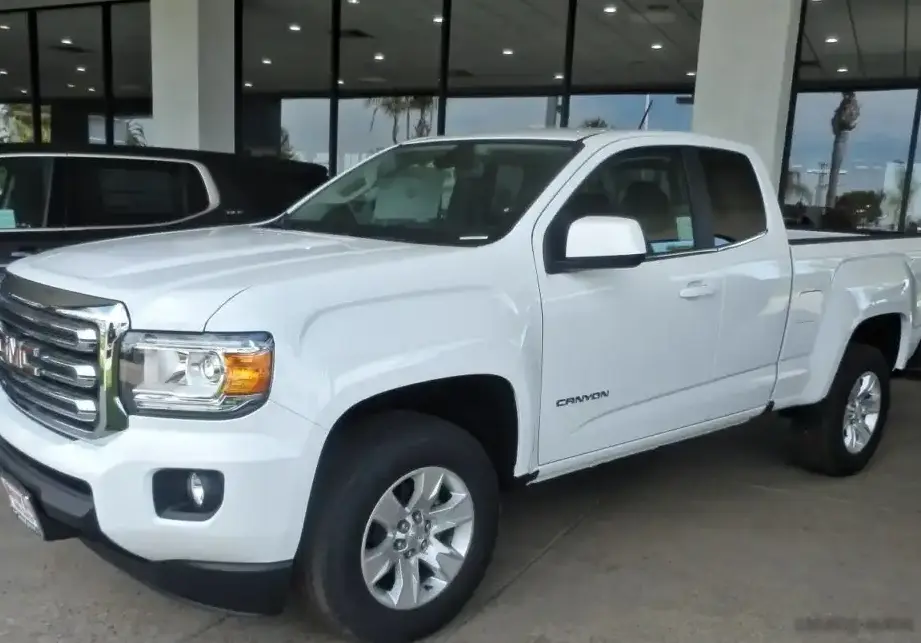
The GMC Canyon II Extended Cab Long Box 2.5, produced from 2015 to 2019, represented GMC’s entry into the mid-size pickup truck segment following a period where the brand had focused primarily on larger trucks. This variant, equipped with the 2.5-liter four-cylinder engine producing 200 horsepower, served as the base model for the Canyon II lineup, targeting buyers seeking a capable and affordable truck for everyday use and light-duty tasks. It occupied the lower end of the spectrum, positioned below the more powerful V6 options and offering a more economical alternative. The Canyon II was a rebadged version of the Chevrolet Colorado, sharing its platform and many components, but with GMC’s signature styling and features aimed at a slightly more upscale customer.
Technical Specifications
| Brand | GMC |
| Model | Canyon |
| Generation | Canyon II Extended Cab Long Box |
| Type (Engine) | 2.5 (200 Hp) |
| Start of production | 2015 |
| End of production | 2019 |
| Powertrain Architecture | Internal Combustion engine |
| Body type | Pick-up |
| Seats | 4 |
| Doors | 2 |
| Fuel consumption (economy) – urban | 12.3 l/100 km (19.1 US mpg, 23 UK mpg, 8.1 km/l) |
| Fuel consumption (economy) – extra urban | 9 l/100 km (26.1 US mpg, 31.4 UK mpg, 11.1 km/l) |
| Fuel Type | Petrol (Gasoline) |
| Weight-to-power ratio | 8.9 kg/Hp, 112.5 Hp/tonne |
| Weight-to-torque ratio | 6.9 kg/Nm, 145.7 Nm/tonne |
| Power | 200 Hp @ 6300 rpm |
| Power per litre | 81.4 Hp/l |
| Torque | 259 Nm @ 4400 rpm (191.03 lb.-ft. @ 4400 rpm) |
| Engine layout | Front, Longitudinal |
| Engine Model/Code | Ecotec LCV |
| Engine displacement | 2457 cm3 (149.94 cu. in.) |
| Number of cylinders | 4 |
| Engine configuration | Inline |
| Cylinder Bore | 88 mm (3.46 in.) |
| Piston Stroke | 101 mm (3.98 in.) |
| Compression ratio | 11.3:1 |
| Number of valves per cylinder | 4 |
| Fuel injection system | Direct injection |
| Engine aspiration | Naturally aspirated engine |
| Valvetrain | DOHC, CVVT |
| Engine oil capacity | 4.7 l (4.97 US qt | 4.14 UK qt) |
| Coolant | 9.1 l (9.62 US qt | 8.01 UK qt) |
| Kerb Weight | 1778 kg (3919.82 lbs.) |
| Max. weight | 2449 kg (5399.12 lbs.) |
| Max load | 671 kg (1479.3 lbs.) |
| Trunk (boot) space – maximum | 1414 l (49.93 cu. ft.) |
| Fuel tank capacity | 79.5 l (21 US gal | 17.49 UK gal) |
| Permitted trailer load with brakes (12%) | 1588 kg (3500.94 lbs.) |
| Length | 5395 mm (212.4 in.) |
| Width | 1886 mm (74.25 in.) |
| Height | 1788 mm (70.39 in.) |
| Wheelbase | 3258 mm (128.27 in.) |
| Front track | 1586 mm (62.44 in.) |
| Rear (Back) track | 1586 mm (62.44 in.) |
| Ride height (ground clearance) | 214 mm (8.43 in.) |
| Minimum turning circle (turning diameter) | 12.6 m (41.34 ft.) |
| Approach angle | 17.7° |
| Departure angle | 22.6° |
| Ramp-over (brakeover) angle | 22° |
| Drivetrain Architecture | The Internal combustion engine (ICE) drives the rear wheels of the vehicle. |
| Drive wheel | Rear wheel drive |
| Number of gears and type of gearbox | 6 gears, manual transmission Eaton N8D |
| Front suspension | Independent coil spring |
| Rear suspension | Rigid axle suspension, Leaf spring |
| Front brakes | Disc, 310×27 mm |
| Rear brakes | Disc, 324×18 mm |
| Assisting systems | ABS (Anti-lock braking system) |
| Steering type | Steering rack and pinion |
| Power steering | Electric Steering |
| Tires size | 265/70 R16; 255/65 R17; 265/60 R18 |
| Wheel rims size | 7J x 16; 8J x 17; 8.5J x 18 |
Powertrain & Engine Architecture
The 2015-2019 GMC Canyon II 2.5 utilized the Ecotec LCV engine, a 2.5-liter inline-four cylinder powerplant. This engine featured direct fuel injection, a double overhead camshaft (DOHC) valvetrain with continuously variable valve timing (CVVT), and a relatively high 11.3:1 compression ratio. The direct injection system helped improve fuel efficiency and power output compared to traditional port fuel injection. The engine produced 200 horsepower at 6300 rpm and 259 Nm (191 lb-ft) of torque at 4400 rpm. The engine was mounted longitudinally in the chassis. The standard transmission for this variant was a six-speed manual transmission manufactured by Eaton (model N8D). While an automatic transmission was available on other Canyon trims, it was not offered with the base 2.5-liter engine.
Driving Characteristics
The 2.5-liter engine, paired with the six-speed manual transmission, provided adequate performance for typical pickup truck duties. Acceleration was not particularly brisk, but sufficient for merging onto highways and maintaining highway speeds. The manual transmission allowed for greater driver control and engagement, but required more effort than an automatic, especially in stop-and-go traffic. The gear ratios were tuned for a balance of fuel economy and usability, with a relatively tall sixth gear for highway cruising. Compared to the V6 options, the 2.5-liter engine offered significantly less power and torque, making it less suitable for heavy towing or hauling. However, it excelled in fuel economy, making it a practical choice for daily commuting and light-duty tasks.
Equipment & Trim Levels
The 2.5-liter Canyon II typically came in a base trim level, offering a functional but relatively spartan feature set. Standard equipment generally included air conditioning, power windows and locks, a basic audio system, and steel wheels. The interior upholstery was typically cloth. Optional extras included features like an upgraded audio system, alloy wheels, a trailer hitch, and various appearance packages. The extended cab configuration provided limited rear seating, suitable for occasional passengers or cargo. The long box offered a generous 1414 liters (49.93 cubic feet) of cargo space.
Chassis & Braking
The Canyon II utilized a body-on-frame construction, providing a robust and durable platform. The front suspension consisted of independent coil springs, while the rear suspension employed a rigid axle with leaf springs. This setup provided a comfortable ride quality and good load-carrying capacity. The braking system featured disc brakes on all four wheels, with ABS (Anti-lock Braking System) as standard equipment. The front brakes measured 310x27mm, while the rear brakes were 324x18mm. The steering system was a rack-and-pinion setup with electric power steering.
Market Reception & Comparison
The 2.5-liter Canyon II received mixed reviews. Critics praised its fuel economy and affordability, but noted its lack of power compared to the V6 models. It was generally seen as a good option for buyers who prioritized fuel efficiency and value over performance. Compared to the Chevrolet Colorado 2.5, the Canyon offered a slightly more refined interior and exterior styling, justifying its slightly higher price point. Fuel economy figures averaged around 12.3 l/100 km (19.1 US mpg) in urban driving and 9 l/100 km (26.1 US mpg) on the highway.
Legacy
The GMC Canyon II 2.5-liter variant, while not the most powerful or feature-rich option in the lineup, proved to be a reliable and economical choice for many truck buyers. The Ecotec LCV engine, while not known for exceptional longevity, generally provided adequate service with proper maintenance. On the used car market, these models are often found at lower price points, making them an attractive option for budget-conscious buyers. The simplicity of the 2.5-liter engine and manual transmission combination also contributes to lower maintenance costs compared to the more complex V6 and automatic transmission options. While not a collector’s item, the Canyon II 2.5 remains a practical and capable mid-size pickup truck.