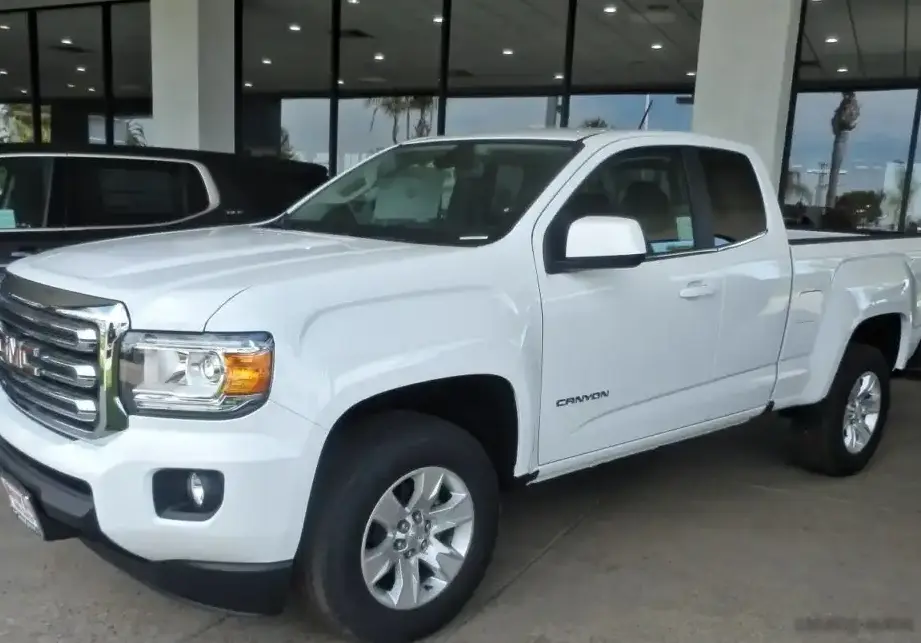
The GMC Canyon II, produced from 2015 to 2020, marked GMC’s return to the mid-size pickup truck segment after a period of focusing on larger trucks. Positioned as a competitor to the Toyota Tacoma and Nissan Frontier, the Canyon II aimed to deliver a more refined and feature-rich experience than its predecessor. Within the Canyon II lineup, the Extended Cab Long Box configuration equipped with the 2.5-liter four-cylinder engine producing 200 horsepower and coupled with a four-wheel-drive system served as the entry-level model. This variant targeted buyers prioritizing affordability and fundamental capability, offering a balance between work-truck functionality and everyday usability.
Technical Specifications
| Brand | GMC |
| Model | Canyon |
| Generation | Canyon II Extended cab Long box |
| Type (Engine) | 2.5 (200 Hp) 4WD |
| Start of production | 2015 |
| End of production | 2020 |
| Powertrain Architecture | Internal Combustion engine |
| Body type | Pick-up |
| Seats | 4 |
| Doors | 2 |
| Fuel consumption (urban) | 12.3 l/100 km (19.1 US mpg) |
| Fuel consumption (extra urban) | 9.4 l/100 km (25 US mpg) |
| Fuel Type | Petrol (Gasoline) |
| Weight-to-power ratio | 9.3 kg/Hp |
| Weight-to-torque ratio | 7.2 kg/Nm |
| Power | 200 Hp @ 6300 rpm |
| Power per litre | 81.4 Hp/l |
| Torque | 259 Nm @ 4400 rpm (191.03 lb.-ft. @ 4400 rpm) |
| Engine layout | Front, Longitudinal |
| Engine Model/Code | Ecotec LCV |
| Engine displacement | 2457 cm3 (149.94 cu. in.) |
| Number of cylinders | 4 |
| Engine configuration | Inline |
| Cylinder Bore | 88 mm (3.46 in.) |
| Piston Stroke | 101 mm (3.98 in.) |
| Compression ratio | 11.3:1 |
| Number of valves per cylinder | 4 |
| Fuel injection system | Direct injection |
| Engine aspiration | Naturally aspirated engine |
| Valvetrain | DOHC, CVVT |
| Engine oil capacity | 4.7 l (4.97 US qt | 4.14 UK qt) |
| Coolant | 9.1 l (9.62 US qt | 8.01 UK qt) |
| Kerb Weight | 1860 kg (4100.6 lbs.) |
| Max. weight | 2540 kg (5599.74 lbs.) |
| Max load | 680 kg (1499.14 lbs.) |
| Trunk (boot) space – maximum | 1414 l (49.93 cu. ft.) |
| Fuel tank capacity | 79.5 l (21 US gal | 17.49 UK gal) |
| Permitted trailer load with brakes (12%) | 1588 kg (3500.94 lbs.) |
| Length | 5395 mm (212.4 in.) |
| Width | 1886 mm (74.25 in.) |
| Height | 1785 mm (70.28 in.) |
| Wheelbase | 3258 mm (128.27 in.) |
| Front track | 1586 mm (62.44 in.) |
| Rear (Back) track | 1586 mm (62.44 in.) |
| Ride height (ground clearance) | 214 mm (8.43 in.) |
| Minimum turning circle (turning diameter) | 12.6 m (41.34 ft.) |
| Approach angle | 17.6° |
| Departure angle | 22.3° |
| Ramp-over (brakeover) angle | 19.7° |
| Drivetrain Architecture | The Internal combustion engine (ICE) drives the rear wheels permanently, and the front wheels are driven through an electrically or mechanically operated clutch if necessary. |
| Drive wheel | All wheel drive (4×4) |
| Number of gears and type of gearbox | 6 gears, manual transmission Eaton N8D |
| Front suspension | Independent coil spring |
| Rear suspension | Rigid axle suspension, Leaf spring |
| Front brakes | Disc, 310×27 mm |
| Rear brakes | Disc, 324×18 mm |
| Assisting systems | ABS (Anti-lock braking system) |
| Steering type | Steering rack and pinion |
| Power steering | Electric Steering |
| Tires size | 265/70 R16; 255/65 R17; 265/60 R18 |
| Wheel rims size | 7J x 16; 8J x 17; 8.5J x 18 |
Powertrain & Engine Architecture
The 2015-2020 GMC Canyon II’s 2.5-liter four-cylinder engine, part of the Ecotec LCV family, is a naturally aspirated, inline-four cylinder powerplant. It incorporates direct fuel injection, a double overhead camshaft (DOHC) valvetrain with continuously variable valve timing (CVVT), and a compression ratio of 11.3:1. These technologies were implemented to balance power output and fuel efficiency. The engine generated 200 horsepower at 6300 rpm and 259 Nm (191 lb-ft) of torque at 4400 rpm. The engine’s longitudinal mounting facilitated a traditional rear-wheel-drive layout, with the four-wheel-drive system engaging the front wheels when needed. The standard transmission was a six-speed manual transmission (Eaton N8D), providing a direct connection between the engine and the wheels.
Driving Characteristics
The 2.5-liter engine, while suitable for everyday driving, offered noticeably less power than the available 3.6-liter V6. Acceleration was moderate, and overtaking required careful consideration. The six-speed manual transmission allowed drivers to maintain the engine within its optimal power range, but the overall driving experience prioritized fuel economy and practicality over outright performance. The four-wheel-drive system enhanced traction in adverse weather conditions and on unpaved surfaces, making it appropriate for light off-road use. Compared to the V6 models, the 2.5-liter Canyon had a lower towing capacity and a less refined driving experience. However, the manual transmission provided a more engaging feel than the optional automatic transmission.
Equipment & Trim Levels
The base Canyon 2.5-liter model typically included standard features such as air conditioning, a basic audio system, power windows and locks, and steel wheels. The interior upholstery was generally cloth. Optional extras encompassed an upgraded audio system, alloy wheels, a trailer hitch, and various convenience packages. Higher trim levels, like the SLE and SLT, added features such as leather upholstery, heated seats, a navigation system, and advanced safety technologies. The Extended Cab configuration featured smaller rear doors and limited rear seat space compared to the Crew Cab models.
Chassis & Braking
The GMC Canyon II employed a body-on-frame construction, providing a robust and durable platform. The front suspension utilized independent coil springs, while the rear suspension featured a rigid axle with leaf springs. This setup prioritized load-carrying capacity and durability over ride comfort. The base model typically came equipped with disc brakes on all four wheels, with ABS (Anti-lock Braking System) as standard. The braking system was adequate for the vehicle’s weight and performance, though it lacked the sophistication found in some competitors. The Canyon II’s chassis was engineered to handle diverse terrains and payloads, making it a versatile work truck.
Market Reception & Comparison
Critics generally regarded the Canyon II 2.5-liter as a capable but unremarkable offering. The engine was considered sufficient for basic tasks but lacked the power and refinement of the V6 option. Fuel economy was a strong point, but the overall driving experience was less engaging than some competitors. Compared to the Toyota Tacoma and Nissan Frontier, the Canyon II offered a more comfortable ride and a more modern interior, but it didn’t match the Tacoma’s proven reliability and off-road capabilities. The 2.5-liter engine often received criticism for being underpowered, particularly when towing or hauling substantial loads.
Legacy
The GMC Canyon II 2.5-liter, while not the most sought-after configuration, remains a relatively affordable and practical option in the used truck market. The Ecotec LCV engine has demonstrated reasonable reliability, provided regular maintenance is performed. Common issues include oil leaks and sensor failures. The Canyon II’s body-on-frame construction and four-wheel-drive system contribute to its durability and capability for various applications. As a base model, it provides an accessible entry point into the mid-size pickup truck segment, offering a blend of functionality and affordability.