Technical Specifications
| Brand | GMC |
| Model | Canyon |
| Generation | Canyon II Extended Cab Long Box |
| Type (Engine) | 2.5 (200 Hp) Automatic |
| Start of production | 2015 |
| End of production | 2020 |
| Powertrain Architecture | Internal Combustion engine |
| Body type | Pick-up |
| Seats | 4 |
| Doors | 2 |
| Fuel consumption (economy) – urban | 11.7 l/100 km (20.1 US mpg, 24.1 UK mpg, 8.5 km/l) |
| Fuel consumption (economy) – extra urban | 8.7 l/100 km (27 US mpg, 32.5 UK mpg, 11.5 km/l) |
| Fuel Type | Petrol (Gasoline) |
| Weight-to-power ratio | 8.8 kg/Hp, 113.6 Hp/tonne |
| Weight-to-torque ratio | 6.8 kg/Nm, 147.2 Nm/tonne |
| Power | 200 Hp @ 6300 rpm |
| Power per litre | 81.4 Hp/l |
| Torque | 259 Nm @ 4400 rpm (191.03 lb.-ft. @ 4400 rpm) |
| Engine layout | Front, Longitudinal |
| Engine Model/Code | Ecotec LCV |
| Engine displacement | 2457 cm3 (149.94 cu. in.) |
| Number of cylinders | 4 |
| Engine configuration | Inline |
| Cylinder Bore | 88 mm (3.46 in.) |
| Piston Stroke | 101 mm (3.98 in.) |
| Compression ratio | 11.3:1 |
| Number of valves per cylinder | 4 |
| Fuel injection system | Direct injection |
| Engine aspiration | Naturally aspirated engine |
| Valvetrain | DOHC, CVVT |
| Engine oil capacity | 4.7 l (4.97 US qt | 4.14 UK qt) |
| Coolant | 9.1 l (9.62 US qt | 8.01 UK qt) |
| Kerb Weight | 1760 kg (3880.14 lbs.) |
| Max. weight | 2449 kg (5399.12 lbs.) |
| Max load | 689 kg (1518.98 lbs.) |
| Trunk (boot) space – maximum | 1414 l (49.93 cu. ft.) |
| Fuel tank capacity | 79.5 l (21 US gal | 17.49 UK gal) |
| Permitted trailer load with brakes (12%) | 1588 kg (3500.94 lbs.) |
| Length | 5395 mm (212.4 in.) |
| Width | 1886 mm (74.25 in.) |
| Height | 1788 mm (70.39 in.) |
| Wheelbase | 3258 mm (128.27 in.) |
| Front track | 1586 mm (62.44 in.) |
| Rear (Back) track | 1586 mm (62.44 in.) |
| Ride height (ground clearance) | 214 mm (8.43 in.) |
| Minimum turning circle (turning diameter) | 12.6 m (41.34 ft.) |
| Approach angle | 17.7° |
| Departure angle | 22.6° |
| Ramp-over (brakeover) angle | 22° |
| Drivetrain Architecture | The Internal combustion engine (ICE) drives the rear wheels of the vehicle. |
| Drive wheel | Rear wheel drive |
| Number of gears and type of gearbox | 6 gears, automatic transmission Hydra-Matic |
| Front suspension | Independent coil spring |
| Rear suspension | Rigid axle suspension, Leaf spring |
| Front brakes | Disc, 310×27 mm |
| Rear brakes | Disc, 324×18 mm |
| Assisting systems | ABS (Anti-lock braking system) |
| Steering type | Steering rack and pinion |
| Power steering | Electric Steering |
| Tires size | 265/70 R16; 255/65 R17; 265/60 R18 |
| Wheel rims size | 7J x 16; 8J x 17; 8.5J x 18 |
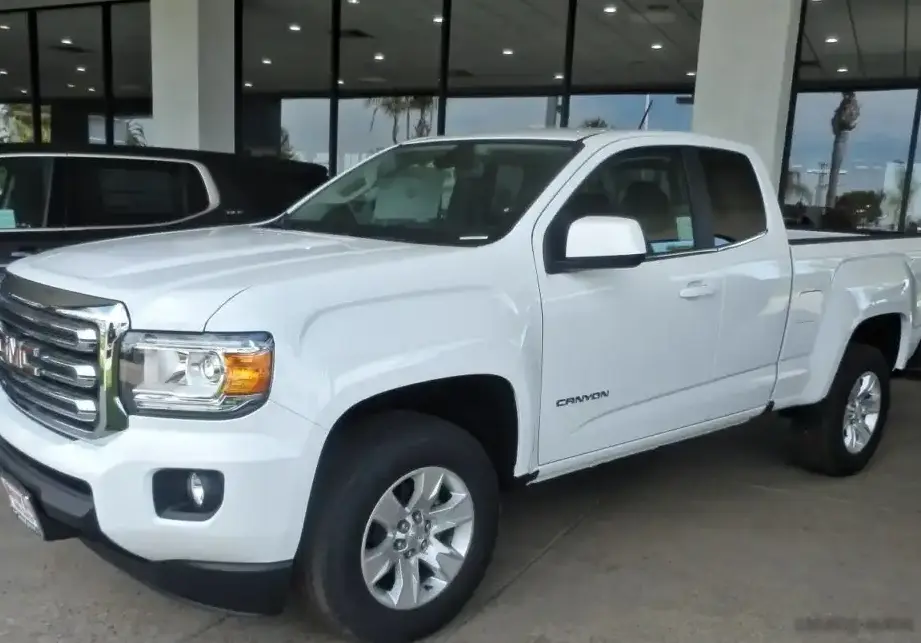
The 2015-2020 GMC Canyon II, specifically the Extended Cab Long Box model equipped with the 2.5-liter four-cylinder engine and six-speed automatic transmission, represented a return to the mid-size pickup market for GMC after a period of absence. Built on the GMT-31XX platform – shared with its corporate sibling, the Chevrolet Colorado – the Canyon aimed to provide a more manageable and fuel-efficient alternative to the larger Sierra pickup. This particular configuration was designed to appeal to buyers who needed the utility of a pickup but didn’t require the higher towing capacity or performance of the V6 or diesel options. It was a practical choice for everyday use, offering a blend of work capability and daily drivability.
Powertrain & Engine Architecture
The foundation of this Canyon variant is the Ecotec LCV 2.5-liter inline-four cylinder engine. This engine incorporates several modern technologies to achieve a balance of power and efficiency. Key features include direct fuel injection, a double overhead camshaft (DOHC) valvetrain with continuously variable valve timing (CVVT), and a relatively high 11.3:1 compression ratio. The engine generates 200 horsepower at 6300 rpm and 259 lb.-ft. of torque at 4400 rpm. The sole transmission option paired with this engine was the Hydra-Matic 6L40 six-speed automatic transmission. This transmission is well-regarded for its smooth shifting characteristics and overall reliability. The transmission’s gear ratios are calibrated for everyday driving, prioritizing fuel economy and a comfortable cruising experience over rapid acceleration.
Driving Characteristics
The 2.5-liter engine and six-speed automatic combination in the Canyon delivers adequate, though not particularly exciting, performance. Acceleration is sufficient for typical driving scenarios, but the truck feels noticeably slower when fully loaded or tackling steep inclines compared to the V6-equipped models. The automatic transmission generally provides smooth gear changes, but can occasionally exhibit some hesitation during quick overtaking maneuvers. The gear ratios are optimized for fuel efficiency, resulting in the engine operating at lower RPMs during highway cruising. This contributes to a quieter cabin environment but can also lead to the transmission downshifting more frequently when encountering hills. The rear-wheel-drive configuration provides a traditional truck feel, and the leaf spring rear suspension contributes to a somewhat firm ride, particularly when the bed is empty.
Equipment & Trim Levels
The base Canyon Extended Cab Long Box 2.5L Automatic typically included standard features such as air conditioning, a basic audio system with USB connectivity, power windows and locks, and a rearview camera. The interior upholstery was generally cloth, and the dashboard featured a straightforward design with user-friendly controls. A range of optional extras were available, including a larger touchscreen infotainment system with Apple CarPlay and Android Auto compatibility, a premium audio system, heated front seats, and a trailering package. Stepping up to higher trim levels, such as the SLE and SLT, added more luxurious appointments like leather upholstery, automatic climate control, and advanced safety technologies.
Chassis & Braking
The Canyon II employed a body-on-frame construction, providing a robust and durable platform. The front suspension utilized an independent coil spring setup, while the rear suspension featured a traditional leaf spring configuration. This combination aimed to strike a balance between ride comfort and payload capacity. The braking system consisted of disc brakes on all four wheels, with ABS (Anti-lock Braking System) as standard equipment. The front brakes measured 310x27mm, while the rear brakes were slightly smaller at 324x18mm. The steering system was a rack-and-pinion setup with electric power steering, offering responsive and precise handling.
Market Reception & Comparison
Critics generally acknowledged the Canyon II’s comfortable ride, well-designed interior (particularly in the higher trim levels), and improved fuel economy compared to full-size trucks. However, the 2.5-liter engine frequently drew criticism for its lack of power, especially when contrasted with the available V6 options. Fuel economy averaged around 20 mpg in city driving and 27 mpg on the highway, making it a relatively efficient pickup truck. Compared to the V6 models, the 2.5-liter engine offered a lower purchase price but came at the expense of performance and towing capability. The 2.5L engine was often considered a suitable choice for buyers who primarily used their trucks for commuting and light-duty tasks.
Legacy
The 2.5-liter Ecotec engine and Hydra-Matic transmission pairing in the GMC Canyon II have demonstrated a generally good level of reliability. While some minor issues, such as occasional oil consumption concerns, have been reported, the powertrain typically holds up well over time with regular maintenance. In the used car market, these Canyon models are often sought after by buyers looking for an affordable and practical pickup truck. Their lower price point and respectable fuel economy make them an appealing option for those who don’t require the extra power or capability of the V6 or diesel variants. The Canyon II played a significant role in re-establishing GMC’s presence in the mid-size pickup segment and laid the groundwork for the current generation Canyon.