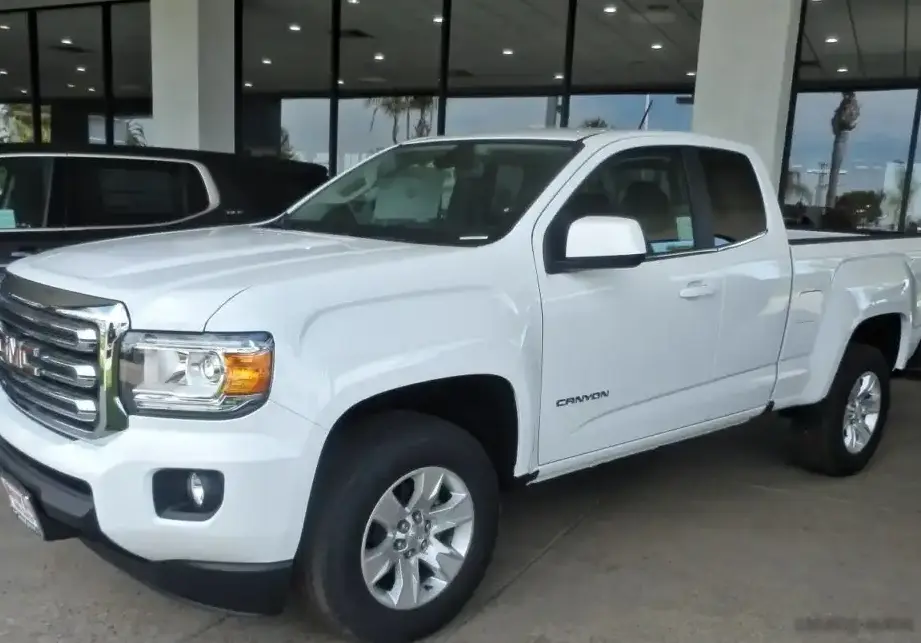
The GMC Canyon II, specifically the Extended Cab Long Box configuration with the 3.6-liter V6 engine producing 305 horsepower and paired with a four-wheel-drive system and automatic transmission, was a mid-size pickup truck sold primarily in North America from 2015 to 2016. It represented GMC’s entry into the increasingly popular mid-size truck segment, offering a blend of capability, comfort, and technology aimed at buyers needing a versatile vehicle for both work and personal use. This variant occupied a middle ground in the Canyon II lineup, positioned above the base four-cylinder models but below the available Duramax diesel option.
Technical Specifications
| Brand | GMC |
| Model | Canyon |
| Generation | Canyon II Extended Cab Long Box |
| Type (Engine) | 3.6 V6 (305 Hp) 4WD Automatic |
| Start of production | 2015 |
| End of production | 2016 |
| Powertrain Architecture | Internal Combustion engine |
| Body type | Pick-up |
| Seats | 4 |
| Doors | 2 |
| Fuel consumption (urban) | 13.8 l/100 km (17 US mpg, 20.5 UK mpg, 7.2 km/l) |
| Fuel consumption (extra urban) | 9.8 l/100 km (24 US mpg, 28.8 UK mpg, 10.2 km/l) |
| Fuel Type | Petrol (Gasoline) |
| Weight-to-power ratio | 6.4 kg/Hp, 157.1 Hp/tonne |
| Weight-to-torque ratio | 5.3 kg/Nm, 188 Nm/tonne |
| Power | 305 Hp @ 6800 rpm |
| Power per litre | 85.6 Hp/l |
| Torque | 365 Nm @ 4000 rpm (269.21 lb.-ft. @ 4000 rpm) |
| Engine layout | Front, Longitudinal |
| Engine Model/Code | LFX |
| Engine displacement | 3564 cm3 (217.49 cu. in.) |
| Number of cylinders | 6 |
| Engine configuration | V-engine |
| Cylinder Bore | 94 mm (3.7 in.) |
| Piston Stroke | 85.6 mm (3.37 in.) |
| Compression ratio | 11.5:1 |
| Number of valves per cylinder | 4 |
| Fuel injection system | Direct injection |
| Engine aspiration | Naturally aspirated engine |
| Valvetrain | DOHC, CVVT |
| Engine oil capacity | 5.7 l (6.02 US qt | 5.02 UK qt) |
| Coolant | 12.4 l (13.1 US qt | 10.91 UK qt) |
| Kerb Weight | 1941 kg (4279.17 lbs.) |
| Max. weight | 2676 kg (5899.57 lbs.) |
| Max load | 735 kg (1620.4 lbs.) |
| Trunk (boot) space – maximum | 1414 l (49.93 cu. ft.) |
| Fuel tank capacity | 79.5 l (21 US gal | 17.49 UK gal) |
| Permitted trailer load with brakes (12%) | 1588 kg (3500.94 lbs.) |
| Length | 5395 mm (212.4 in.) |
| Width | 1886 mm (74.25 in.) |
| Height | 1785 mm (70.28 in.) |
| Wheelbase | 3258 mm (128.27 in.) |
| Front track | 1586 mm (62.44 in.) |
| Rear (Back) track | 1586 mm (62.44 in.) |
| Ride height (ground clearance) | 214 mm (8.43 in.) |
| Minimum turning circle (turning diameter) | 12.6 m (41.34 ft.) |
| Approach angle | 17.6° |
| Departure angle | 22.3° |
| Ramp-over (brakeover) angle | 22° |
| Drivetrain Architecture | The Internal combustion engine (ICE) drives the rear wheels permanently, and the front wheels are driven through an electrically or mechanically operated clutch if necessary. |
| Drive wheel | All wheel drive (4×4) |
| Number of gears and type of gearbox | 6 gears, automatic transmission Hydra-Matic |
| Front suspension | Independent coil spring |
| Rear suspension | Rigid axle suspension, Leaf spring |
| Front brakes | Disc, 310×27 mm |
| Rear brakes | Disc, 324×18 mm |
| Assisting systems | ABS (Anti-lock braking system) |
| Steering type | Steering rack and pinion |
| Power steering | Electric Steering |
| Tires size | 265/70 R16; 255/65 R17; 265/60 R18 |
| Wheel rims size | 7J x 16; 8J x 17; 8.5J x 18 |
Powertrain & Engine Architecture
At the heart of this Canyon variant lies the GM LFX 3.6-liter V6 engine. This engine is a naturally aspirated, 60-degree V6 featuring direct fuel injection and a double overhead camshaft (DOHC) valvetrain with variable valve timing (CVVT). The LFX engine was a staple in GM’s lineup, known for its relatively smooth operation and adequate power delivery. The direct injection system contributes to improved fuel efficiency and reduced emissions. The engine produces 305 horsepower at 6800 rpm and 270 lb-ft of torque at 4000 rpm. The torque figure is crucial for towing and hauling capabilities. The engine’s longitudinal mounting allowed for a traditional rear-wheel-drive layout, with the four-wheel-drive system engaging the front axle as needed. The transmission is a six-speed Hydra-Matic automatic, providing smooth shifts and a wide gear ratio spread. This transmission was chosen for its balance of efficiency and drivability.
Driving Characteristics
The 3.6L V6 and automatic transmission combination in the Canyon II offered a comfortable and capable driving experience. While not a performance-oriented setup, it provided sufficient power for everyday driving and moderate towing. Acceleration from a standstill was adequate, but the automatic transmission sometimes felt hesitant during quick overtaking maneuvers. The six-speed automatic was tuned for fuel economy, resulting in taller gear ratios. Compared to the available Duramax diesel, the V6 offered quicker acceleration but lacked the diesel’s superior towing capacity and fuel efficiency. Compared to the base 2.5L four-cylinder, the V6 provided a significant boost in power and refinement. The four-wheel-drive system provided enhanced traction in inclement weather and on unpaved surfaces.
Equipment & Trim Levels
The Canyon II Extended Cab Long Box 3.6L 4WD Automatic was typically offered in SLE and SLT trim levels. The SLE trim included standard features such as air conditioning, power windows and locks, a basic infotainment system with a touchscreen display, and cloth upholstery. The SLT trim added features like leather upholstery, heated front seats, a more advanced infotainment system with navigation, and additional chrome exterior trim. Optional extras included a trailering package, a premium audio system, and various convenience features. The extended cab configuration provided limited rear seating, suitable for occasional passengers or cargo.
Chassis & Braking
The Canyon II utilized a body-on-frame construction, providing a robust and durable platform for hauling and towing. The front suspension consisted of independent coil springs, while the rear suspension employed a traditional leaf spring setup. This configuration prioritized load-carrying capacity and durability over outright handling precision. Braking duties were handled by disc brakes on all four wheels, with ABS (Anti-lock Braking System) as standard equipment. The braking system was adequate for the vehicle’s weight and performance, but lacked the stopping power of some competitors. The Canyon II’s relatively high ground clearance (8.43 inches) allowed for moderate off-road capability.
Market Reception & Comparison
The GMC Canyon II was generally well-received by critics as a competent and versatile mid-size pickup truck. The 3.6L V6 and automatic transmission combination was praised for its smooth operation and adequate power. However, some reviewers noted that the transmission could be hesitant at times and that the fuel economy was not class-leading. Compared to the Toyota Tacoma and Nissan Frontier, the Canyon II offered a more comfortable ride and a more refined interior, but lacked the established reputation for reliability of its Japanese competitors. The Duramax diesel option was often favored by buyers prioritizing towing and fuel efficiency.
Legacy
The GMC Canyon II, particularly the 3.6L V6 automatic variant, has proven to be a relatively reliable vehicle in the used car market. The LFX engine is known for its durability, and the Hydra-Matic transmission is generally dependable when properly maintained. Common issues include oil leaks and occasional sensor failures. The Canyon II remains a popular choice for buyers seeking a capable and affordable mid-size pickup truck. Its blend of comfort, capability, and technology continues to appeal to a wide range of buyers. The Canyon II helped to revitalize the mid-size truck segment and paved the way for the redesigned Canyon introduced in 2023.