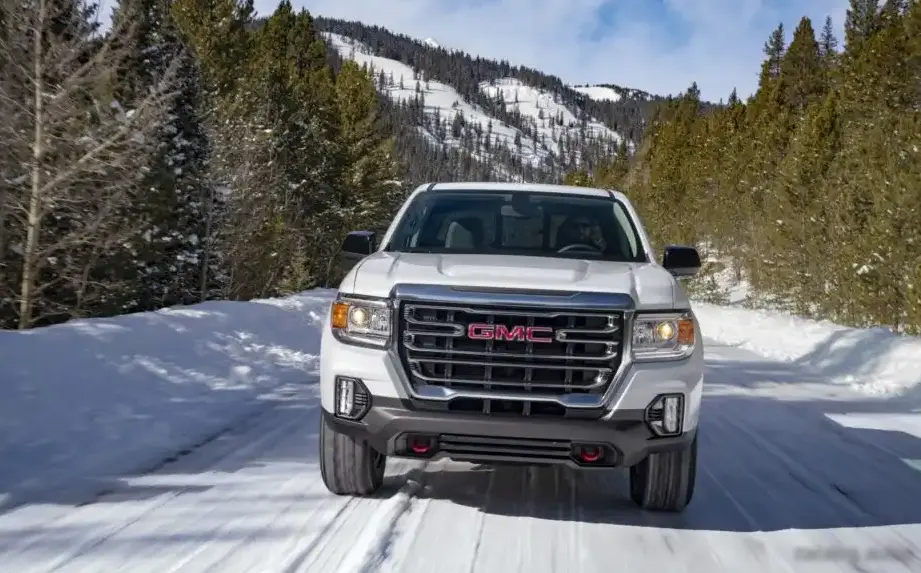
The GMC Canyon II, specifically the facelifted version introduced for the 2021 model year, represents GMC’s entry into the mid-size pickup truck segment in North America. This iteration of the Canyon, built on the GMT-315 platform (shared with the Chevrolet Colorado), received updated styling and technology. The 2.5-liter (149.94 cu. in.) four-cylinder engine paired with a six-speed Hydra-Matic automatic transmission was offered as the base engine option for the Crew Cab configuration during the 2021 and 2022 model years. This variant occupied the entry-level position in the Canyon lineup, targeting buyers prioritizing affordability and basic functionality over outright performance.
Technical Specifications
| Brand | GMC |
| Model | Canyon |
| Generation | Canyon II (facelift 2021) Crew cab |
| Type (Engine) | 2.5 (200 Hp) Automatic |
| Start of production | 2021 |
| End of production | 2022 |
| Powertrain Architecture | Internal Combustion engine |
| Body type | Pick-up |
| Seats | 5 |
| Doors | 4 |
| Fuel consumption (urban) | 12.4 l/100 km (19 US mpg) |
| Fuel consumption (extra urban) | 9.4 l/100 km (25 US mpg) |
| Fuel Type | Petrol (Gasoline) |
| Weight-to-power ratio | 9.1 kg/Hp |
| Weight-to-torque ratio | 7.1 kg/Nm |
| Power | 200 Hp @ 6300 rpm |
| Power per litre | 81.4 Hp/l |
| Torque | 259 Nm @ 4400 rpm (191.03 lb.-ft. @ 4400 rpm) |
| Engine layout | Front, Longitudinal |
| Engine Model/Code | LCV |
| Engine displacement | 2457 cm3 |
| Number of cylinders | 4 |
| Engine configuration | Inline |
| Cylinder Bore | 88 mm (3.46 in.) |
| Piston Stroke | 101 mm (3.98 in.) |
| Compression ratio | 11.3:1 |
| Number of valves per cylinder | 4 |
| Fuel injection system | Direct injection |
| Engine aspiration | Naturally aspirated engine |
| Valvetrain | DOHC, CVVT |
| Engine oil capacity | 4.7 l (4.97 US qt | 4.14 UK qt) |
| Coolant | 9.1 l (9.62 US qt | 8.01 UK qt) |
| Kerb Weight | 1826 kg (4025.64 lbs.) |
| Max. weight | 2494 kg (5498.33 lbs.) |
| Max load | 668 kg (1472.69 lbs.) |
| Fuel tank capacity | 79.5 l (21 US gal | 17.49 UK gal) |
| Permitted trailer load with brakes (12%) | 1588 kg (3500.94 lbs.) |
| Length | 5395 mm (212.4 in.) |
| Width | 1886 mm (74.25 in.) |
| Height | 1795 mm (70.67 in.) |
| Wheelbase | 3258 mm (128.27 in.) |
| Front track | 1586 mm (62.44 in.) |
| Rear (Back) track | 1586 mm (62.44 in.) |
| Ride height (ground clearance) | 211 mm (8.31 in.) |
| Drivetrain Architecture | Rear wheel drive |
| Drive wheel | Rear wheel drive |
| Number of gears and type of gearbox | 6 gears, automatic transmission Hydra-Matic |
| Front suspension | Independent coil spring |
| Rear suspension | Rigid axle suspension, Leaf spring |
| Front brakes | Disc, 310×27 mm |
| Rear brakes | Disc, 324×18 mm |
| Assisting systems | ABS (Anti-lock braking system) |
| Steering type | Steering rack and pinion |
| Power steering | Electric Steering |
| Tires size | 255/65 R17; 265/65 R17; 265/60 R18 |
| Wheel rims size | 8J x 17; 8.5J x 18 |
Introduction
The 2021-2022 GMC Canyon Crew Cab equipped with the 2.5-liter four-cylinder engine and six-speed automatic transmission represents a value-oriented offering within the Canyon II range. Following a mid-cycle refresh in 2021, the Canyon aimed to provide a more refined experience compared to its predecessor. This particular configuration was designed for buyers who needed the utility of a pickup truck but didn’t require the higher performance or premium features of the V6 or Duramax diesel options. It served as a practical choice for everyday commuting, light hauling, and occasional towing.
Powertrain & Engine Architecture
The heart of this Canyon variant is the LCV 2.5-liter inline-four cylinder engine. This engine utilizes direct fuel injection, a technology that improves fuel efficiency and power output by injecting fuel directly into the combustion chamber. The engine also features a Double Overhead Camshaft (DOHC) valvetrain with Continuously Variable Valve Timing (CVVT), further optimizing engine performance across the rev range. The six-speed Hydra-Matic automatic transmission is a conventional torque converter automatic, known for its smooth shifting characteristics. While not as technologically advanced as some newer transmissions, it provided reliable performance and adequate gear ratios for the engine’s power band. The engine is longitudinally mounted, sending power to the rear wheels as standard.
Driving Characteristics
The 200 horsepower and 191 lb-ft of torque produced by the 2.5-liter engine, when paired with the six-speed automatic, resulted in adequate, but not exhilarating, performance. Acceleration was modest, and passing maneuvers required careful planning. The automatic transmission was tuned for fuel economy, meaning it often upshifted quickly to maintain lower engine speeds. This resulted in a relaxed driving experience during highway cruising, but could sometimes feel sluggish when needing to accelerate quickly. Compared to the available 3.6-liter V6, the 2.5-liter engine offered significantly less power and towing capacity. However, it provided a more fuel-efficient alternative, particularly for urban driving.
Equipment & Trim Levels
The 2.5-liter Canyon typically came standard with a relatively basic set of features. Standard equipment generally included air conditioning, a basic infotainment system with a touchscreen display, Bluetooth connectivity, and a rearview camera. Interior upholstery was typically cloth. Higher trim levels, such as the SLE and AT4, offered upgrades like leather upholstery, heated seats, a premium audio system, and advanced safety features. Optional extras for the 2.5-liter model included a trailering package, upgraded wheels, and various convenience features.
Chassis & Braking
The Canyon II utilizes a body-on-frame construction, providing a robust and durable platform. The front suspension consists of independent coil springs, while the rear suspension employs a traditional leaf spring setup. This configuration is typical for mid-size pickup trucks and prioritizes load-carrying capacity and durability. Braking duties are handled by disc brakes on all four wheels, with ABS (Anti-lock Braking System) as standard. The rear brakes are slightly smaller in diameter than the front brakes. The steering system is a rack-and-pinion setup with electric power steering, providing responsive and precise handling.
Market Reception & Comparison
Critics generally viewed the 2.5-liter Canyon as a competent, but unremarkable, offering. Its primary strength was its affordability. Fuel economy was a highlight compared to the V6 and diesel options, making it an attractive choice for budget-conscious buyers. However, the engine’s lack of power was a common criticism, particularly when compared to competitors like the Toyota Tacoma and Ford Ranger. The 3.6-liter V6 Canyon offered a significant performance upgrade, but at a higher price point. The Duramax diesel provided even more torque and towing capacity, but also came with a substantial price premium.
Legacy
The 2.5-liter engine and six-speed automatic transmission combination in the GMC Canyon II represents a reliable, if not particularly exciting, powertrain. While not known for exceptional longevity or performance, these components generally proved durable with proper maintenance. In the used car market, these Canyon variants are often found at lower price points, making them an accessible entry point into the mid-size pickup truck segment. Their simplicity and relatively low maintenance costs contribute to their continued appeal among buyers seeking a practical and affordable truck.