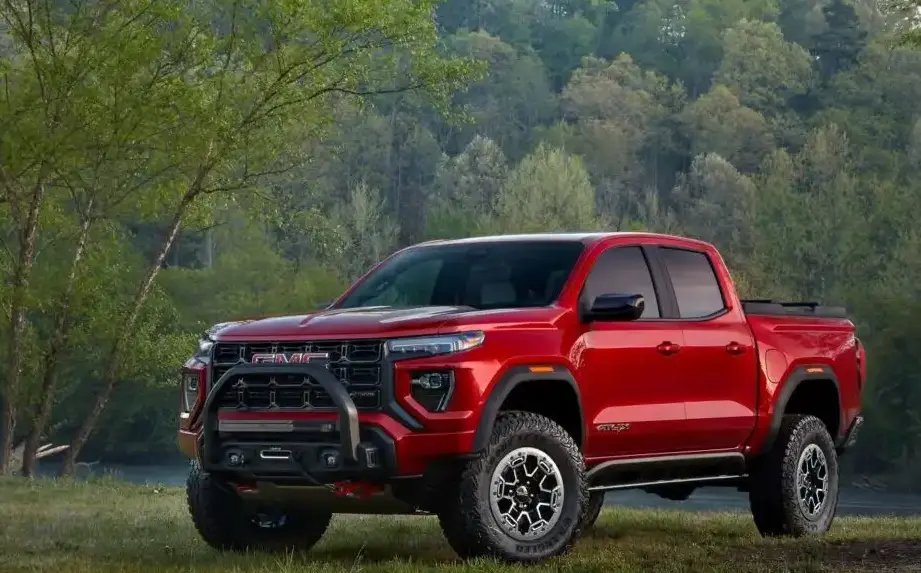
The GMC Canyon III Crew Cab, introduced in 2023, represents the third generation of GMC’s mid-size pickup truck. Built on the GM GT2 platform (shared with the Chevrolet Colorado), the Canyon underwent a complete redesign, shifting away from the previous generation’s more utilitarian focus towards a more premium and refined experience. The 2.7L Turbo variant, producing 313 horsepower and paired with the Hydra-Matic 8-speed automatic transmission, occupies the mid-range position within the Canyon III lineup, offering a balance of capability and comfort. It slots above the base 2.7L engine and below the more potent, high-output 2.7L turbo option, and the AT4X off-road focused trim.
Technical Specifications
| Brand | GMC |
| Model | Canyon |
| Generation | Canyon III Crew Cab |
| Type (Engine) | 2.7L Turbo (313 Hp) Hydra-Matic |
| Start of production | 2023 |
| Powertrain Architecture | Internal Combustion engine |
| Body type | Pick-up |
| Seats | 5 |
| Doors | 4 |
| Fuel Type | Petrol (Gasoline) |
| Weight-to-power ratio | 6.4 kg/Hp, 155.8 Hp/tonne |
| Weight-to-torque ratio | 3.4 kg/Nm, 290.2 Nm/tonne |
| Power | 313 Hp @ 5600 rpm |
| Torque | 583 Nm @ 3000 rpm, 430 lb.-ft. @ 3000 rpm |
| Engine Model/Code | L3B |
| Number of cylinders | 4 |
| Engine configuration | Inline |
| Cylinder Bore | 92.25 mm (3.63 in.) |
| Piston Stroke | 102 mm (4.02 in.) |
| Number of valves per cylinder | 4 |
| Fuel injection system | Direct injection |
| Engine aspiration | Turbocharger, Intercooler |
| Valvetrain | DOHC, CVVT |
| Engine oil capacity | 5.7 l (6.02 US qt | 5.02 UK qt) |
| Coolant | 11 l (11.62 US qt | 9.68 UK qt) |
| Kerb Weight | 2009 kg (4429.09 lbs.) |
| Max. weight | 2767 kg (6100.19 lbs.) |
| Max load | 758 kg (1671.1 lbs.) |
| Fuel tank capacity | 81 l (21.4 US gal | 17.82 UK gal) |
| Permitted trailer load with brakes (12%) | 3493 kg (7700.75 lbs.) |
| Length | 5416 mm (213.23 in.) |
| Width including mirrors | 2144 mm (84.41 in.) |
| Height | 2028 mm (79.84 in.) |
| Wheelbase | 3337 mm (131.38 in.) |
| Front track | 1680 mm (66.14 in.) |
| Rear (Back) track | 1679 mm (66.1 in.) |
| Ride height (ground clearance) | 245 mm (9.65 in.) |
| Approach angle | 33.3° |
| Departure angle | 22.3° |
| Ramp-over (brakeover) angle | 20.9° |
| Drivetrain Architecture | Rear wheel drive. Internal Combustion engine (ICE) |
| Drive wheel | Rear wheel drive |
| Number of gears and type of gearbox | 8 gears, automatic transmission Hydra-Matic |
| Front suspension | Independent coil spring |
| Rear suspension | Dependent suspension of two longitudinal semi-elliptic leaf springs, Rigid axle suspension |
| Front brakes | Disc, 340 mm |
| Rear brakes | Disc, 337 mm |
| Assisting systems | ABS (Anti-lock braking system) |
| Steering type | Steering rack and pinion |
| Power steering | Electric Steering |
| Tires size | 265/65 R18 |
| Wheel rims size | 8.5J x 18 |
Powertrain & Engine Architecture
The heart of this Canyon variant is the GM L3B 2.7-liter turbocharged inline-four cylinder engine. This engine is a member of GM’s Life series of engines, known for its focus on efficiency and refinement. The L3B utilizes direct injection, a single twin-scroll turbocharger, and continuously variable valve timing (CVVT) on both intake and exhaust valves. These features contribute to a broad torque curve and responsive power delivery. The Hydra-Matic 8L45-D eight-speed automatic transmission is specifically tuned to complement the engine’s characteristics. This transmission features electronically controlled shifts and a wide gear ratio spread, optimizing both acceleration and fuel economy. The transmission is known for its smooth operation and responsiveness, though some critics have noted a tendency to hunt for gears in certain situations.
Driving Characteristics
The 313-horsepower and 430 lb-ft of torque provided by the 2.7L turbo engine and Hydra-Matic transmission deliver a capable driving experience. While not as overtly powerful as the higher-output 2.7L turbo option, this configuration provides ample power for everyday driving and towing. The eight-speed transmission allows for relatively quick acceleration, and the turbocharger provides a noticeable boost in power when needed. The gear ratios are well-suited for both on-road cruising and moderate off-road conditions. Compared to the base 2.7L engine, the turbo variant offers significantly improved acceleration and towing capacity. However, it doesn’t quite match the raw power of the high-output turbo, which is geared towards more demanding tasks. The rear-wheel-drive configuration provides a traditional truck feel, while available four-wheel drive enhances traction in inclement weather or off-road scenarios.
Equipment & Trim Levels
The 2.7L Turbo engine was available across several Canyon trim levels, including the Elevation, AT4, and Denali. Standard equipment typically included an 8-inch touchscreen infotainment system with wireless Apple CarPlay and Android Auto compatibility, keyless entry, and a suite of safety features such as automatic emergency braking and lane keep assist. Higher trims, like the Denali, added premium features such as leather upholstery, a larger touchscreen display (11.3-inch), a premium sound system, and advanced driver-assistance systems. Optional extras included a bed liner, a trailering package, and various appearance packages.
Chassis & Braking
The Canyon III utilizes a body-on-frame construction, providing a robust and durable platform. The front suspension features independent coil springs, while the rear suspension employs a traditional leaf spring setup. This configuration balances ride comfort with load-carrying capacity. The 2.7L Turbo models are equipped with disc brakes on all four wheels, providing ample stopping power. ABS (Anti-lock Braking System) is standard. The steering system utilizes an electric power steering rack and pinion, offering precise and responsive steering feel. The Canyon’s chassis is designed to handle a variety of terrains and payloads, making it a versatile vehicle for both work and recreation.
Market Reception & Comparison
The 2023 GMC Canyon III, and specifically the 2.7L Turbo variant, received generally positive reviews from automotive critics. The redesigned interior and improved ride quality were frequently praised. The 2.7L Turbo engine was lauded for its balance of power and efficiency. Fuel economy figures typically ranged around 19 mpg city and 24 mpg highway, depending on driving conditions and whether the vehicle was equipped with two-wheel or four-wheel drive. Compared to the base 2.7L engine, the turbo variant offered a significant improvement in performance and towing capacity, making it a more appealing option for buyers who needed extra power. However, some critics noted that the price of the 2.7L Turbo models was higher than comparable offerings from competitors like the Toyota Tacoma and Ford Ranger.
Legacy
The GMC Canyon III, with its 2.7L Turbo engine, represents a significant step forward for the mid-size pickup truck segment. The L3B engine has proven to be a reliable and capable powerplant, and the Hydra-Matic transmission provides smooth and efficient shifting. As the Canyon III enters the used car market, the 2.7L Turbo variant is expected to hold its value well due to its combination of performance, features, and refinement. Early reports suggest good long-term reliability, though regular maintenance, including oil changes and transmission fluid checks, will be crucial to ensure the longevity of the powertrain. The Canyon III’s focus on a more premium experience has helped to elevate the mid-size truck segment, offering buyers a compelling alternative to traditional, more utilitarian options.