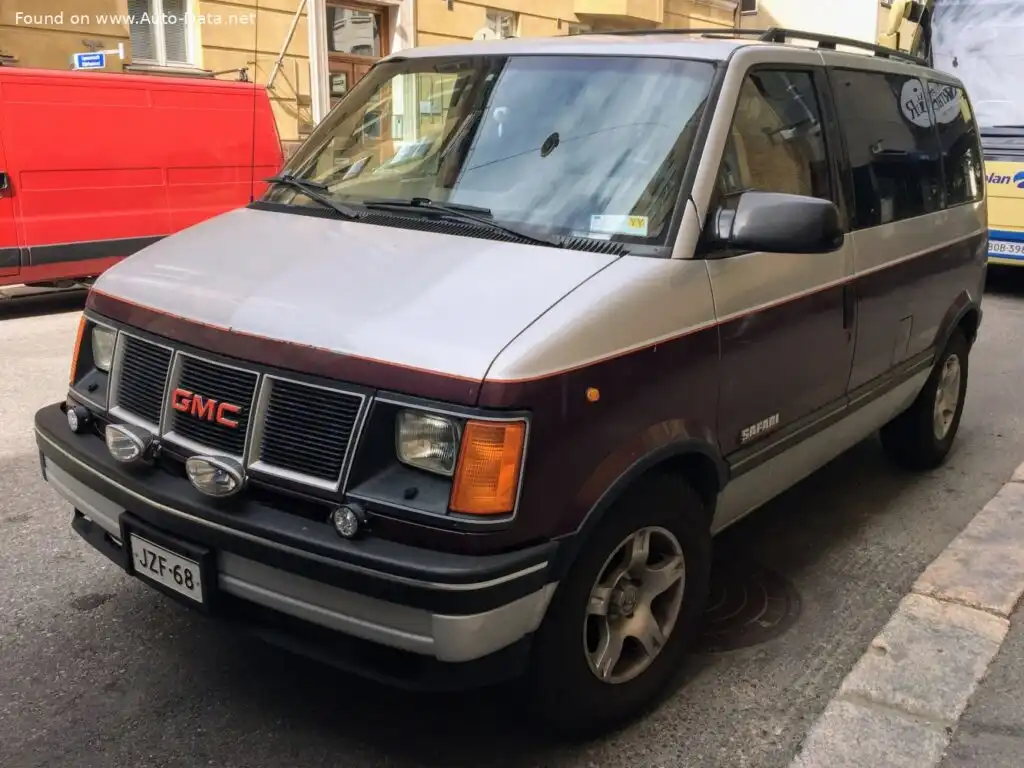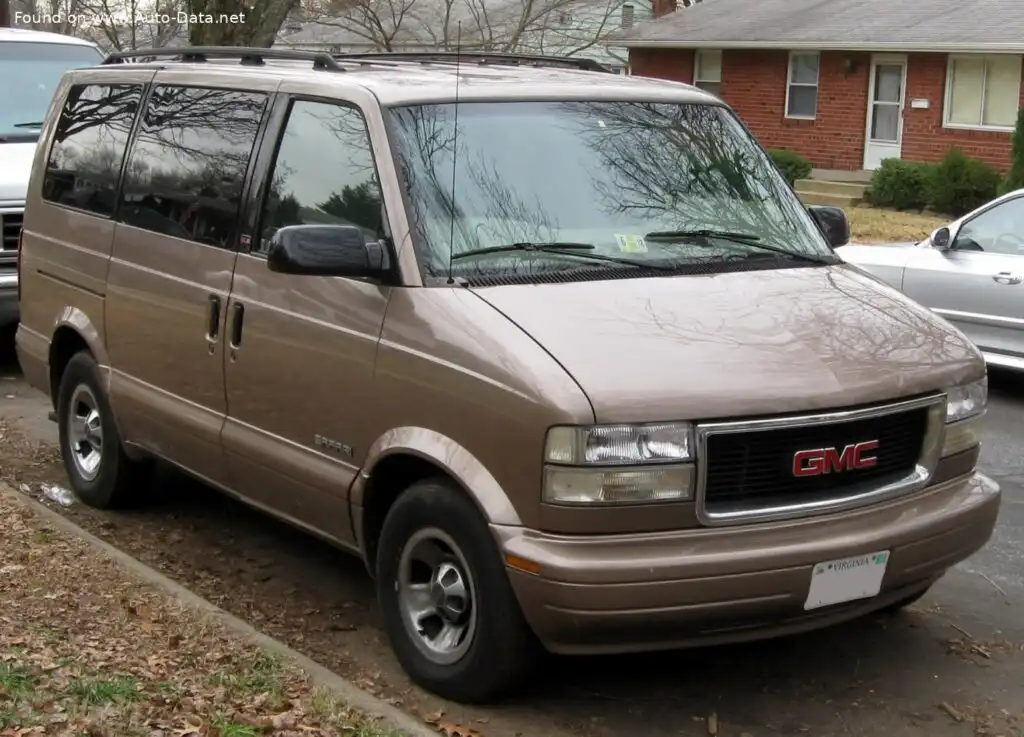
The GMC Safari II, specifically the 4.3i V6 variant with an automatic transmission, represents a significant iteration of GMC’s long-running minivan platform. Produced from 2001 to 2005, this version of the Safari occupied a middle ground in the lineup, offering a balance between affordability and capability. It was part of the second generation of the Safari (introduced in 1996), which shared a platform with the Chevrolet Astro and Oldsmobile Silhouette, though each brand maintained distinct styling and trim levels. The Safari II catered to families and those needing substantial cargo space, particularly in markets where full-size vans were considered too large or cumbersome for daily use.
Technical Specifications
| Brand | GMC |
| Model | Safari |
| Generation | Safari II |
| Type (Engine) | 4.3i V6 (190 Hp) Automatic |
| Start of production | 2001 |
| End of production | 2005 |
| Powertrain Architecture | Internal Combustion engine |
| Body type | Minivan |
| Seats | 8 |
| Doors | 3 |
| Fuel Type | Petrol (Gasoline) |
| Weight-to-power ratio | 10.3 kg/Hp, 96.9 Hp/tonne |
| Weight-to-torque ratio | 5.8 kg/Nm, 172.9 Nm/tonne |
| Power | 190 Hp @ 4400 rpm |
| Power per litre | 44.2 Hp/l |
| Torque | 339 Nm @ 2800 rpm, 250.03 lb.-ft. @ 2800 rpm |
| Maximum engine speed | 5600 rpm |
| Engine layout | Front, Longitudinal |
| Engine Model/Code | L35 Vortec 4300 |
| Engine displacement | 4300 cm3, 262.4 cu. in. |
| Number of cylinders | 6 |
| Engine configuration | V-engine |
| Cylinder Bore | 101.6 mm, 4 in. |
| Piston Stroke | 88.39 mm, 3.48 in. |
| Compression ratio | 9.2:1 |
| Fuel injection system | Multi-port manifold injection |
| Engine aspiration | Naturally aspirated engine |
| Engine oil capacity | 4.3 l, 4.54 US qt | 3.78 UK qt |
| Coolant | 12.8 l, 13.53 US qt | 11.26 UK qt |
| Kerb Weight | 1961 kg, 4323.26 lbs |
| Max. weight | 2699 kg, 5950.28 lbs |
| Max load | 738 kg, 1627.01 lbs |
| Trunk (boot) space – minimum | 1169 l, 41.28 cu. ft. |
| Trunk (boot) space – maximum | 4825 l, 170.39 cu. ft. |
| Fuel tank capacity | 102 l, 26.95 US gal | 22.44 UK gal |
| Length | 4821 mm, 189.8 in. |
| Width | 1968 mm, 77.48 in. |
| Height | 1903 mm, 74.92 in. |
| Wheelbase | 2824 mm, 111.18 in. |
| Front track | 1653 mm, 65.08 in. |
| Rear (Back) track | 1653 mm, 65.08 in. |
| Ride height (ground clearance) | 172 mm, 6.77 in. |
| Minimum turning circle (turning diameter) | 12.3 m, 40.35 ft. |
| Drivetrain Architecture | The Internal combustion engine (ICE) drives the rear wheels of the vehicle. |
| Drive wheel | Rear wheel drive |
| Number of gears and type of gearbox | 4 gears, automatic transmission |
| Front suspension | Independent coil spring |
| Rear suspension | Leaf spring |
| Front brakes | Disc |
| Rear brakes | Drum |
| Assisting systems | ABS (Anti-lock braking system) |
| Tires size | 215/75 R15 |
| Wheel rims size | 6.5J x 15 |
Powertrain & Engine Architecture
The heart of the Safari II 4.3i was the L35 Vortec 4300 V6 engine. This engine, a member of GM’s Vortec family, was a 90-degree V6 known for its robust construction and relatively simple design. It featured a cast iron block with aluminum cylinder heads, contributing to its durability. The engine utilized a multi-port fuel injection system, delivering fuel directly to each cylinder for improved efficiency and power delivery. The valvetrain employed two valves per cylinder, operated by a single overhead camshaft. The 4L60-E four-speed automatic transmission was the standard pairing for this engine. This transmission was a workhorse unit, known for its reliability, but not particularly for its performance or fuel efficiency compared to more modern automatics. The transmission’s gear ratios were geared towards providing adequate acceleration and towing capacity, rather than maximizing fuel economy.
Driving Characteristics
The 190 horsepower and 339 lb-ft of torque produced by the 4.3L V6 and 4L60-E automatic combination resulted in adequate, but not exhilarating, performance. Acceleration was sufficient for everyday driving and highway merging, but the Safari II wasn’t designed for sporty driving. The automatic transmission, while smooth, lacked the responsiveness of a manual gearbox. The 4L60-E’s shift points were programmed for comfort and fuel economy, sometimes resulting in the engine feeling slightly strained during uphill climbs or when fully loaded. Compared to the available 4.3L manual transmission option, the automatic sacrificed some responsiveness for ease of use. It also lagged behind the performance of the higher-end trims equipped with the 4.3L engine and a more aggressive tune.
Equipment & Trim Levels
The 4.3i Automatic Safari II typically came standard with features like air conditioning, power windows and locks, an AM/FM stereo, and cloth upholstery. Higher trim levels offered upgrades such as leather seating, a premium sound system, and alloy wheels. Optional extras included a rear entertainment system, power sliding doors, and upgraded interior trim packages. The Safari II aimed for a balance of practicality and comfort, offering a reasonably well-equipped interior without the luxury features found in some competing minivans.
Chassis & Braking
The Safari II utilized a body-on-frame construction, which contributed to its robust feel and towing capacity. The front suspension consisted of independent coil springs, providing a comfortable ride. The rear suspension employed leaf springs, a more traditional design that prioritized load-carrying capacity over handling precision. Braking duties were handled by disc brakes at the front and drum brakes at the rear. Anti-lock braking system (ABS) was standard, enhancing safety during emergency stops. The rear drum brakes were a cost-saving measure, and while adequate for normal use, they didn’t offer the same stopping power as rear discs.
Market Reception & Comparison
The GMC Safari II 4.3i Automatic was generally well-received as a practical and reliable minivan. Critics praised its spacious interior, comfortable ride, and strong V6 engine. However, it was often criticized for its dated styling, body-on-frame construction (which resulted in a higher ride height and less agile handling compared to unibody minivans), and relatively low fuel economy. Compared to the Chevrolet Astro, the Safari offered a slightly more upscale interior and exterior styling. Against competitors like the Dodge Caravan and Chrysler Town & Country, the Safari lagged in terms of modern features and fuel efficiency, but it often held an advantage in terms of durability and towing capacity.
Legacy
The GMC Safari II 4.3i Automatic, while not a groundbreaking vehicle, has proven to be a durable and reliable option in the used car market. The L35 Vortec 4300 engine is known for its longevity, and the 4L60-E transmission, while not without its potential issues, is relatively easy to repair. Today, these vans are often sought after by those needing a dependable and affordable vehicle for hauling cargo or families. Their body-on-frame construction makes them well-suited for light-duty work and towing, and their simple mechanical design makes them relatively easy to maintain. While fuel economy isn’t a strong point, the Safari II remains a viable option for those prioritizing practicality and reliability over modern amenities.