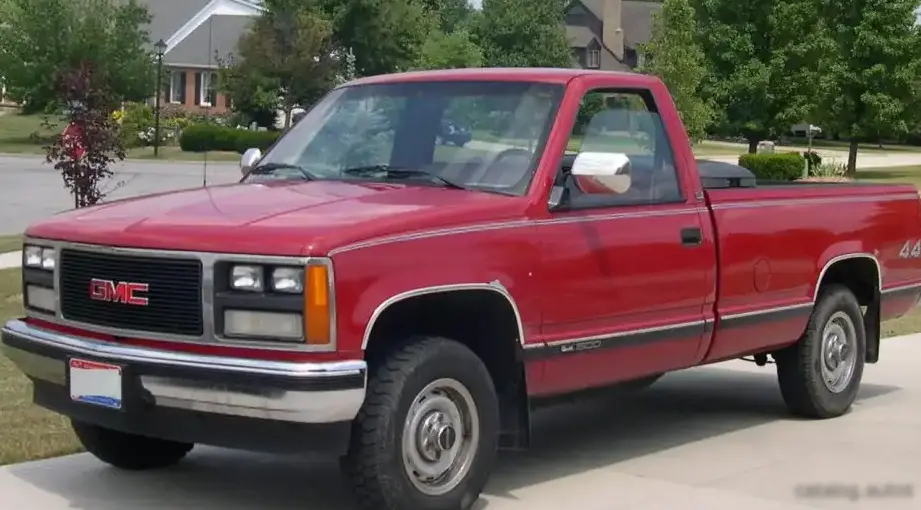
The GMC Sierra 1500, in its first generation (GMT400 platform) produced from 1988 to 1992, represented GMC’s entry into the increasingly popular full-size pickup truck market. This generation marked a significant departure from the previous square-bodied designs, adopting a more aerodynamic and modern aesthetic. Within the GMT400 lineup, the Regular Cab Long Wheelbase (LWB) Wideside configuration with the 4.3L V6 engine, producing 160 horsepower, served as a work-oriented, value-focused offering. It was positioned as the base model, appealing to buyers prioritizing functionality and affordability over outright performance or luxury.
Technical Specifications
| Brand | GMC |
| Model | Sierra 1500 |
| Generation | Sierra 1500 I (GMT400) Regular cab LWB Wideside |
| Type (Engine) | 4.3 V6 (160 Hp) |
| Start of production | 1988 |
| End of production | 1992 |
| Powertrain Architecture | Internal Combustion engine |
| Body type | Pick-up |
| Seats | 3 |
| Doors | 2 |
| Fuel Type | Petrol (Gasoline) |
| Power | 160 Hp @ 4000 rpm |
| Torque | 319 Nm @ 2400 rpm / 235.28 lb.-ft. @ 2400 rpm |
| Engine layout | Front, Longitudinal |
| Number of cylinders | 6 |
| Engine configuration | V-engine |
| Cylinder Bore | 101.6 mm / 4 in. |
| Piston Stroke | 88.39 mm / 3.48 in. |
| Compression ratio | 9.3:1 |
| Fuel injection system | Single-point injection |
| Engine aspiration | Naturally aspirated engine |
| Max. weight | 2767 kg / 6100.19 lbs. |
| Fuel tank capacity | 129 l / 34.08 US gal | 28.38 UK gal |
| Length | 5547 mm / 218.39 in. |
| Width | 1951 mm / 76.81 in. |
| Height | 1788 mm / 70.39 in. |
| Wheelbase | 3340 mm / 131.5 in. |
| Front overhang | 886 mm / 34.88 in. |
| Rear overhang | 1321 mm / 52.01 in. |
| Drivetrain Architecture | The Internal combustion engine (ICE) drives the rear wheels of the vehicle. |
| Drive wheel | Rear wheel drive |
| Number of gears and type of gearbox | 5 gears, manual transmission |
| Front suspension | Independent coil spring |
| Rear suspension | Rigid axle suspension, Leaf spring |
| Front brakes | Disc |
| Rear brakes | Drum |
| Tires size | 225/75 R15 |
Powertrain & Engine Architecture
The heart of this Sierra 1500 variant was the 4.3L (262 cubic inch) V6 engine. Designated as the LB4, this engine was a member of GMC’s small-block V6 family. It featured a 90-degree V-angle and utilized a cast iron block with aluminum cylinder heads. The engine employed a throttle body injection (TBI) fuel system, a relatively simple single-point injection method where fuel is injected into the intake manifold before the intake valves. This system, while less sophisticated than multi-port fuel injection, was cost-effective and reliable. The valvetrain consisted of two valves per cylinder, operated by a single camshaft. The 5-speed manual transmission was the standard offering, providing a relatively direct connection between the engine and the rear wheels. The transmission’s gear ratios were geared towards work applications, prioritizing torque multiplication over rapid acceleration.
Driving Characteristics
The 160 horsepower and 235 lb-ft of torque delivered by the 4.3L V6 and 5-speed manual transmission resulted in a utilitarian driving experience. Acceleration was modest, and the truck was not designed for spirited driving. However, the engine provided adequate power for typical pickup truck tasks such as hauling moderate loads and towing small trailers. The manual transmission allowed for a degree of driver control, but the gear ratios were spaced to maximize fuel economy and towing capacity rather than performance. Compared to the available 5.7L V8 engine, the 4.3L V6 offered significantly less power and acceleration, but it also provided better fuel economy and a lower initial purchase price. The ride quality, typical of body-on-frame trucks of this era, was firm, and the handling was best described as predictable rather than agile.
Equipment & Trim Levels
The base-level Sierra 1500 Regular Cab LWB Wideside with the 4.3L V6 was sparsely equipped, reflecting its position as the entry-level model. Standard features typically included a basic vinyl bench seat, a simple dashboard with analog gauges, and manual windows and locks. Air conditioning and an AM/FM radio were often optional extras. The interior trim was primarily utilitarian, with durable materials designed to withstand heavy use. Optional equipment could include a tilt steering wheel, upgraded sound systems, and various convenience packages. The “Wideside” designation referred to the width of the bed, offering a larger cargo area compared to the narrower “Narrowside” bed option.
Chassis & Braking
The GMT400 Sierra 1500 utilized a traditional body-on-frame construction. The front suspension consisted of independent coil springs, providing a reasonable level of ride comfort. The rear suspension employed a solid axle with leaf springs, a robust and durable design well-suited for hauling and towing. The braking system featured disc brakes on the front wheels and drum brakes on the rear. Power steering was standard, but power brakes were often an optional extra. The tires, typically 225/75R15, were chosen for durability and load-carrying capacity rather than high-performance handling.
Market Reception & Comparison
The 4.3L V6-powered Sierra 1500 was generally well-received by buyers seeking a basic, affordable, and reliable pickup truck. Critics acknowledged its practicality and fuel efficiency, but also noted its lack of power and refinement compared to V8-powered competitors. Compared to the Chevrolet C/K 1500, which shared the same platform and powertrain options, the Sierra 1500 offered a slightly more upscale interior and exterior trim. However, the overall value proposition remained similar. Fuel economy was a key selling point, with the 4.3L V6 offering a noticeable improvement over the larger V8 engines.
Legacy
The GMT400 Sierra 1500 with the 4.3L V6 engine has proven to be a relatively durable and reliable vehicle. The LB4 engine, while not particularly powerful, is known for its longevity and relatively simple maintenance requirements. Today, these trucks are often found in the used car market, appealing to buyers seeking an affordable and capable work truck. While not highly sought after by collectors, well-maintained examples are appreciated for their simplicity and ruggedness. The powertrain, while dated by modern standards, remains capable of providing years of service with proper maintenance. The 4.3L V6’s reputation for reliability has contributed to its continued presence on the road, making it a lasting example of American truck engineering from the late 1980s and early 1990s.