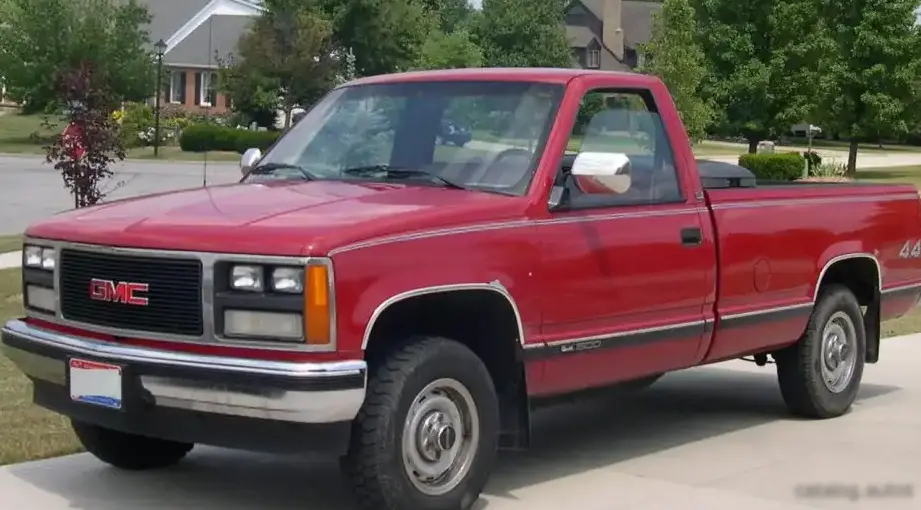
The GMC Sierra 1500, in its first generation (GMT400), was a full-size pickup truck produced from 1988 through 1992. This generation marked a significant redesign for GMC’s truck line, offering a more modern appearance and improved features compared to its predecessors. The Regular Cab Long Wheelbase (LWB) Wideside configuration, equipped with the 4.3-liter V6 engine and four-wheel drive, represented a work-oriented, value-focused offering within the Sierra 1500 range. It served as a popular choice for buyers needing a capable truck for both daily driving and light-duty hauling or towing.
Technical Specifications
| Brand | GMC |
| Model | Sierra 1500 |
| Generation | Sierra 1500 I (GMT400) Regular cab LWB Wideside |
| Type (Engine) | 4.3 V6 (160 Hp) 4WD |
| Start of production | 1988 |
| End of production | 1992 |
| Powertrain Architecture | Internal Combustion engine |
| Body type | Pick-up |
| Seats | 3 |
| Doors | 2 |
| Fuel Type | Petrol (Gasoline) |
| Power | 160 Hp @ 4000 rpm |
| Torque | 319 Nm @ 2400 rpm / 235.28 lb.-ft. @ 2400 rpm |
| Engine layout | Front, Longitudinal |
| Number of cylinders | 6 |
| Engine configuration | V-engine |
| Cylinder Bore | 101.6 mm / 4 in |
| Piston Stroke | 88.39 mm / 3.48 in |
| Compression ratio | 9.3:1 |
| Fuel injection system | Single-point injection |
| Engine aspiration | Naturally aspirated engine |
| Max. weight | 2767 kg / 6100.19 lbs |
| Fuel tank capacity | 129 l / 34.08 US gal | 28.38 UK gal |
| Length | 5547 mm / 218.39 in |
| Width | 1951 mm / 76.81 in |
| Height | 1788 mm / 70.39 in |
| Wheelbase | 3340 mm / 131.5 in |
| Front overhang | 886 mm / 34.88 in |
| Rear overhang | 1321 mm / 52.01 in |
| Drivetrain Architecture | The Internal combustion engine (ICE) drives the rear wheels permanently, and the front wheels are driven through an electrically or mechanically operated clutch if necessary. |
| Drive wheel | All wheel drive (4×4) |
| Number of gears and type of gearbox | 5 gears, manual transmission |
| Front suspension | Independent torsion bar, double wishbone |
| Rear suspension | Rigid axle suspension, Leaf spring |
| Front brakes | Disc |
| Rear brakes | Drum |
| Tires size | 225/75 R16 |
Powertrain & Engine Architecture
The heart of this Sierra 1500 variant was the 4.3-liter (262 cubic inch) V6 engine. Designated as the LB4, this engine was a member of GMC’s small-block V6 family. It featured a 90-degree V-angle and utilized a cast iron block with aluminum cylinder heads. The engine employed a throttle body injection (TBI) fuel system, a relatively simple form of fuel injection where fuel is injected into the intake manifold rather than directly into the cylinders. This system, while less efficient than multi-port fuel injection, was cost-effective and reliable. The engine’s valvetrain consisted of two valves per cylinder, operated by a single camshaft. The 5-speed manual transmission was the standard offering, providing a balance between fuel economy and usability. The 4WD system was typically a part-time system, engaging the front axle when needed for increased traction in off-road or slippery conditions.
Driving Characteristics
The 160 horsepower and 235 lb-ft of torque produced by the 4.3L V6, coupled with the 5-speed manual transmission, provided adequate, but not exhilarating, performance. Acceleration was modest, and the truck wasn’t designed for quick sprints. However, the engine delivered a usable amount of low-end torque, making it suitable for hauling moderate loads and navigating varied terrain. The manual transmission allowed for greater driver control and potentially better fuel economy compared to an automatic. The part-time 4WD system enhanced traction in challenging conditions, but the truck’s relatively high weight and long wheelbase limited its off-road agility compared to smaller, more specialized off-road vehicles. The ride quality, typical of body-on-frame trucks of this era, was firm but generally comfortable for everyday use.
Equipment & Trim Levels
The Regular Cab LWB Wideside 4.3L 4WD Sierra 1500 typically represented the base level of the Sierra 1500 lineup. Standard equipment generally included a basic vinyl interior, a simple instrument cluster, and manual windows and locks. Air conditioning and an AM/FM radio were often optional extras. The “Wideside” designation referred to the width of the truck bed, offering a larger cargo area compared to the narrower “Fleetside” bed option. Optional equipment could include power windows and locks, upgraded audio systems, and various towing packages. The interior was functional and durable, prioritizing practicality over luxury.
Chassis & Braking
The GMT400 Sierra 1500 utilized a traditional body-on-frame construction. The front suspension featured an independent torsion bar setup with double wishbone components, providing a reasonable level of ride comfort and handling. The rear suspension employed a solid axle with leaf springs, a robust and cost-effective design well-suited for hauling and towing. Braking duties were handled by disc brakes at the front and drum brakes at the rear. The braking system was adequate for the truck’s weight and intended use, but lacked the sophistication of more modern braking systems. Steering was typically a recirculating ball system, providing a somewhat indirect steering feel.
Market Reception & Comparison
The 1988-1992 GMC Sierra 1500 with the 4.3L V6 and manual transmission was generally well-received as a capable and affordable work truck. Critics noted its improved styling and features compared to previous generations. However, the 4.3L V6 was often considered underpowered compared to the available V8 engines. The 5.0L and 5.7L V8s offered significantly more horsepower and torque, making them more suitable for demanding tasks. Fuel economy with the 4.3L V6 was reasonable for a full-size truck, but not exceptional. Reliability was generally good, although the TBI fuel injection system could require occasional maintenance. Compared to the Ford F-150 and Chevrolet C/K series trucks of the same era, the Sierra 1500 offered a similar level of capability and value.
Legacy
The GMT400 Sierra 1500, particularly the 4.3L V6-equipped models, have become increasingly popular among classic truck enthusiasts. The 4.3L V6 engine, while not a powerhouse, is known for its durability and relative simplicity. Parts availability remains reasonably good, making these trucks relatively easy to maintain and repair. Today, these trucks are often sought after for restoration projects, light-duty hauling, or as affordable and reliable daily drivers. While not the most powerful or luxurious truck of its era, the 1988-1992 GMC Sierra 1500 4.3L 4WD represents a solid and dependable piece of American automotive history.