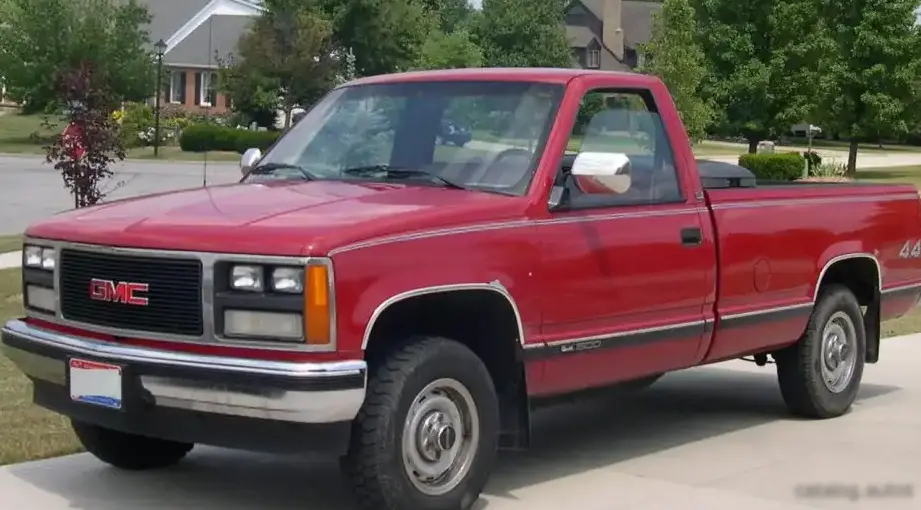
The GMC Sierra 1500, in its first generation (GMT400), marked GMC’s entry into the competitive full-size pickup truck market. Produced from 1988 through 1991, the GMT400 series was a substantial redesign for GMC, presenting a more contemporary and aerodynamic profile compared to its boxier predecessors. The Regular Cab Long Wheelbase Wideside configuration equipped with the 6.2-liter diesel V8 engine, delivering 135 horsepower, was available from 1989 to 1990. This particular variant occupied a distinct position within the Sierra 1500 lineup, catering to buyers who prioritized fuel efficiency and longevity over sheer performance, especially for tasks like towing and hauling. It was positioned as a work-focused truck, appealing to farmers, ranchers, and individuals requiring a robust vehicle for demanding applications.
Technical Specifications
| Brand | GMC |
| Model | Sierra 1500 |
| Generation | Sierra 1500 I (GMT400) Regular cab LWB Wideside |
| Type (Engine) | 6.2 diesel V8 (135 Hp) |
| Start of production | 1989 |
| End of production | 1990 |
| Powertrain Architecture | Internal Combustion engine |
| Body type | Pick-up |
| Seats | 3 |
| Doors | 2 |
| Fuel Type | Diesel |
| Power | 135 Hp @ 3600 rpm |
| Torque | 325 Nm @ 1900 rpm / 239.71 lb.-ft. @ 1900 rpm |
| Engine layout | Front, Longitudinal |
| Number of cylinders | 8 |
| Engine configuration | V-engine |
| Cylinder Bore | 101.09 mm / 3.98 in. |
| Piston Stroke | 97.03 mm / 3.82 in. |
| Compression ratio | 21.3:1 |
| Fuel injection system | Precombustion chamber injection |
| Engine aspiration | Naturally aspirated engine |
| Engine oil capacity | 6.6 l / 6.97 US qt | 5.81 UK qt |
| Coolant | 23.5 l / 24.83 US qt | 20.68 UK qt |
| Fuel tank capacity | 129 l / 34.08 US gal | 28.38 UK gal |
| Length | 5547 mm / 218.39 in. |
| Width | 1951 mm / 76.81 in. |
| Height | 1788 mm / 70.39 in. |
| Wheelbase | 3340 mm / 131.5 in. |
| Front overhang | 886 mm / 34.88 in. |
| Rear overhang | 1321 mm / 52.01 in. |
| Drivetrain Architecture | The Internal combustion engine (ICE) drives the rear wheels of the vehicle. |
| Drive wheel | Rear wheel drive |
| Number of gears and type of gearbox | 4 gears, manual transmission |
| Front suspension | Independent coil spring |
| Rear suspension | Rigid axle suspension, Leaf spring |
| Front brakes | Disc |
| Rear brakes | Drum |
| Tires size | 225/75 R15 |
Powertrain & Engine Architecture
The core of this Sierra 1500 variant was the 6.2-liter (379 cubic inch) Detroit Diesel 6.2L V8 engine. Manufactured by Detroit Diesel (a General Motors division), this engine was a naturally aspirated, overhead valve diesel celebrated for its durability and relatively straightforward design. It employed a precombustion chamber injection system, a prevalent diesel technology of the time, where fuel was injected into a small pre-chamber to initiate combustion before entering the main cylinder. This system aided in cold-weather starting and reduced engine noise. The engine generated 135 horsepower at 3600 rpm and 325 Nm (239.71 lb-ft) of torque at 1900 rpm. The engine was mounted longitudinally within the chassis. The 6.2L diesel was typically paired with a 4-speed manual transmission, the standard offering for this configuration. While an automatic transmission was available on other Sierra 1500 trims, it wasn’t commonly offered with the 6.2L diesel due to the engine’s torque characteristics and the transmission’s limitations.
Driving Characteristics
The 6.2-liter diesel-powered Sierra 1500 wasn’t engineered for quick acceleration. Its strength resided in its capacity to deliver consistent torque at lower engine speeds, making it exceptionally well-suited for towing and hauling substantial loads. The 4-speed manual transmission demanded deliberate shifting, and the engine’s modest horsepower meant that highway passing maneuvers required careful consideration. In comparison to the gasoline-powered V6 and V8 engines available in the Sierra 1500 range, the diesel offered significantly improved fuel economy, albeit at the cost of performance. The manual transmission provided a more direct connection to the engine, enabling the driver to maximize the available power and maintain effective control in challenging situations. The gear ratios were optimized for work, prioritizing pulling power over high-speed capability.
Equipment & Trim Levels
The 6.2-liter diesel Sierra 1500 generally came with a fairly spartan level of standard equipment, reflecting its work-truck focus. Standard features included a vinyl bench seat, basic instrumentation, and a simple AM radio. Options were limited but could encompass a more comfortable cloth bench seat, upgraded audio systems, and power steering. The interior was functional and durable, designed to withstand the demands of daily use. The exterior featured minimal chrome trim and was typically available in a limited palette of solid colors. The “Wideside” designation indicated the truck’s bed width, providing a larger cargo area compared to the narrower “Fleetside” bed option.
Chassis & Braking
The GMT400 Sierra 1500 utilized a body-on-frame construction, providing a robust and durable platform. The front suspension consisted of independent coil springs, offering a reasonable ride quality for a truck of its size. The rear suspension employed a traditional leaf spring setup, designed to handle heavy payloads. The front brakes were disc brakes, providing adequate stopping power, while the rear brakes were drum brakes, a cost-saving measure common in trucks of this era. Steering was typically manual, although power steering was available as an option. The chassis was engineered to prioritize load-carrying capacity and durability over sporty handling characteristics.
Market Reception & Comparison
The 6.2-liter diesel Sierra 1500 received a mixed reception from reviewers. Critics lauded its fuel efficiency and durability, but noted its power deficit compared to gasoline-powered alternatives. It was often viewed as a pragmatic choice for those needing a dependable work truck and prioritizing fuel economy. Compared to the 5.7-liter V8 gasoline engine, the diesel delivered significantly better fuel economy but considerably less horsepower. The diesel also carried a higher initial purchase price, but its lower operating costs could potentially offset this over the vehicle’s lifespan. The manual transmission was also a point of contention for some buyers, who preferred the convenience of an automatic.
Legacy
The 6.2-liter Detroit Diesel V8 engine earned a reputation for exceptional longevity and reliability. Numerous examples of these engines continue to operate today, often accumulating hundreds of thousands of miles. While parts availability can present a challenge, the engine’s simple design and robust construction make it relatively straightforward to maintain and repair. In the used car market, the 6.2-liter diesel Sierra 1500 is sought after by enthusiasts and those seeking a durable and fuel-efficient work truck. The GMT400 generation Sierra 1500, particularly the diesel variants, represents a significant chapter in GMC’s truck history, demonstrating the brand’s commitment to building tough and dependable vehicles.