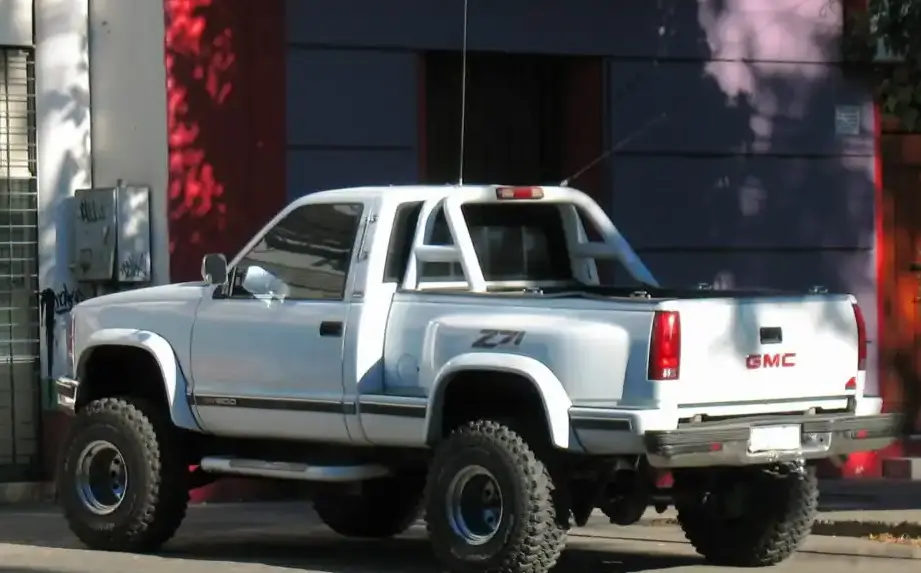
The GMC Sierra 1500, in its first generation (GMT400), represented GMC’s entry into the increasingly popular full-size pickup truck market. Produced from 1988 through 1992, this iteration of the Sierra aimed to provide a robust and capable work vehicle, while also offering a degree of comfort and style. The Regular Cab SWB (Short Wheelbase) Sportside configuration, equipped with the 4.3-liter V6 engine producing 160 horsepower and paired with a four-wheel-drive system, occupied a significant position in the lineup as a balance between affordability and capability. It served as a workhorse for many, offering a practical solution for both personal and commercial use.
Technical Specifications
| Brand | GMC |
| Model | Sierra 1500 |
| Generation | Sierra 1500 I (GMT400) Regular cab SWB Sportside |
| Type (Engine) | 4.3 V6 (160 Hp) 4WD |
| Start of production | 1988 |
| End of production | 1992 |
| Powertrain Architecture | Internal Combustion engine |
| Body type | Pick-up |
| Seats | 3 |
| Doors | 2 |
| Fuel Type | Petrol (Gasoline) |
| Power | 160 Hp @ 4000 rpm |
| Torque | 319 Nm @ 2400 rpm / 235.28 lb.-ft. @ 2400 rpm |
| Engine layout | Front, Longitudinal |
| Number of cylinders | 6 |
| Engine configuration | V-engine |
| Cylinder Bore | 101.6 mm / 4 in. |
| Piston Stroke | 88.39 mm / 3.48 in. |
| Compression ratio | 9.3:1 |
| Fuel injection system | Single-point injection |
| Engine aspiration | Naturally aspirated engine |
| Max. weight | 2540 kg / 5599.74 lbs. |
| Fuel tank capacity | 95 l / 25.1 US gal | 20.9 UK gal |
| Length | 5065 mm / 199.41 in. |
| Width | 1958 mm / 77.09 in. |
| Height | 1788 mm / 70.39 in. |
| Wheelbase | 2985 mm / 117.52 in. |
| Front overhang | 886 mm / 34.88 in. |
| Rear overhang | 1194 mm / 47.01 in. |
| Drivetrain Architecture | The Internal combustion engine (ICE) drives the rear wheels permanently, and the front wheels are driven through an electrically or mechanically operated clutch if necessary. |
| Drive wheel | All wheel drive (4×4) |
| Number of gears and type of gearbox | 5 gears, manual transmission |
| Front suspension | Independent torsion bar, double wishbone |
| Rear suspension | Rigid axle suspension, Leaf spring |
| Front brakes | Disc |
| Rear brakes | Drum |
| Tires size | 225/75 R16 |
Introduction
The GMT400 platform, introduced in 1988, marked a significant redesign for GMC’s full-size pickup line. The Sierra 1500, alongside its Chevrolet C/K counterpart, aimed to modernize the pickup experience with improved comfort, handling, and styling. The Regular Cab SWB Sportside configuration, featuring a shorter wheelbase and a stepside bed, was a popular choice for buyers prioritizing maneuverability and a more traditional pickup truck aesthetic. The 4.3L V6 4WD variant was positioned as an entry-level to mid-range offering, appealing to customers who needed four-wheel drive capability but didn’t require the power or expense of the larger V8 engines.
Powertrain & Engine Architecture
The heart of this Sierra 1500 was the 4.3-liter (262 cubic inch) V6 engine. Designated with various codes depending on the year (likely L03 in this generation), this engine was a relatively simple, pushrod design featuring a cast iron block and cylinder heads. It utilized a single-point fuel injection system, where fuel injectors were located in the throttle body, delivering fuel to all cylinders. This system, while less sophisticated than multi-port fuel injection, was reliable and cost-effective. The engine produced 160 horsepower at 4000 rpm and 235 lb-ft of torque at 2400 rpm. The five-speed manual transmission was the standard offering, providing a direct connection to the engine and allowing for driver control. The 4WD system employed a transfer case allowing the driver to switch between 2WD, 4HI, and 4LO modes, providing enhanced traction in various off-road or inclement weather conditions.
Driving Characteristics
The 4.3L V6 and five-speed manual combination in the Sierra 1500 offered a practical, if not exhilarating, driving experience. Acceleration was adequate for everyday driving, but the truck wasn’t designed for rapid speeds. The manual transmission allowed drivers to maximize the engine’s torque, particularly useful when towing or hauling loads. The short wheelbase contributed to a more nimble feel compared to the extended cab or long bed models. Compared to the available 5.7L V8, the 4.3L offered significantly less power, resulting in slower acceleration and reduced towing capacity. However, the V6 was more fuel-efficient and generally required less maintenance. The 4WD system provided confident traction on slippery surfaces, making it a capable work truck in a variety of conditions.
Equipment & Trim Levels
The Sierra 1500 SWB Sportside with the 4.3L V6 typically came standard with basic features such as a vinyl bench seat, AM/FM radio, and manual windows and locks. The “Sportside” designation indicated the presence of the stepside bed, offering a more classic pickup truck look. Optional extras included air conditioning, a tilt steering wheel, upgraded sound systems, and various trim packages. Higher trim levels, such as the SLE, added features like cloth upholstery, carpeting, and more exterior chrome. The interior was functional and durable, designed to withstand the rigors of daily use.
Chassis & Braking
The GMT400 chassis featured an independent torsion bar suspension in the front, providing a relatively comfortable ride for a pickup truck. The rear suspension utilized a traditional leaf spring setup, which was robust and capable of handling heavy loads. Front disc brakes provided adequate stopping power, while rear drum brakes were standard. The 225/75R16 tires offered a good balance of on-road comfort and off-road traction. The frame was a fully boxed design, contributing to the truck’s overall strength and durability. Stabilizer bars were typically not standard on the base models, but could be added as an option.
Market Reception & Comparison
The 4.3L V6-equipped Sierra 1500 was generally well-received as a practical and affordable work truck. Critics noted its adequate power for most tasks, its comfortable ride, and its relatively fuel-efficient engine. However, it was often overshadowed by the more powerful V8 options. Compared to the 5.7L V8, the 4.3L offered significantly lower performance, but also a lower purchase price and potentially lower operating costs. The 4.3L was also seen as a more reliable option than some of the early fuel-injected V8s. Fuel economy was a strong point for the V6, making it an attractive option for buyers who prioritized efficiency.
Legacy
The GMT400 Sierra 1500, particularly the 4.3L V6 4WD variant, has developed a reputation as a durable and reliable truck. The 4.3L V6 engine, while not a powerhouse, proved to be a long-lasting and relatively trouble-free powerplant. Today, these trucks are often found in the used car market, offering an affordable and capable option for those seeking a classic American pickup. Parts availability is generally good, and the relatively simple mechanical design makes them relatively easy to maintain. While not a collector’s item, well-maintained examples are appreciated by enthusiasts and continue to serve as reliable work vehicles.