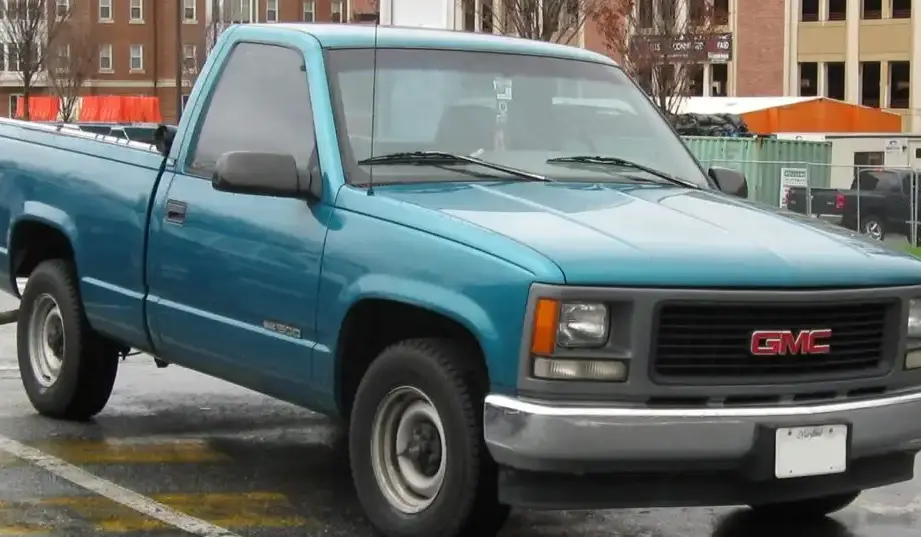
The GMC Sierra 1500, in its first generation (GMT400), marked GMC’s entry into the competitive full-size pickup truck market. Produced from 1988 through 1992, this Sierra iteration aimed to deliver a robust and capable work truck alongside a degree of comfort and refinement often absent in its class. The Regular Cab Short Bed Wideside configuration, coupled with the 5.7-liter V8 engine and automatic transmission, was a common sight on American roads and job sites during this period. This specific combination occupied a middle ground in the Sierra 1500 lineup, balancing affordability, capability, and ease of use. It represented a step up from base models with smaller engines, yet remained more accessible than heavier-duty or four-wheel-drive options.
Technical Specifications
| Brand | GMC |
| Model | Sierra 1500 |
| Generation | Sierra 1500 I (GMT400) Regular cab SWB Wideside |
| Type (Engine) | 5.7 V8 (210 Hp) Automatic |
| Start of production | 1988 |
| End of production | 1992 |
| Powertrain Architecture | Internal Combustion engine |
| Body type | Pick-up |
| Seats | 3 |
| Doors | 2 |
| Fuel Type | Petrol (Gasoline) |
| Power | 210 Hp @ 4000 rpm |
| Torque | 407 Nm @ 2800 rpm / 300.19 lb.-ft. @ 2800 rpm |
| Engine layout | Front, Longitudinal |
| Number of cylinders | 8 |
| Engine configuration | V-engine |
| Cylinder Bore | 101.6 mm / 4 in. |
| Piston Stroke | 88.39 mm / 3.48 in. |
| Compression ratio | 9.3:1 |
| Fuel injection system | Multi-port manifold injection |
| Engine aspiration | Naturally aspirated engine |
| Max. weight | 2540 kg / 5599.74 lbs. |
| Fuel tank capacity | 95 l / 25.1 US gal | 20.9 UK gal |
| Length | 5065 mm / 199.41 in. |
| Width | 1951 mm / 76.81 in. |
| Height | 1788 mm / 70.39 in. |
| Wheelbase | 2985 mm / 117.52 in. |
| Front overhang | 886 mm / 34.88 in. |
| Rear overhang | 1194 mm / 47.01 in. |
| Drivetrain Architecture | The Internal combustion engine (ICE) drives the rear wheels of the vehicle. |
| Drive wheel | Rear wheel drive |
| Number of gears and type of gearbox | 4 gears, automatic transmission |
| Front suspension | Independent coil spring |
| Rear suspension | Rigid axle suspension, Leaf spring |
| Front brakes | Disc |
| Rear brakes | Drum |
| Tires size | 225/75 R15 |
Powertrain & Engine Architecture
The core of this Sierra 1500 variant was the 5.7-liter (350 cubic inch) small-block Chevrolet V8 engine. This engine, designated L05 in GMC applications, was a mainstay of General Motors’ truck and SUV lineup for decades. It featured a cast iron block and cylinder heads, a 9.3:1 compression ratio, and a multi-port fuel injection system. The multi-port injection, a relatively modern feature for the time, enhanced fuel efficiency and throttle response compared to earlier carbureted designs. The engine generated 210 horsepower at 4000 rpm and 300 lb-ft of torque at 2800 rpm. The torque output was particularly crucial for a pickup truck, providing substantial pulling power for towing and hauling. The engine was mounted longitudinally in the chassis, powering the rear wheels. The automatic transmission was a 4-speed TH700R4, renowned for its durability and relatively smooth shifting. This transmission was a significant improvement over older 3-speed automatics, offering a wider gear ratio spread for improved fuel economy and performance.
Driving Characteristics
The 5.7L V8 and 4-speed automatic combination delivered a respectable, though not exhilarating, driving experience. Acceleration was adequate for everyday driving, but the truck wasn’t engineered for rapid acceleration. The automatic transmission’s gear ratios were optimized for towing and hauling, resulting in a comfortable cruising experience at highway speeds. The TH700R4 transmission, while reliable, wasn’t known for aggressive shift points, fostering a more relaxed driving style. Compared to the available 5-speed manual transmission, the automatic offered greater convenience, particularly in stop-and-go traffic. However, the manual transmission generally provided slightly better fuel economy and a more direct connection to the engine. The 5.7L engine, while powerful, wasn’t as fuel-efficient as the smaller 4.3L V6 option, but it offered a significant performance advantage, especially when carrying a load or towing a trailer.
Equipment & Trim Levels
The Sierra 1500 equipped with the 5.7L V8 and automatic transmission typically included standard features such as air conditioning, a basic AM/FM radio, and cloth upholstery. The “Wideside” designation indicated a wider bed, increasing cargo capacity. Optional extras encompassed power windows and locks, a tilt steering wheel, cruise control, and upgraded sound systems. Interior trim levels varied, with higher trims offering more comfortable seating and additional convenience features. The base interior was fairly utilitarian, prioritizing durability and functionality. The exterior generally featured minimal chrome trim, reflecting the truck’s work-oriented purpose.
Chassis & Braking
The GMT400 Sierra 1500 employed a body-on-frame construction, providing a robust and durable platform. The front suspension utilized independent coil springs, delivering a relatively comfortable ride. The rear suspension incorporated a traditional leaf spring setup, designed to manage heavy loads. The front brakes were disc brakes, providing adequate stopping power, while the rear brakes were drum brakes, a cost-saving measure common during that era. The steering system was a recirculating ball type, offering a solid feel but lacking the precision of more contemporary steering technologies. The tires were typically 225/75R15, striking a balance between ride comfort and durability.
Market Reception & Comparison
The GMC Sierra 1500, particularly the 5.7L V8 automatic variant, received generally positive reviews from critics and consumers. It was lauded for its robust construction, comfortable ride, and ample power. However, some reviewers noted that the truck’s styling was somewhat conservative compared to its competitors. Compared to the Chevrolet C/K 1500 (which shared the same platform), the Sierra offered a slightly more upscale interior and a more refined driving experience. The 5.7L V8 automatic provided a good compromise between performance and fuel economy, though it wasn’t as fuel-efficient as the smaller engine options. Reliability was generally good, although some owners reported issues with the automatic transmission over the long term.
Legacy
The GMT400 Sierra 1500 established a foundation for GMC’s continued success in the full-size pickup truck market. The 5.7L V8 engine proved to be a durable and reliable powerplant, and numerous examples remain operational today. While not as highly sought-after as some of the rarer or higher-performance variants, the 5.7L automatic Sierra 1500 remains a popular choice for those seeking a classic American pickup truck. In the used car market, these trucks are typically affordable and relatively easy to maintain, making them a good value for those needing a capable and dependable work truck or a piece of automotive history. Parts availability is generally good, thanks to the engine’s widespread use in other GM vehicles.