
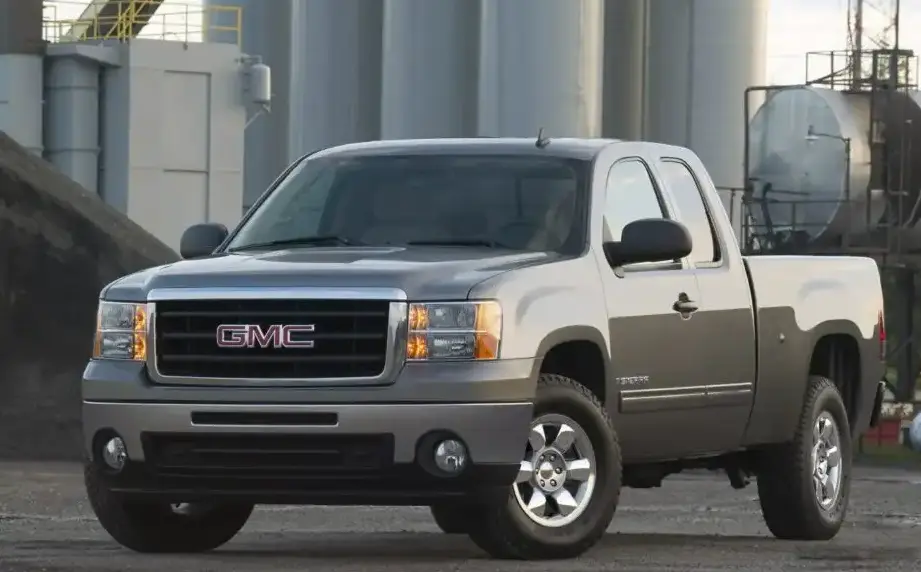
The GMC Sierra 1500 III, produced from 2007 to 2013, represented a significant evolution in GMC’s full-size pickup truck offerings. This generation, known internally as GMT900, aimed to balance capability with improved refinement and fuel efficiency. Within the Sierra 1500 lineup, the Extended Cab Standard Box configuration with the 4.3-liter Vortec V6 engine and four-speed automatic transmission occupied a crucial middle ground, offering a compelling blend of affordability, practicality, and reasonable power for a wide range of buyers. This variant was positioned as a step up from the base models, providing more passenger space than the regular cab while remaining more accessible than the crew cab and larger engine options.
Technical Specifications
| Brand | GMC |
| Model | Sierra 1500 |
| Generation | Sierra 1500 III (GMT900) Extended Cab Standard Box |
| Type (Engine) | 4.3 Vortec V6 (195 Hp) Automatic |
| Start of production | 2007 |
| End of production | 2013 |
| Powertrain Architecture | Internal Combustion engine |
| Body type | Pick-up |
| Seats | 6 |
| Doors | 2 |
| Fuel consumption (urban) | 15.7 l/100 km (15 US mpg, 18 UK mpg) |
| Fuel consumption (extra urban) | 11.8 l/100 km (19.9 US mpg, 23.9 UK mpg) |
| Fuel Type | Petrol (Gasoline) |
| Power | 195 Hp @ 4600 rpm |
| Torque | 353 Nm @ 2800 rpm (260.36 lb.-ft. @ 2800 rpm) |
| Maximum engine speed | 5600 rpm |
| Engine layout | Front, Longitudinal |
| Engine Model/Code | LU3 |
| Engine displacement | 4300 cm3 (262.4 cu. in.) |
| Number of cylinders | 6 |
| Engine configuration | V-engine |
| Cylinder Bore | 101.6 mm (4 in.) |
| Piston Stroke | 88.39 mm (3.48 in.) |
| Compression ratio | 9.2:1 |
| Number of valves per cylinder | 2 |
| Fuel injection system | Multi-port manifold injection |
| Engine aspiration | Naturally aspirated engine |
| Valvetrain | OHV |
| Engine oil capacity | 4.3 l (4.54 US qt | 3.78 UK qt) |
| Coolant capacity | 11.9 l (12.57 US qt | 10.47 UK qt) |
| Max. weight | 2903 kg (6400.02 lbs.) |
| Trunk (boot) space – maximum | 1718 l (60.67 cu. ft.) |
| Fuel tank capacity | 98 l (25.89 US gal | 21.56 UK gal) |
| Length | 5844 mm (230.08 in.) |
| Width including mirrors | 2029 mm (79.88 in.) |
| Height | 1876 mm (73.86 in.) |
| Wheelbase | 3645 mm (143.5 in.) |
| Front track | 1730 mm (68.11 in.) |
| Rear (Back) track | 1702 mm (67.01 in.) |
| Ride height (ground clearance) | 226 mm (8.9 in.) |
| Minimum turning circle | 14.3 m (46.92 ft.) |
| Approach angle | 15.9° |
| Departure angle | 24° |
| Ramp-over angle | 19.6° |
| Drivetrain Architecture | Rear wheel drive |
| Number of gears and type of gearbox | 4 gears, automatic transmission Hydra-Matic |
| Front suspension | Independent coil spring |
| Rear suspension | Rigid axle suspension, Leaf spring |
| Front brakes | Disc, 330×30 mm |
| Rear brakes | Drum, 295×60 mm |
| Assisting systems | ABS (Anti-lock braking system) |
| Steering type | Steering rack and pinion |
| Power steering | Electric Steering |
| Tires size | 245/70 R17 |
| Wheel rims size | 7.5J x 17 |
INTRODUCTION
The 2007-2013 GMC Sierra 1500 GMT900 series marked a significant step forward for GMC’s light-duty trucks. Built on a fully-boxed frame for increased rigidity and improved ride quality, the GMT900 generation aimed to compete more effectively with domestic rivals like Ford and Dodge, as well as emerging Japanese trucks. The Extended Cab configuration, with its rear-hinged doors and additional seating, provided a practical solution for families or those needing occasional passenger space. The 4.3-liter V6 engine, paired with a four-speed automatic transmission, was a popular choice for buyers prioritizing fuel economy and affordability without sacrificing too much capability. This combination offered a balance between work and everyday use, making it a versatile option for a broad spectrum of customers.
Powertrain & Engine Architecture
The heart of this Sierra 1500 variant is the 4.3-liter (262 cubic inch) Vortec V6 engine, designated as the LU3. This engine is a member of GM’s Vortec family, known for its robust construction and relatively simple design. It features a 90-degree V6 configuration with an overhead valve (OHV) valvetrain – two valves per cylinder. The LU3 utilizes multi-port fuel injection, delivering fuel directly to each intake port for improved combustion efficiency. The engine produces 195 horsepower at 4600 rpm and 353 Nm (260.36 lb-ft) of torque at 2800 rpm. The four-speed Hydra-Matic 4L60-E automatic transmission was the standard pairing. This transmission is electronically controlled, offering smooth shifts and adaptive shift patterns. While not the most technologically advanced transmission available at the time, the 4L60-E proved to be reasonably durable and reliable when properly maintained.
Driving Characteristics
The 4.3L V6 and 4-speed automatic combination in the Sierra 1500 delivered adequate, but not exhilarating, performance. Acceleration was modest, particularly when fully loaded or towing. The transmission’s gear ratios were optimized for fuel economy and everyday driving, rather than aggressive acceleration. Compared to the available 5.3-liter V8, the 4.3L felt noticeably less powerful, especially when merging onto highways or climbing steep grades. However, the V6 offered a smoother and quieter driving experience than the V8, and its lower weight contributed to slightly better handling. The automatic transmission generally shifted smoothly, but could sometimes feel hesitant during quick downshifts. Overall, the driving experience was geared towards practicality and comfort rather than sporty performance.
Equipment & Trim Levels
The 4.3L V6 Sierra 1500 Extended Cab typically came standard with features like air conditioning, power windows and locks, an AM/FM stereo with CD player, and cloth upholstery. The Extended Cab configuration added a small rear seat capable of accommodating two passengers, although legroom was limited. Available options included upgraded audio systems, power-adjustable seats, cruise control, and alloy wheels. Higher trim levels, such as SLE and SLT, added more luxurious features like leather upholstery, heated seats, and a premium sound system. The standard interior was functional and durable, with a focus on practicality rather than luxury.
Chassis & Braking
The GMT900 Sierra 1500 featured a fully-boxed frame, providing a solid foundation for the truck’s body. The front suspension utilized independent coil springs, offering a comfortable ride. The rear suspension employed a traditional leaf spring setup, which was well-suited for hauling and towing. Brakes were disc brakes in the front (330x30mm) and drum brakes in the rear (295x60mm). Anti-lock brakes (ABS) were standard. The steering system was a rack-and-pinion setup with power assist. The standard tire size was 245/70R17, mounted on 7.5J x 17 inch wheels. The suspension was tuned for a balance between ride comfort and load-carrying capability.
Market Reception & Comparison
The 4.3L V6 Sierra 1500 was generally well-received by critics as a capable and affordable work truck. It offered a good value for buyers who didn’t need the extra power of the V8 engines. Fuel economy was a key selling point, particularly as gasoline prices rose in the late 2000s. Compared to the 5.3L V8, the 4.3L offered better fuel economy but significantly less towing capacity and overall performance. The 4.3L also tended to be more reliable than the early versions of the 5.3L, which were prone to oil consumption issues. Against competitors like the Ford F-150 and Dodge Ram 1500, the Sierra 1500 offered a competitive combination of features, capability, and price.
Legacy
The 4.3L Vortec V6 in the GMT900 Sierra 1500 has proven to be a relatively reliable powertrain. While not without its quirks, the engine is known for its durability and relatively low maintenance costs. Today, these trucks can be found in the used car market at affordable prices, making them a popular choice for budget-minded buyers. Common issues include oil leaks and sensor failures, but these are generally inexpensive to repair. The 4L60-E transmission can also be prone to failure if not properly maintained. Overall, the 4.3L Sierra 1500 remains a practical and capable truck that offers a good value for the money, and continues to be a workhorse for many owners.

