
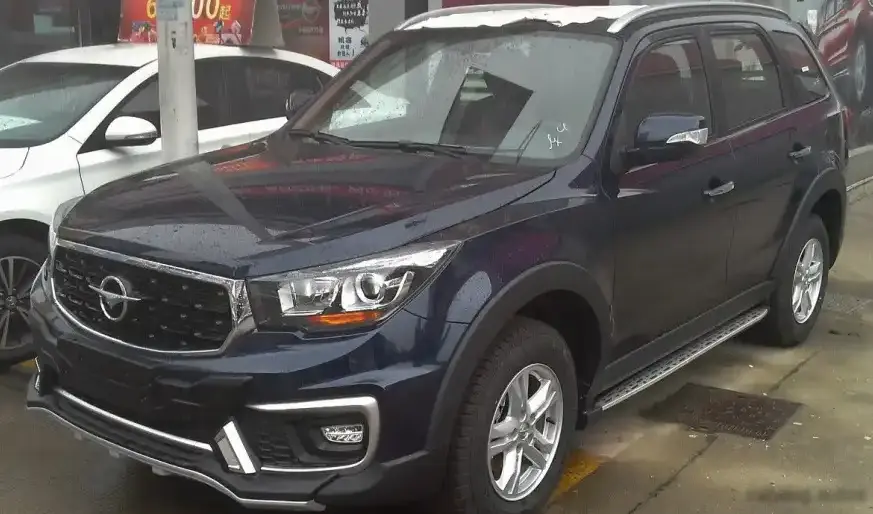
The Haima S7 (facelift 2017) 1.8 is a compact SUV produced by the Chinese manufacturer Haima Automobile. Introduced in 2017 as a refreshed version of the original S7, this variant aimed to provide a more competitive offering in the rapidly expanding Chinese SUV market. Positioned as a mid-range trim, the 1.8-liter turbocharged engine offered a balance between performance and fuel efficiency, appealing to a broad customer base. The S7, in general, represented Haima’s attempt to move upmarket and offer a more modern and technologically advanced vehicle compared to their earlier offerings. This facelift brought styling updates and improvements to the interior, aiming to enhance the vehicle’s overall appeal.
Technical Specifications
| Brand | Haima |
| Model | S7 |
| Generation | S7 (facelift 2017) |
| Type (Engine) | 1.8 (188 Hp) |
| Start of production | 2017 |
| Powertrain Architecture | Internal Combustion engine |
| Body type | SUV |
| Seats | 5 |
| Doors | 5 |
| Fuel Type | Petrol (Gasoline) |
| Maximum speed | 165 km/h (102.53 mph) |
| Emission standard | China V |
| Weight-to-power ratio | 8.2 kg/Hp, 121.7 Hp/tonne |
| Weight-to-torque ratio | 6.7 kg/Nm, 148.9 Nm/tonne |
| Power | 188 Hp @ 5500 rpm |
| Power per litre | 104.7 Hp/l |
| Torque | 230 Nm @ 1800-4500 rpm (169.64 lb.-ft. @ 1800-4500 rpm) |
| Engine layout | Front, Transverse |
| Engine Model/Code | HM484Q-T |
| Engine displacement | 1795 cm3 (109.54 cu. in.) |
| Number of cylinders | 4 |
| Engine configuration | Inline |
| Compression ratio | 9.3:1 |
| Number of valves per cylinder | 4 |
| Fuel injection system | Multi-port manifold injection |
| Engine aspiration | Turbocharger, Intercooler |
| Valvetrain | DVVT, iVVT |
| Engine oil capacity | 4.7 l (4.97 US qt | 4.14 UK qt) |
| Coolant | 7.2 l (7.61 US qt | 6.34 UK qt) |
| Kerb Weight | 1545 kg (3406.14 lbs) |
| Fuel tank capacity | 61 l (16.11 US gal | 13.42 UK gal) |
| Length | 4480 mm (176.38 in) |
| Width | 1860 mm (73.23 in) |
| Height | 1715 mm (67.52 in) |
| Wheelbase | 2619 mm (103.11 in) |
| Front track | 1550 mm (61.02 in) |
| Rear (Back) track | 1530 mm (60.24 in) |
| Ride height (ground clearance) | 165-180 mm (6.5 – 7.09 in) |
| Drivetrain Architecture | The Internal combustion engine (ICE) drives the front wheels of the vehicle. |
| Drive wheel | Front wheel drive |
| Number of gears and type of gearbox | 6 gears, manual transmission |
| Front suspension | Independent, type McPherson with coil spring and anti-roll bar |
| Rear suspension | Independent multi-link suspension |
| Front brakes | Ventilated discs |
| Rear brakes | Disc |
| Assisting systems | ABS (Anti-lock braking system) |
| Steering type | Steering rack and pinion |
| Power steering | Electric Steering |
| Tires size | 215/70 R16; 225/65 R17; 235/65 R17 |
| Wheel rims size | 16; 17 |
Powertrain & Engine Architecture
The heart of the Haima S7 1.8 is the HM484Q-T, a 1.8-liter inline-four cylinder gasoline engine. This engine is turbocharged and features multi-point fuel injection, along with both intake and exhaust Variable Valve Timing (DVVT and iVVT). The turbocharger and intercooler work together to increase power output and improve efficiency. The engine produces 188 horsepower at 5500 rpm and 230 Nm (169.64 lb-ft) of torque between 1800 and 4500 rpm. This power is delivered through a 6-speed manual transmission, driving the front wheels. The engine’s design prioritizes a balance between performance and fuel economy, making it suitable for everyday driving conditions. The use of variable valve timing helps to optimize engine performance across a wider range of engine speeds.
Driving Characteristics
The Haima S7 1.8 with the 6-speed manual transmission offers a reasonably engaging driving experience. While not a performance-oriented SUV, the turbocharger provides a noticeable boost in power during acceleration. The 6-speed gearbox allows for precise control and helps to keep the engine within its optimal power band. Compared to lower-powered versions of the S7, the 1.8-liter engine provides significantly more responsive acceleration and improved highway cruising ability. However, it doesn’t offer the same level of refinement or power as some of its competitors from established global brands. The suspension is tuned for comfort, providing a relatively smooth ride, but it can feel somewhat soft during more aggressive cornering.
Equipment & Trim Levels
The 2017 facelift of the Haima S7 1.8 typically included standard features such as air conditioning, power windows, power mirrors, a basic audio system with USB connectivity, and ABS. Higher trim levels offered additional features like alloy wheels, a touchscreen infotainment system, rear parking sensors, and a sunroof. Interior upholstery was generally cloth, with leather options available on higher-spec models. The dashboard layout was functional and straightforward, with a focus on ease of use. Safety features were relatively basic, with ABS being the primary safety system.
Chassis & Braking
The Haima S7 1.8 utilizes a front-wheel-drive chassis with an independent McPherson strut suspension in the front and an independent multi-link suspension in the rear. This suspension setup aims to provide a comfortable ride and reasonable handling characteristics. The braking system consists of ventilated discs on the front wheels and solid discs on the rear wheels. ABS (Anti-lock Braking System) is standard, providing enhanced braking control in emergency situations. The steering is rack and pinion with electric power assistance, offering a light and easy steering feel.
Market Reception & Comparison
The Haima S7 1.8 received mixed reviews in the Chinese market. Critics generally praised its spacious interior and relatively affordable price point. However, it was often criticized for its lack of brand recognition compared to established international brands, as well as its somewhat basic interior materials and limited safety features. Compared to other SUVs in its class, the S7 1.8 offered a competitive level of performance and fuel economy, but it often fell short in terms of refinement and overall build quality. Fuel economy figures were typically in the range of 7-9 liters per 100 kilometers (approximately 28-32 mpg) in combined driving conditions.
Legacy
The Haima S7 1.8, while not a groundbreaking vehicle, played a role in Haima’s efforts to establish itself as a more competitive player in the Chinese automotive market. The 1.8-liter turbocharged engine proved to be relatively reliable, although long-term durability data is limited due to the relatively short production run and limited export market. In the used car market, the S7 1.8 represents an affordable option for buyers seeking a spacious and reasonably well-equipped SUV. However, potential buyers should be aware of the vehicle’s limitations in terms of refinement and build quality compared to more established brands. The S7’s legacy lies in its contribution to the growth of the Chinese automotive industry and Haima’s ambition to offer a more modern and competitive product.
