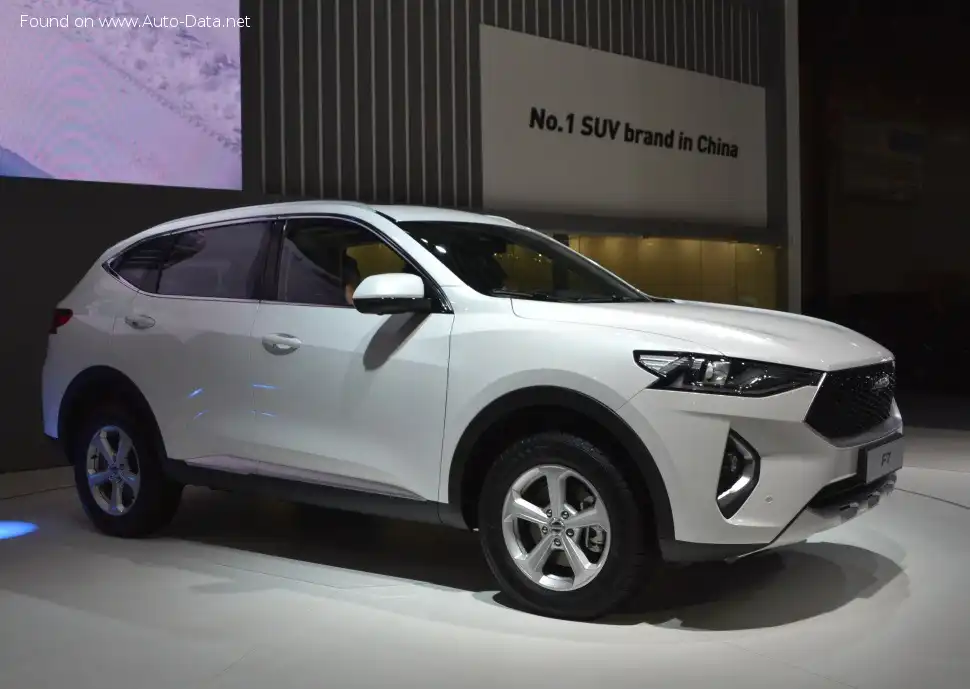
Technical Specifications
| Brand | Haval |
| Model | F7 |
| Generation | F7 I (facelift 2022) |
| Type (Engine) | 1.5 GDIT (150 Hp) DCT |
| Start of production | 2022 |
| End of production | 2024 |
| Powertrain Architecture | Internal Combustion engine |
| Body type | SUV |
| Seats | 5 |
| Doors | 5 |
| Fuel consumption (combined) | 8.2 l/100 km (28.7 US mpg, 34.4 UK mpg, 12.2 km/l) |
| Fuel Type | Petrol (Gasoline) |
| Emission standard | Euro 5 |
| Weight-to-power ratio | 10.8 kg/Hp, 92.7 Hp/tonne |
| Weight-to-torque ratio | 5.8 kg/Nm, 173.1 Nm/tonne |
| Power | 150 Hp @ 5000-5600 rpm |
| Power per litre | 100.1 Hp/l |
| Torque | 280 Nm @ 1400-3000 rpm (206.52 lb.-ft. @ 1400-3000 rpm) |
| Engine layout | Front, Transverse |
| Engine Model/Code | GW4B15 |
| Engine displacement | 1499 cm3 (91.47 cu. in.) |
| Number of cylinders | 4 |
| Engine configuration | Inline |
| Cylinder Bore | 76 mm (2.99 in.) |
| Piston Stroke | 82.6 mm (3.25 in.) |
| Compression ratio | 9.6:1 |
| Number of valves per cylinder | 4 |
| Fuel injection system | Direct injection |
| Engine aspiration | Turbocharger, Intercooler |
| Valvetrain | DOHC |
| Engine oil capacity | 3.7 l (3.91 US qt | 3.26 UK qt) |
| Coolant | 7.5 l (7.93 US qt | 6.6 UK qt) |
| Kerb Weight | 1618 kg (3567.08 lbs.) |
| Fuel tank capacity | 56 l (14.79 US gal | 12.32 UK gal) |
| Length | 4691 mm (184.69 in.) |
| Width | 1866 mm (73.46 in.) |
| Height | 1690 mm (66.54 in.) |
| Wheelbase | 2725 mm (107.28 in.) |
| Ride height (ground clearance) | 190 mm (7.48 in.) |
| Drivetrain Architecture | Front wheel drive, Internal Combustion engine |
| Number of gears and type of gearbox | 7 gears, automatic transmission DCT |
| Front suspension | Independent type McPherson |
| Rear suspension | Double wishbone |
| Front brakes | Ventilated discs |
| Rear brakes | Disc |
| Steering type | Steering rack and pinion |
| Power steering | Electric Steering |
| Tires size | 235/55 R19 |
| Wheel rims size | 7.5J x 19 ET50 |
The Haval F7 I (facelift 2022) 1.5 GDIT (150 Hp) DCT represents Haval’s entry into the increasingly competitive compact SUV segment. Introduced in 2022 as a refreshed version of the original F7, this variant aimed to provide a balance of fuel efficiency, modern technology, and affordability for consumers. Positioned as a mid-range offering within the F7 lineup, it slotted between the base models and the more powerful, larger-displacement engine options. The F7, in general, was designed to appeal to a growing Chinese market seeking domestically produced SUVs with international standards of quality and features, and later expanded to select export markets. This specific 1.5-liter turbocharged version with the dual-clutch transmission (DCT) was a key component of Haval’s strategy to broaden its customer base.
Powertrain & Engine Architecture
The heart of the Haval F7 I 1.5 GDIT is the GW4B15 engine, a 1.5-liter inline-four cylinder gasoline engine. This engine utilizes direct fuel injection and is coupled with a single turbocharger and intercooler to boost power and efficiency. The direct injection system allows for precise fuel delivery, optimizing combustion and reducing emissions. The engine employs a double overhead camshaft (DOHC) valvetrain, contributing to improved engine breathing and overall performance. The compression ratio of 9.6:1 strikes a balance between power output and fuel economy. This engine is part of Haval’s broader effort to downsize and turbocharge its engines, moving away from larger displacement naturally aspirated designs. The engine is transversely mounted in the front of the vehicle.
The transmission is a 7-speed dual-clutch transmission (DCT). DCTs offer faster and smoother gear changes compared to traditional automatic transmissions, contributing to a more engaging driving experience and improved fuel efficiency. The DCT’s programming is tuned for a balance of performance and comfort, prioritizing smooth shifts during normal driving conditions and quicker response times when accelerating.
Driving Characteristics
The 150 horsepower and 280 Nm (206.52 lb-ft) of torque produced by the 1.5 GDIT engine provide adequate performance for everyday driving. Acceleration is reasonably brisk, though not particularly sporty. The DCT transmission contributes to a responsive feel, with quick shifts during acceleration. Compared to higher-output engine options in the F7 lineup, such as the 2.0-liter turbocharged engine, this variant offers less outright power. However, the 1.5 GDIT provides a more fuel-efficient and affordable alternative. The DCT transmission, while generally smooth, can exhibit some hesitation at low speeds or during parking maneuvers, a common characteristic of some DCT implementations. The front-wheel-drive configuration provides predictable handling, but lacks the all-weather capability of all-wheel-drive variants.
Equipment & Trim Levels
The Haval F7 I (facelift 2022) 1.5 GDIT DCT typically came equipped with a range of standard features, including automatic climate control, a touchscreen infotainment system with smartphone connectivity (Apple CarPlay and Android Auto), and a suite of safety features such as ABS, electronic stability control, and multiple airbags. Interior upholstery was typically cloth or leatherette, depending on the specific trim level. Higher trim levels offered features such as a panoramic sunroof, heated front seats, and advanced driver-assistance systems (ADAS) like adaptive cruise control and lane departure warning. The dashboard layout was modern and functional, with a focus on ease of use. Optional extras included upgraded sound systems, premium interior trim materials, and exterior styling enhancements.
Chassis & Braking
The F7 I utilizes a McPherson strut independent suspension setup at the front and a double wishbone independent suspension at the rear. This suspension configuration provides a comfortable ride quality and decent handling characteristics. The front brakes are ventilated discs, providing good stopping power, while the rear brakes are solid discs. The steering system is an electric power steering (EPS) rack and pinion, offering light and precise steering feel. The vehicle’s weight of 1618 kg (3567.08 lbs) is relatively moderate for its class, contributing to reasonable handling and braking performance. Stabilizer bars are included both front and rear to reduce body roll during cornering.
Market Reception & Comparison
The Haval F7 I 1.5 GDIT DCT was generally well-received in its primary market, China, as a competitive offering in the compact SUV segment. Critics praised its modern styling, spacious interior, and comprehensive feature set. Fuel economy was also a strong point, with the 8.2 l/100 km combined fuel consumption being competitive with other similarly sized SUVs. Compared to other trims in the F7 lineup, the 1.5 GDIT DCT offered a more affordable entry point, making it attractive to budget-conscious buyers. However, some reviewers noted that the engine lacked the punch of the larger-displacement options, and the DCT transmission could be occasionally jerky. Reliability reports have been mixed, with some owners reporting minor issues with the infotainment system and DCT, while others have experienced no significant problems.
Legacy
The Haval F7 I 1.5 GDIT DCT played a significant role in establishing Haval as a major player in the Chinese SUV market. The combination of a turbocharged engine, DCT transmission, and modern features appealed to a wide range of consumers. In the used car market, these models represent a relatively affordable option for those seeking a feature-rich and fuel-efficient SUV. The long-term reliability of the GW4B15 engine and the DCT transmission remains a subject of ongoing evaluation, but early indications suggest that with proper maintenance, these powertrains can provide years of reliable service. The F7, and this variant in particular, helped to shift perceptions of Chinese automotive brands, demonstrating that they were capable of producing vehicles that could compete with established international manufacturers.