
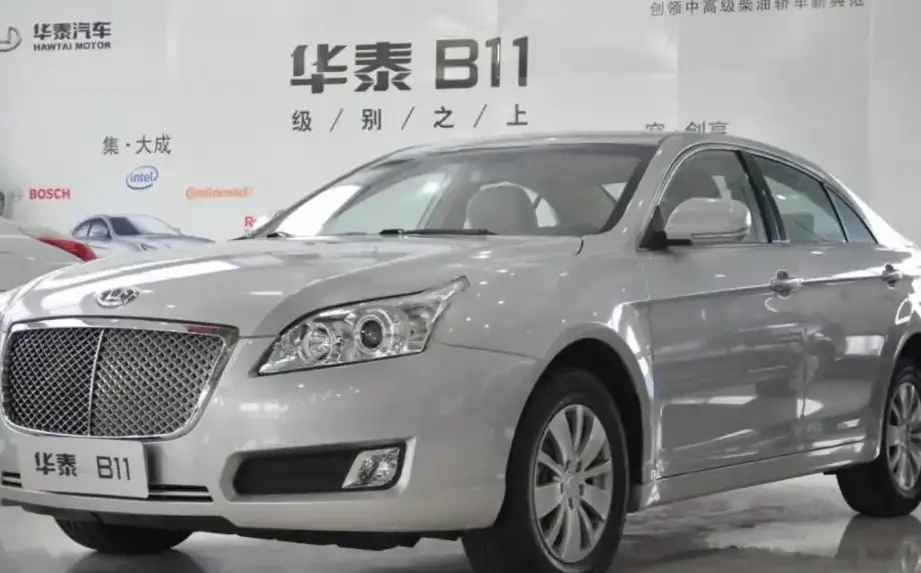
The Hawtai B11 2.0 TD (150 Hp) was a mid-size sedan produced by the Chinese manufacturer Hawtai Motor Group between 2014 and 2017. Positioned as a more premium offering within Hawtai’s lineup, the B11 aimed to compete with established international brands in the Chinese market. This variant, equipped with a 2.0-liter turbocharged diesel engine and a five-speed manual transmission, represented a balance between fuel efficiency and performance for buyers seeking a comfortable and relatively powerful sedan. The B11 was Hawtai’s attempt to move upmarket, offering a more refined experience than their earlier models.
Technical Specifications
| Brand | Hawtai |
| Model | B11 |
| Generation | B11 |
| Type (Engine) | 2.0 TD (150 Hp) |
| Start of production | 2014 |
| End of production | 2017 |
| Powertrain Architecture | Internal Combustion engine |
| Body type | Sedan |
| Seats | 5 |
| Doors | 4 |
| Fuel Type | Diesel |
| Emission standard | Euro 4 |
| Weight-to-power ratio | 10.6 kg/Hp, 94.6 Hp/tonne |
| Weight-to-torque ratio | 5.1 kg/Nm, 195.6 Nm/tonne |
| Power | 150 Hp @ 4000 rpm |
| Power per litre | 75.3 Hp/l |
| Torque | 310 Nm @ 2000 rpm (228.64 lb.-ft. @ 2000 rpm) |
| Engine layout | Front, Transverse |
| Engine Model/Code | OED |
| Engine displacement | 1991 cm3 (121.5 cu. in.) |
| Number of cylinders | 4 |
| Engine configuration | Inline |
| Cylinder Bore | 83 mm (3.27 in.) |
| Piston Stroke | 92 mm (3.62 in.) |
| Compression ratio | 17.5:1 |
| Number of valves per cylinder | 4 |
| Fuel injection system | Diesel Commonrail |
| Engine aspiration | Turbocharger, Intercooler |
| Valvetrain | DOHC |
| Engine oil capacity | 6.3 l (6.66 US qt | 5.54 UK qt) |
| Coolant | 9 l (9.51 US qt | 7.92 UK qt) |
| Kerb Weight | 1585 kg (3494.33 lbs) |
| Trunk (boot) space – minimum | 450 l (15.89 cu. ft.) |
| Trunk (boot) space – maximum | 500 l (17.66 cu. ft.) |
| Fuel tank capacity | 70 l (18.49 US gal | 15.4 UK gal) |
| Length | 4943 mm (194.61 in.) |
| Width | 1852 mm (72.91 in.) |
| Height | 1511 mm (59.49 in.) |
| Wheelbase | 2764 mm (108.82 in.) |
| Ride height (ground clearance) | 138 mm (5.43 in.) |
| Drivetrain Architecture | The Internal combustion engine (ICE) drives the front wheels of the vehicle. |
| Drive wheel | Front wheel drive |
| Number of gears and type of gearbox | 5 gears, manual transmission |
| Front suspension | Independent type McPherson |
| Rear suspension | Independent multi-link suspension |
| Front brakes | Ventilated discs |
| Rear brakes | Disc |
| Assisting systems | ABS (Anti-lock braking system) |
| Steering type | Steering rack and pinion |
| Tires size | 225/60 R16 |
Powertrain & Engine Architecture
The heart of the B11 2.0 TD was the OED engine, a 1.991-liter inline-four cylinder diesel engine. This engine utilized a common rail direct injection system, allowing for precise fuel delivery and contributing to both power and efficiency. A turbocharger with an intercooler was employed to boost power output, bringing the engine to 150 horsepower at 4000 rpm and 310 Nm (228.64 lb-ft) of torque at 2000 rpm. The engine featured a double overhead camshaft (DOHC) valvetrain with four valves per cylinder, optimizing airflow for improved performance. The five-speed manual transmission was the sole gearbox option for this variant, providing drivers with full control over gear selection. This configuration was typical for a diesel engine of this era, prioritizing fuel economy and torque delivery over outright horsepower.
Driving Characteristics
The B11 2.0 TD with the manual transmission offered a reasonably engaging driving experience. The 310 Nm of torque available from 2000 rpm provided ample pulling power for everyday driving and overtaking maneuvers. While not a sports sedan, the engine delivered sufficient acceleration for comfortable highway cruising. The five-speed gearbox was well-matched to the engine’s characteristics, although some reviewers noted that the shift quality could be improved. Compared to potential gasoline-powered variants (which were less common), the diesel offered superior fuel economy and a more relaxed driving style. The manual transmission allowed for greater driver involvement than an automatic would have, but also required more effort in stop-and-go traffic. The gear ratios were tuned for efficiency, with a relatively long fifth gear for highway cruising, and a first gear geared for getting the vehicle moving from a standstill with the engine’s substantial torque.
Equipment & Trim Levels
The Hawtai B11 2.0 TD typically came equipped with a standard set of features aimed at providing comfort and convenience. These included air conditioning, power windows, power door locks, and a basic audio system. Interior upholstery was generally cloth, with higher trim levels offering optional leather seating. The dashboard layout was functional and straightforward, prioritizing usability over extravagant design. Optional extras could include a sunroof, upgraded audio system, and alloy wheels. Safety features typically included ABS (Anti-lock Braking System) as standard, with airbags available as an option depending on the specific trim level. The B11 aimed to provide a level of equipment comparable to other mid-size sedans in the Chinese market, focusing on practicality and value.
Chassis & Braking
The B11 utilized an independent McPherson strut suspension setup at the front and an independent multi-link suspension at the rear, providing a comfortable ride quality. The front brakes were ventilated discs, offering good stopping power, while the rear brakes were solid discs. The steering system employed a rack and pinion setup, providing reasonably precise steering feel. The vehicle rode on 225/60 R16 tires, which balanced ride comfort with handling characteristics. The suspension tuning was geared towards comfort rather than sporty handling, making it well-suited for everyday driving conditions. The chassis was designed to provide a stable and predictable driving experience, prioritizing passenger comfort over aggressive cornering.
Market Reception & Comparison
The Hawtai B11 2.0 TD received mixed reviews in the Chinese automotive press. Critics generally praised the engine’s fuel efficiency and torque output, but some found the interior materials and build quality to be lacking compared to established international competitors. The manual transmission was seen as a positive by some, offering a more engaging driving experience, while others preferred the convenience of an automatic. In terms of fuel economy, the diesel variant offered a significant advantage over potential gasoline-powered alternatives. Reliability reports were limited, but early indications suggested that the powertrain was generally robust. Compared to rivals like the Geely Emgrand EC8 or the Chery Arrizo 7, the B11 offered a competitive price point but often lagged behind in terms of perceived quality and brand recognition.
Legacy
The Hawtai B11 2.0 TD, while not a runaway success, represented Hawtai’s ambition to move upmarket and compete with more established brands. The 2.0-liter diesel engine proved to be a reasonably reliable unit, and examples continue to be found on the used car market in China. While the B11 didn’t achieve widespread international recognition, it played a role in Hawtai’s development as a Chinese automotive manufacturer. The B11’s legacy lies in its attempt to offer a blend of fuel efficiency, performance, and comfort at a competitive price point within the rapidly evolving Chinese automotive landscape. It served as a stepping stone for Hawtai, allowing them to gain experience in designing and manufacturing more sophisticated vehicles, and ultimately contributing to the growth of the Chinese automotive industry.
