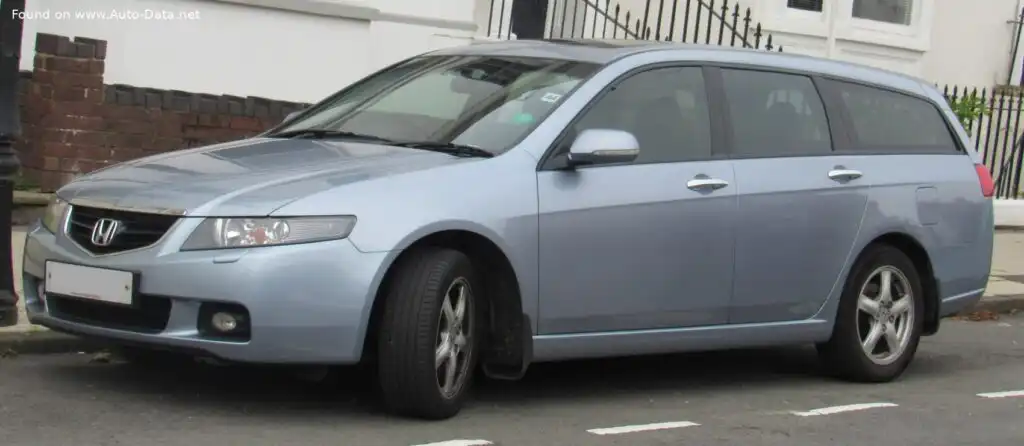
The Honda Accord VII Wagon 2.2 i-CTDi, produced between 2002 and 2008, represents a significant offering in the European market for a practical and efficient family vehicle. Positioned as a mid-range trim within the seventh-generation Accord wagon (estate) lineup, it combined the versatility of a station wagon with a modern diesel engine. This variant aimed to appeal to buyers seeking a balance between fuel economy, performance, and cargo capacity. It was never officially sold in the North American market, where the Accord sedan was the primary focus.
Technical Specifications
| Brand | Honda |
| Model | Accord |
| Generation | Accord VII Wagon |
| Type (Engine) | 2.2 i-CTDi (140 Hp) |
| Start of production | 2002 |
| End of production | 2008 |
| Powertrain Architecture | Internal Combustion engine |
| Body type | Station wagon (estate) |
| Seats | 5 |
| Doors | 5 |
| Fuel consumption (urban) | 7.5 l/100 km (31.4 US mpg) |
| Fuel consumption (extra urban) | 4.8 l/100 km (49 US mpg) |
| Fuel consumption (combined) | 5.8 l/100 km (40.6 US mpg) |
| Fuel Type | Diesel |
| Acceleration 0 – 100 km/h | 10.1 sec |
| Acceleration 0 – 62 mph | 10.1 sec |
| Acceleration 0 – 60 mph | 9.6 sec |
| Maximum speed | 198 km/h (123.03 mph) |
| Weight-to-power ratio | 10.5 kg/Hp |
| Weight-to-torque ratio | 4.3 kg/Nm |
| Power | 140 Hp @ 4000 rpm |
| Torque | 340 Nm @ 2000 rpm (250.77 lb.-ft. @ 2000 rpm) |
| Engine layout | Front, Transverse |
| Engine Model/Code | N22A1 |
| Engine displacement | 2204 cm3 (134.5 cu. in.) |
| Number of cylinders | 4 |
| Engine configuration | Inline |
| Cylinder Bore | 85 mm (3.35 in.) |
| Piston Stroke | 97.1 mm (3.82 in.) |
| Compression ratio | 16.7:1 |
| Number of valves per cylinder | 4 |
| Fuel injection system | Diesel Commonrail |
| Engine aspiration | Turbocharger, Intercooler |
| Valvetrain | DOHC |
| Engine oil capacity | 5.9 l (6.23 US qt | 5.19 UK qt) |
| Coolant capacity | 6.8 l (7.19 US qt | 5.98 UK qt) |
| Kerb Weight | 1470 kg (3240.8 lbs.) |
| Trunk (boot) space – minimum | 576 l (20.34 cu. ft.) |
| Trunk (boot) space – maximum | 1657 l (58.52 cu. ft.) |
| Fuel tank capacity | 65 l (17.17 US gal | 14.3 UK gal) |
| Length | 4750 mm (187.01 in.) |
| Width | 1760 mm (69.29 in.) |
| Height | 1470 mm (57.87 in.) |
| Wheelbase | 2720 mm (107.09 in.) |
| Front track | 1515 mm (59.65 in.) |
| Rear track | 1530 mm (60.24 in.) |
| Drivetrain Architecture | Front wheel drive |
| Number of gears | 5 |
| Gearbox type | Manual transmission |
| Front suspension | Double wishbone |
| Rear suspension | Wishbone |
| Front brakes | Ventilated discs |
| Rear brakes | Disc |
| Assisting systems | ABS (Anti-lock braking system) |
| Steering type | Steering rack and pinion |
| Tires size | 205/55 R16 |
| Wheel rims size | 16 |
INTRODUCTION
The Honda Accord VII Wagon, launched in 2002, was a key model for Honda in the European market, offering a practical alternative to traditional saloons. The 2.2 i-CTDi variant, powered by the N22A1 engine, was introduced to cater to customers desiring a diesel option. This engine provided a good balance of power and fuel efficiency, making it a popular choice for long-distance driving and family transport. The Accord Wagon competed with other European estate cars like the Ford Mondeo Estate, Volkswagen Passat Variant, and Peugeot 406 SW.
Powertrain & Engine Architecture
The heart of the 2.2 i-CTDi Accord Wagon is the N22A1 engine, a 2.2-liter inline-four cylinder diesel. This engine utilizes a common rail direct injection system, delivering fuel directly into the combustion chamber at extremely high pressure. This technology, coupled with a turbocharger and intercooler, allows for increased power output and improved fuel efficiency. The engine features a double overhead camshaft (DOHC) valvetrain, optimizing airflow for enhanced performance. The 5-speed manual transmission was the standard offering for this variant, providing a direct connection between the engine and the front wheels. The engine’s design prioritized low-end torque, making it well-suited for everyday driving and hauling loads.
Driving Characteristics
The 2.2 i-CTDi Accord Wagon offered a comfortable and refined driving experience. While not a performance-oriented vehicle, the 140 horsepower and 340 Nm (250 lb-ft) of torque provided adequate power for most driving situations. Acceleration from 0-60 mph took around 9.6 seconds, and it had a top speed of 123 mph. The manual transmission allowed for precise gear changes, and the engine’s strong low-end torque meant that frequent downshifting wasn’t necessary. Compared to the petrol-powered Accord wagons, the 2.2 i-CTDi offered significantly better fuel economy and a more relaxed driving experience, particularly on long journeys. It wasn’t as quick as the higher-powered petrol variants, but it excelled in fuel efficiency and usability.
Equipment & Trim Levels
The 2.2 i-CTDi trim typically included features such as air conditioning, power windows, central locking, and an integrated audio system. Interior upholstery was generally cloth, with options for upgraded materials available. Safety features included ABS brakes, front airbags, and seatbelt pretensioners. Optional extras could include alloy wheels, a sunroof, and a more advanced audio system with CD changer. The trim level aimed for a balance between comfort and practicality, appealing to families and individuals who needed a versatile vehicle without excessive luxury.
Chassis & Braking
The Accord Wagon featured a front-engine, front-wheel-drive layout. The suspension consisted of a double wishbone setup at the front and a wishbone arrangement at the rear, providing a comfortable ride and good handling characteristics. The braking system utilized ventilated discs on the front wheels and solid discs on the rear, offering adequate stopping power. ABS (Anti-lock Braking System) was standard, enhancing safety during emergency braking situations. The chassis was designed to provide a stable and predictable driving experience, even when fully loaded with passengers and cargo.
Market Reception & Comparison
The 2.2 i-CTDi Accord Wagon was generally well-received by automotive critics in Europe. It was praised for its fuel efficiency, comfortable ride, and spacious interior. Compared to other diesel estate cars in its class, the Accord offered a good balance of performance and refinement. However, some critics noted that the interior design was somewhat conservative compared to some of its rivals. In terms of reliability, the N22A1 engine proved to be generally robust, although regular maintenance was essential to prevent issues with the diesel particulate filter (DPF) and fuel injectors. Fuel economy was a key selling point, consistently outperforming the petrol alternatives.
Legacy
The Honda Accord VII Wagon 2.2 i-CTDi remains a popular choice in the used car market, particularly for those seeking a reliable and fuel-efficient estate car. The N22A1 engine, while requiring regular maintenance, is known for its durability. Common issues include DPF blockages and potential fuel injector problems, but these can often be addressed with preventative maintenance. The Accord Wagon’s spacious interior and practical design continue to appeal to buyers looking for a versatile family vehicle. Its reputation for reliability and relatively low running costs has ensured its continued presence on European roads.