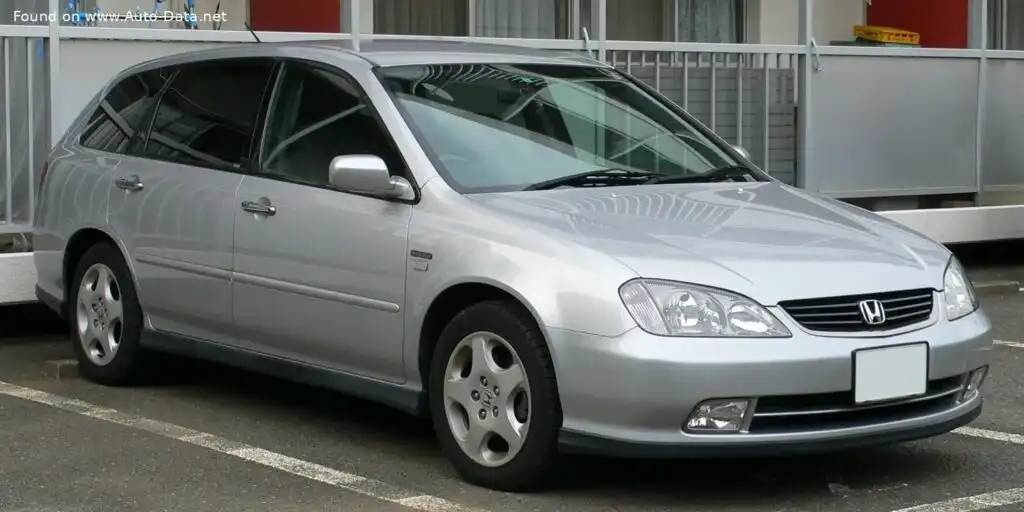
The Honda Avancier, launched in 1999 and produced through 2001, represented Honda’s entry into the burgeoning market for larger, more comfortable station wagons, primarily aimed at the Japanese domestic market (JDM). Positioned as a more premium offering than the Accord Wagon, the Avancier sought to blend practicality with a degree of luxury and all-weather capability. The variant featuring the 2.3-liter inline-four engine paired with a four-speed automatic transmission and all-wheel drive was a significant part of the Avancier lineup, offering a balance between performance, fuel efficiency, and ease of use. It was built on the Honda platform, sharing components with other Honda vehicles of the era.
Technical Specifications
| Brand | Honda |
| Model | Avancier |
| Generation | Avancier I |
| Type (Engine) | L4 2.3 (150 Hp) 4×4 Automatic |
| Start of production | 1999 |
| End of production | 2001 |
| Powertrain Architecture | Internal Combustion engine |
| Body type | Station wagon (estate) |
| Seats | 5 |
| Doors | 5 |
| Fuel consumption (combined) | 8.5 l/100 km (27.7 US mpg, 33.2 UK mpg, 11.8 km/l) |
| Fuel Type | Petrol (Gasoline) |
| Maximum speed | 180 km/h (111.85 mph) |
| Weight-to-power ratio | 10.8 kg/Hp, 92.6 Hp/tonne |
| Weight-to-torque ratio | 7.9 kg/Nm, 127.2 Nm/tonne |
| Power | 150 Hp @ 5800 rpm |
| Power per litre | 66.5 Hp/l |
| Torque | 206 Nm @ 4800 rpm (151.94 lb.-ft. @ 4800 rpm) |
| Engine layout | Front, Transverse |
| Engine Model/Code | F23A1 |
| Engine displacement | 2254 cm3 (137.55 cu. in.) |
| Number of cylinders | 4 |
| Engine configuration | Inline |
| Cylinder Bore | 86 mm (3.39 in.) |
| Piston Stroke | 97 mm (3.82 in.) |
| Compression ratio | 9.3:1 |
| Number of valves per cylinder | 4 |
| Fuel injection system | Multi-port manifold injection |
| Engine aspiration | Naturally aspirated engine |
| Valvetrain | SOHC |
| Engine oil capacity | 4.3 l (4.54 US qt | 3.78 UK qt) |
| Kerb Weight | 1620 kg (3571.49 lbs.) |
| Fuel tank capacity | 61 l (16.11 US gal | 13.42 UK gal) |
| Length | 4795 mm (188.78 in.) |
| Width | 1810 mm (71.26 in.) |
| Height | 1545 mm (60.83 in.) |
| Wheelbase | 2765 mm (108.86 in.) |
| Front track | 1555 mm (61.22 in.) |
| Rear track | 1540 mm (60.63 in.) |
| Ride height (ground clearance) | 185 mm (7.28 in.) |
| Drag coefficient (Cd) | 0.37 |
| Minimum turning circle | 11.40 m (37.4 ft.) |
| Drive wheel | All wheel drive (4×4) |
| Number of gears | 4 |
| Gearbox type | automatic transmission |
| Front suspension | Double wishbone |
| Rear suspension | Coil spring |
| Front brakes | Ventilated discs |
| Rear brakes | Disc |
| Assisting systems | ABS (Anti-lock braking system) |
| Steering type | Steering rack and pinion |
| Power steering | Hydraulic Steering |
| Tires size | 215/65 R16 98S |
| Wheel rims size | 16 |
Powertrain & Engine Architecture
The heart of this Avancier variant was the F23A1 engine, a 2.3-liter inline-four cylinder gasoline engine. This engine utilized a single overhead camshaft (SOHC) valvetrain and multi-point fuel injection. The F23A1 was known for its relative simplicity and durability, characteristics valued in the Japanese market. While not a high-performance engine, it provided adequate power for comfortable cruising and everyday driving. The four-speed automatic transmission was a conventional torque converter type, prioritizing smooth shifts over outright speed. The all-wheel-drive system was typically a part-time system, engaging the rear wheels when traction was needed, enhancing stability in inclement weather.
Driving Characteristics
The 150 horsepower and 206 Nm (152 lb-ft) of torque delivered by the 2.3-liter engine and automatic transmission resulted in a driving experience geared towards comfort and ease of use. Acceleration was adequate, but not particularly brisk. The automatic transmission, with its four gears, was tuned for smooth transitions rather than aggressive downshifts. Compared to the manual transmission versions of the Avancier, or those equipped with the larger 2.5-liter V6 engine, this variant offered a more relaxed driving experience. The all-wheel-drive system provided enhanced grip, particularly on slippery surfaces, making it a practical choice for regions with harsh winters or challenging road conditions.
Equipment & Trim Levels
The 2.3-liter automatic Avancier typically came with a reasonable level of standard equipment. This included power windows, power locks, air conditioning, and an AM/FM radio. Higher trim levels offered features such as alloy wheels, a sunroof, upgraded audio systems, and leather upholstery. Interior materials were generally of good quality, reflecting Honda’s reputation for build quality. The dashboard layout was functional and straightforward, prioritizing ease of use. Optional extras often included navigation systems (a relatively new technology at the time) and upgraded sound systems.
Chassis & Braking
The Avancier’s chassis featured a double wishbone suspension at the front and a coil spring suspension at the rear. This setup provided a comfortable ride, absorbing bumps and irregularities in the road surface effectively. The braking system consisted of ventilated discs at the front and solid discs at the rear. Anti-lock brakes (ABS) were standard, enhancing safety by preventing wheel lockup during hard braking. The steering was rack and pinion, providing precise and responsive handling. The suspension was tuned for comfort, rather than sporty handling, prioritizing a smooth and stable ride.
Market Reception & Comparison
The Avancier was generally well-received in the Japanese market as a practical and comfortable station wagon. Critics praised its spacious interior, build quality, and all-weather capability. The 2.3-liter automatic variant was seen as a good all-rounder, offering a balance between performance, fuel economy, and price. Compared to the more powerful V6 models, the 2.3-liter version was more fuel-efficient and less expensive to maintain. However, it lacked the outright performance of its larger-engined siblings. Against competitors like the Subaru Legacy Touring Wagon and the Mitsubishi RVR, the Avancier offered a compelling package of features and reliability.
Legacy
The Honda Avancier, while not a huge sales success outside of Japan, remains a fondly remembered vehicle among enthusiasts. The F23A1 engine is known for its durability and relatively simple maintenance requirements. Today, well-maintained examples of the Avancier are becoming increasingly collectible, particularly those in original condition. The 2.3-liter automatic variant is a particularly desirable choice for those seeking a comfortable and reliable classic station wagon. Its blend of practicality, comfort, and all-wheel-drive capability continues to appeal to drivers seeking a versatile and dependable vehicle.