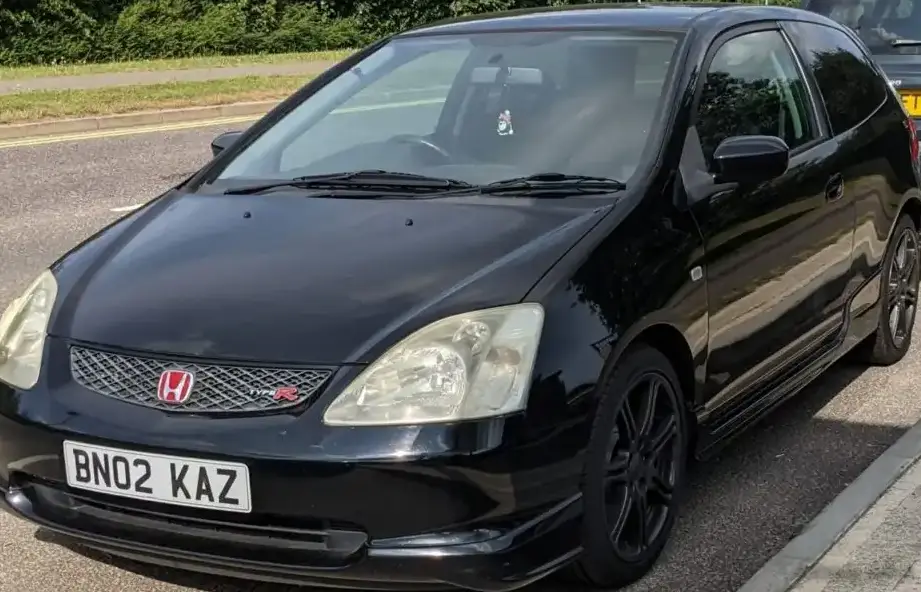
The Honda Civic Type R (EP3), produced between 2001 and 2003, represented Honda’s foray into the hot hatch market with a dedicated performance model based on the seventh-generation Civic. Specifically designed for the European market, though some examples found their way to other regions, the EP3 aimed to deliver a more focused driving experience than the standard Civic. It was positioned as a direct competitor to cars like the Volkswagen Golf GTI and Ford Focus ST. The 2.0-liter (200 hp) variant, detailed here, was the sole engine option offered in the Type R, and it came exclusively with a six-speed manual transmission. The EP3 marked a significant shift for Honda, moving away from subtle modifications to a more aggressive and visually distinct performance package.
Technical Specifications
| Brand | Honda |
| Model | Civic Type R |
| Generation | Civic Type R (EP3) |
| Type (Engine) | 2.0 (200 Hp) |
| Start of production | 2001 |
| End of production | 2003 |
| Powertrain Architecture | Internal Combustion engine |
| Body type | Hatchback |
| Seats | 4 |
| Doors | 3 |
| Fuel consumption (economy) – urban (NEDC) | 12.3 l/100 km (19.1 US mpg, 23 UK mpg, 8.1 km/l) |
| Fuel consumption (economy) – extra urban (NEDC) | 7 l/100 km (33.6 US mpg, 40.4 UK mpg, 14.3 km/l) |
| Fuel consumption (economy) – combined (NEDC) | 8.9 l/100 km (26.4 US mpg, 31.7 UK mpg, 11.2 km/l) |
| CO2 emissions (NEDC) | 212 g/km |
| Fuel Type | Petrol (Gasoline) |
| Acceleration 0 – 100 km/h | 6.8 sec |
| Acceleration 0 – 62 mph | 6.8 sec |
| Acceleration 0 – 60 mph | 6.4 sec |
| Maximum speed | 235 km/h (146.02 mph) |
| Emission standard | Euro 3 |
| Weight-to-power ratio | 6 kg/Hp, 166.1 Hp/tonne |
| Weight-to-torque ratio | 6.1 kg/Nm, 162.8 Nm/tonne |
| Power | 200 Hp @ 7400 rpm |
| Power per litre | 100.1 Hp/l |
| Torque | 196 Nm @ 5900 rpm (144.56 lb.-ft. @ 5900 rpm) |
| Engine layout | Front, Transverse |
| Engine Model/Code | K20A2 |
| Engine displacement | 1998 cm3 (121.93 cu. in.) |
| Number of cylinders | 4 |
| Engine configuration | Inline |
| Cylinder Bore | 86 mm (3.39 in.) |
| Piston Stroke | 86 mm (3.39 in.) |
| Compression ratio | 11:1 |
| Number of valves per cylinder | 4 |
| Fuel injection system | Multi-port manifold injection |
| Engine aspiration | Naturally aspirated engine |
| Valvetrain | DOHC, i-VTEC |
| Engine oil capacity | 4.5 l (4.76 US qt, 3.96 UK qt) |
| Coolant | 5.3 l (5.6 US qt, 4.66 UK qt) |
| Kerb Weight | 1204 kg (2654.37 lbs.) |
| Max. weight | 1550 kg (3417.17 lbs.) |
| Max load | 346 kg (762.8 lbs.) |
| Trunk (boot) space – minimum | 315 l (11.12 cu. ft.) |
| Trunk (boot) space – maximum | 610 l (21.54 cu. ft.) |
| Fuel tank capacity | 50 l (13.21 US gal, 11 UK gal) |
| Length | 4135 mm (162.8 in.) |
| Width | 1695 mm (66.73 in.) |
| Height | 1425 mm (56.1 in.) |
| Wheelbase | 2575 mm (101.38 in.) |
| Front track | 1472 mm (57.95 in.) |
| Rear (Back) track | 1487 mm (58.54 in.) |
| Minimum turning circle (turning diameter) | 11.4 m (37.4 ft.) |
| Drivetrain Architecture | The Internal combustion engine (ICE) drives the front wheels of the vehicle. |
| Drive wheel | Front wheel drive |
| Number of gears and type of gearbox | 6 gears, manual transmission |
| Front suspension | Independent, type McPherson with coil spring and anti-roll bar |
| Rear suspension | Double wishbone, Transverse stabilizer |
| Front brakes | Ventilated discs, 300 mm |
| Rear brakes | Disc, 260 mm |
| Assisting systems | ABS (Anti-lock braking system) |
| Steering type | Steering rack and pinion |
| Power steering | Electric Steering |
| Tires size | 205/45 R17 |
| Wheel rims size | 7J x 17 |
INTRODUCTION
The EP3 Civic Type R, launched in 2001, was a pivotal model for Honda, marking its commitment to creating a genuinely engaging and performance-oriented hatchback. Built on the 7th generation Civic platform (often referred to as the ES platform in North America), the EP3 was specifically engineered to deliver a more dynamic driving experience than the standard Civic. Unlike its predecessors which were often subtle upgrades, the EP3 featured a more aggressive body kit, a high-revving 2.0-liter engine, and a track-focused suspension setup. It was primarily aimed at the European market, where the hot hatch segment was particularly competitive. The EP3 was discontinued in 2003, paving the way for the next generation Civic Type R (FD2) in Japan and later the FG/FK models globally.
Powertrain & Engine Architecture
The heart of the EP3 Type R is the K20A2 engine, a 1998cc naturally aspirated inline-four cylinder. This engine is a derivative of the K20A found in the Japanese Domestic Market (JDM) Integra Type R, but with modifications to suit the European market and emissions regulations. The K20A2 features a high compression ratio of 11:1 and Honda’s VTEC (Variable Valve Timing and Lift Electronic Control) system, allowing for a broad powerband and a thrilling high-rpm experience. Fuel delivery is managed by a multi-point fuel injection system. The engine produces 200 horsepower at 7400 rpm and 196 Nm (144.56 lb-ft) of torque at 5900 rpm. The EP3 exclusively came with a close-ratio six-speed manual transmission, designed to maximize the engine’s performance potential. The transmission’s gear ratios were optimized for quick acceleration and responsive driving.
Driving Characteristics
The EP3 Type R delivers a raw and engaging driving experience. The high-revving K20A2 engine requires the driver to actively work the gearbox to stay in the powerband, but the reward is a thrilling surge of acceleration. The close-ratio six-speed manual transmission allows for precise gear changes and keeps the engine within its optimal operating range. While the 200 hp output might not seem substantial by modern standards, the EP3’s relatively light weight (1204 kg / 2654.37 lbs) contributes to a lively and nimble feel. Compared to other variants of the seventh-generation Civic, the Type R’s suspension is significantly stiffer and lower, resulting in reduced body roll and improved handling. However, this also translates to a firmer ride quality, which some found less comfortable for everyday driving. Compared to a potential future turbocharged variant, the K20A2 offers a more linear power delivery, making it predictable and rewarding for skilled drivers.
Equipment & Trim Levels
The EP3 Type R was relatively sparsely equipped compared to some of its competitors, with Honda prioritizing performance over luxury. Standard features included sport seats with a distinctive red and black fabric upholstery, a leather-wrapped steering wheel, and air conditioning. The dashboard featured aluminum trim and unique Type R badging. Optional extras were limited, but included features like a sunroof and upgraded audio system. The interior design was functional and driver-focused, with a clear and concise instrument cluster. The exterior styling was also distinctive, with a more aggressive front bumper, side skirts, and a rear spoiler. The color palette was limited to Championship White, Milano Red, and Nighthawk Black.
Chassis & Braking
The EP3 Type R features an independent McPherson strut suspension at the front and a double wishbone suspension at the rear. The suspension components were specifically tuned for performance, with stiffer springs and dampers compared to the standard Civic. A front anti-roll bar helps to reduce body roll during cornering. The braking system consists of ventilated discs at the front and solid discs at the rear. ABS (Anti-lock Braking System) was standard. The EP3’s chassis was reinforced in key areas to improve rigidity and handling. The steering is a rack and pinion system with electric power assistance, providing precise and responsive steering feel.
Market Reception & Comparison
The EP3 Type R received mixed reviews upon its launch. Critics praised its engaging driving dynamics, high-revving engine, and precise handling. However, some criticized its styling, which was considered less refined than some of its rivals, and its relatively basic interior. Compared to the Volkswagen Golf GTI, the EP3 offered a more focused and raw driving experience, but lacked the GTI’s refinement and practicality. Compared to the standard Civic, the Type R was significantly more expensive, but offered a substantial performance upgrade. Fuel economy was reasonable for a performance car of its era, averaging around 26.4 US mpg in combined driving. Reliability was generally good, although some owners reported issues with the engine’s i-VTEC system.
Legacy
The EP3 Civic Type R has gained a cult following among enthusiasts in recent years. Its raw driving experience, high-revving engine, and relative rarity have made it a desirable used car. The K20A2 engine is known for its durability and tunability, making it a popular choice for engine swaps and modifications. While not as widely celebrated as some other hot hatches, the EP3 Type R represents a significant chapter in Honda’s performance history and remains a rewarding and engaging car to drive. Well-maintained examples are becoming increasingly valuable, and the EP3 is now recognized as a classic among Honda enthusiasts.