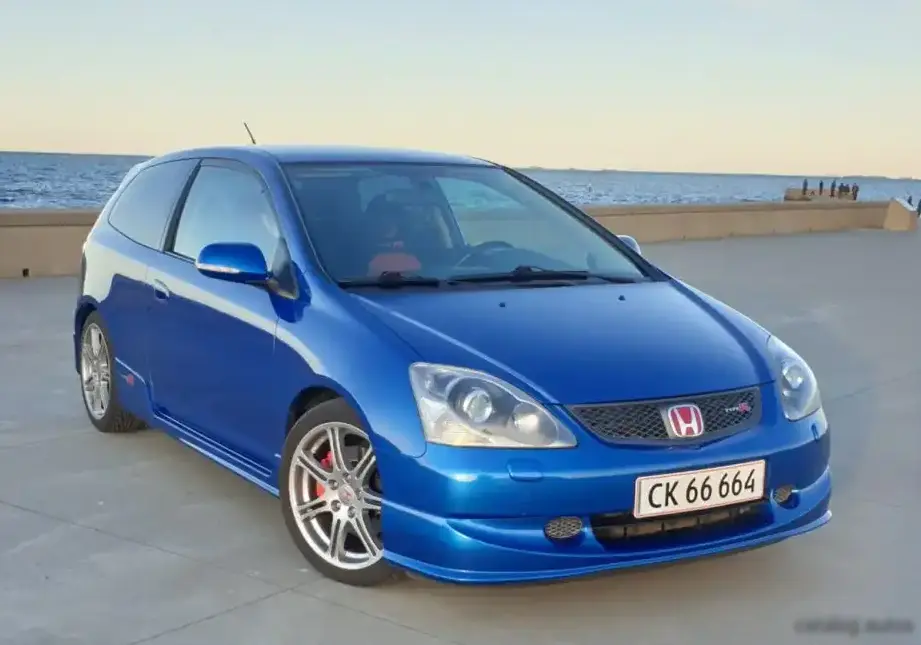
The Honda Civic Type R (EP3), particularly the facelifted version introduced in 2003, represents a significant chapter in the evolution of Honda’s performance-oriented subcompact. Produced from 2003 to 2005, this generation marked the first time the Type R designation was applied to a Civic sold outside of Japan. Built on the Honda Civic (EP3/A3) platform, the 2003 facelift brought subtle but important revisions to the exterior styling and, crucially, to the engine management system, refining the already potent performance characteristics. This variant aimed to deliver a focused driving experience, bridging the gap between everyday usability and track-day capability, primarily targeting driving enthusiasts.
Technical Specifications
| Brand | Honda |
| Model | Civic Type R |
| Generation | Civic Type R (EP3, facelift 2003) |
| Type (Engine) | 2.0 (200 Hp) |
| Start of production | 2003 |
| End of production | 2005 |
| Powertrain Architecture | Internal Combustion engine |
| Body type | Hatchback |
| Seats | 4 |
| Doors | 3 |
| Fuel consumption (economy) – urban (NEDC) | 12.3 l/100 km (19.1 US mpg, 23 UK mpg, 8.1 km/l) |
| Fuel consumption (economy) – extra urban (NEDC) | 7 l/100 km (33.6 US mpg, 40.4 UK mpg, 14.3 km/l) |
| Fuel consumption (economy) – combined (NEDC) | 8.9 l/100 km (26.4 US mpg, 31.7 UK mpg, 11.2 km/l) |
| CO2 emissions (NEDC) | 212 g/km |
| Fuel Type | Petrol (Gasoline) |
| Acceleration 0 – 100 km/h | 6.6 sec |
| Acceleration 0 – 62 mph | 6.6 sec |
| Acceleration 0 – 60 mph | 6.3 sec |
| Maximum speed | 235 km/h (146.02 mph) |
| Emission standard | Euro 3 |
| Weight-to-power ratio | 6 kg/Hp, 166.1 Hp/tonne |
| Weight-to-torque ratio | 6.1 kg/Nm, 162.8 Nm/tonne |
| Power | 200 Hp @ 7400 rpm |
| Power per litre | 100.1 Hp/l |
| Torque | 196 Nm @ 5900 rpm (144.56 lb.-ft. @ 5900 rpm) |
| Engine layout | Front, Transverse |
| Engine Model/Code | K20A2 |
| Engine displacement | 1998 cm3 (121.93 cu. in.) |
| Number of cylinders | 4 |
| Engine configuration | Inline |
| Cylinder Bore | 86 mm (3.39 in.) |
| Piston Stroke | 86 mm (3.39 in.) |
| Compression ratio | 11:1 |
| Number of valves per cylinder | 4 |
| Fuel injection system | Multi-port manifold injection |
| Engine aspiration | Naturally aspirated engine |
| Valvetrain | DOHC, i-VTEC |
| Engine oil capacity | 4.5 l (4.76 US qt, 3.96 UK qt) |
| Coolant | 5.3 l (5.6 US qt, 4.66 UK qt) |
| Kerb Weight | 1204 kg (2654.37 lbs.) |
| Max. weight | 1550 kg (3417.17 lbs.) |
| Max load | 346 kg (762.8 lbs.) |
| Trunk (boot) space – minimum | 315 l (11.12 cu. ft.) |
| Trunk (boot) space – maximum | 610 l (21.54 cu. ft.) |
| Fuel tank capacity | 50 l (13.21 US gal, 11 UK gal) |
| Max. roof load | 30 kg (66.14 lbs.) |
| Length | 4140 mm (162.99 in.) |
| Width | 1695 mm (66.73 in.) |
| Width including mirrors | 1980 mm (77.95 in.) |
| Height | 1425 mm (56.1 in.) |
| Wheelbase | 2575 mm (101.38 in.) |
| Front track | 1472 mm (57.95 in.) |
| Rear (Back) track | 1487 mm (58.54 in.) |
| Ride height (ground clearance) | 125 mm (4.92 in.) |
| Minimum turning circle (turning diameter) | 12.2 m (40.03 ft.) |
| Drivetrain Architecture | The Internal combustion engine (ICE) drives the front wheels of the vehicle. |
| Drive wheel | Front wheel drive |
| Number of gears and type of gearbox | 6 gears, manual transmission |
| Front suspension | Independent, type McPherson with coil spring and anti-roll bar |
| Rear suspension | Double wishbone, Transverse stabilizer |
| Front brakes | Ventilated discs, 300 mm |
| Rear brakes | Disc, 260 mm |
| Assisting systems | ABS (Anti-lock braking system) |
| Steering type | Steering rack and pinion |
| Power steering | Electric Steering |
| Tires size | 205/45 R17 |
| Wheel rims size | 7J x 17 |
Powertrain & Engine Architecture
The heart of the 2003 facelift Civic Type R is the K20A2 2.0-liter inline-four cylinder engine. This engine is a naturally aspirated powerplant, benefiting from Honda’s i-VTEC (intelligent Variable Timing and Lift Electronic Control) technology. The i-VTEC system allows for variable valve timing and lift, optimizing performance across the rev range. The K20A2 features a high 11:1 compression ratio and multi-point fuel injection. The engine produces 200 horsepower at 7400 rpm and 196 Nm (144.56 lb-ft) of torque at 5900 rpm. The engine is transversely mounted, driving the front wheels. The sole transmission option was a close-ratio 6-speed manual gearbox, designed to maximize the engine’s potential and provide a direct connection to the driver.
Driving Characteristics
The EP3 Type R, with its 200 hp and 6-speed manual, offered a distinctly engaging driving experience. While not possessing the outright acceleration of some rivals, the engine’s responsiveness and the precise gearbox made for a rewarding drive. The close-ratio gearbox kept the engine within its powerband, allowing for quick shifts and maintaining momentum. Compared to the later Civic Si models, the Type R offered a more raw and focused experience, prioritizing handling and driver involvement over outright comfort. The EP3’s steering was precise and well-weighted, contributing to a confident feel on winding roads.
Equipment & Trim Levels
The Civic Type R was relatively sparsely equipped compared to some contemporary hot hatches, reflecting its focus on performance. Standard features included sport seats with a distinctive red and black fabric, a leather-wrapped steering wheel, and air conditioning. The interior featured aluminum trim accents and a unique instrument cluster with a prominent tachometer. Optional extras were limited, typically including a sunroof and upgraded audio system. The overall interior design was functional and driver-focused, prioritizing usability over luxury.
Chassis & Braking
The EP3 Type R benefited from a revised suspension setup compared to the standard Civic. It featured stiffer springs and dampers, along with a thicker front anti-roll bar, to reduce body roll and improve handling. The front suspension utilized a McPherson strut design, while the rear employed a double-wishbone setup. Braking duties were handled by ventilated discs at the front and solid discs at the rear, equipped with ABS. The chassis was reinforced in key areas to improve rigidity and enhance handling precision.
Market Reception & Comparison
The EP3 Type R received mixed reviews upon its release. While praised for its engaging driving dynamics and potent engine, some critics found the styling somewhat bland and the ride quality firm. Compared to rivals like the Volkswagen Golf GTI and Ford Focus ST, the Type R offered a more focused and raw driving experience, but lacked some of their refinement and practicality. Fuel economy was reasonable for a performance car of its era, averaging around 26.4 US mpg in combined driving. Reliability was generally good, typical of Honda products, although preventative maintenance was crucial to ensure longevity.
Legacy
The Honda Civic Type R (EP3) holds a special place in the hearts of many Honda enthusiasts. It was a pivotal model, marking the expansion of the Type R badge beyond the Japanese market. While later generations of the Civic Type R have raised the performance bar significantly, the EP3 remains a popular choice for those seeking a classic, engaging, and relatively affordable hot hatch. The K20A2 engine is known for its durability and tunability, making it a favorite among enthusiasts. Today, well-maintained examples of the EP3 Type R are becoming increasingly collectible, representing a significant piece of Honda’s performance heritage.