Technical Specifications
| Brand | Honda |
| Model | Civic |
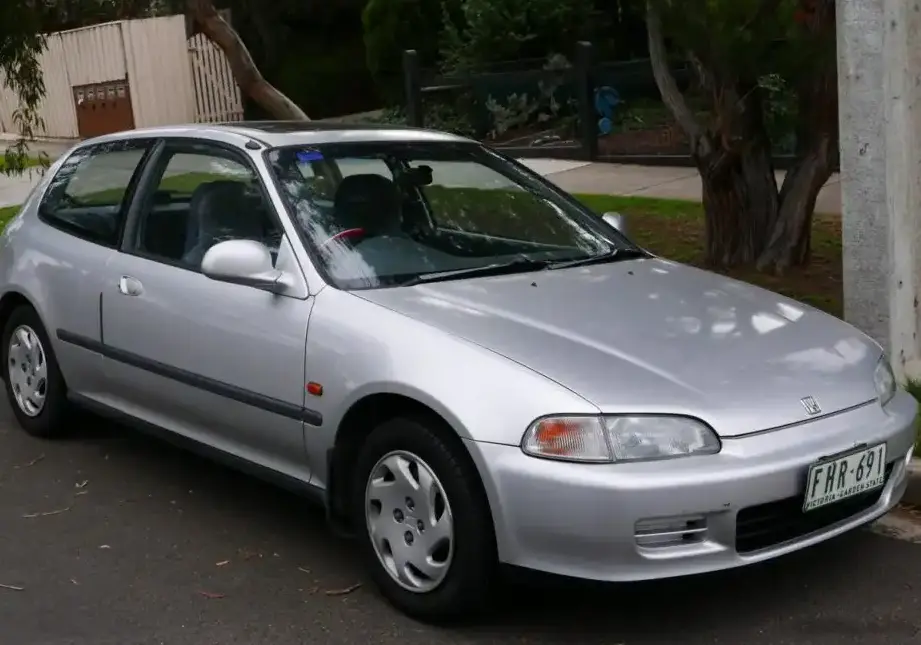
| Generation | Civic V Hatchback |
| Type (Engine) | 1.6 VTi 16V (160 Hp) |
| Start of production | 1991 |
| End of production | 1995 |
| Powertrain Architecture | Internal Combustion engine |
| Body type | Hatchback |
| Seats | 5 |
| Doors | 3 |
| Fuel consumption (combined) | 7.5 l/100 km |
| Fuel consumption (US mpg) | 31.4 US mpg |
| Fuel consumption (UK mpg) | 37.7 UK mpg |
| Fuel consumption (km/l) | 13.3 km/l |
| Fuel Type | Petrol (Gasoline) |
| Acceleration 0 – 100 km/h | 7.3 sec |
| Acceleration 0 – 62 mph | 7.3 sec |
| Acceleration 0 – 60 mph | 6.9 sec |
| Maximum speed | 215 km/h (133.59 mph) |
| Weight-to-power ratio | 6.8 kg/Hp |
| Weight-to-torque ratio | 7.2 kg/Nm |
| Power | 160 Hp @ 7600 rpm |
| Power per litre | 100.3 Hp/l |
| Torque | 150 Nm @ 7000 rpm (110.63 lb.-ft. @ 7000 rpm) |
| Engine layout | Front, Transverse |
| Engine Model/Code | B16A2 |
| Engine displacement | 1595 cm3 (97.33 cu. in.) |
| Number of cylinders | 4 |
| Engine configuration | Inline |
| Cylinder Bore | 81 mm (3.19 in.) |
| Piston Stroke | 77.4 mm (3.05 in.) |
| Compression ratio | 10.2:1 |
| Number of valves per cylinder | 4 |
| Fuel injection system | Multi-port manifold injection |
| Engine aspiration | Naturally aspirated engine |
| Valvetrain | DOHC |
| Engine oil capacity | 4 l (4.23 US qt | 3.52 UK qt) |
| Coolant capacity | 3.9 l (4.12 US qt | 3.43 UK qt) |
| Kerb Weight | 1080 kg (2380.99 lbs.) |
| Max. weight | 1460 kg (3218.75 lbs.) |
| Max load | 380 kg (837.76 lbs.) |
| Trunk (boot) space – minimum | 190 l (6.71 cu. ft.) |
| Trunk (boot) space – maximum | 510 l (18.01 cu. ft.) |
| Fuel tank capacity | 45 l (11.89 US gal | 9.9 UK gal) |
| Length | 4080 mm (160.63 in.) |
| Width | 1695 mm (66.73 in.) |
| Height | 1345 mm (52.95 in.) |
| Wheelbase | 2570 mm (101.18 in.) |
| Front track | 1475 mm (58.07 in.) |
| Rear (Back) track | 1465 mm (57.68 in.) |
| Drivetrain Architecture | Front wheel drive |
| Number of gears | 5 gears, manual transmission |
| Front suspension | Double wishbone |
| Rear suspension | Double wishbone |
| Front brakes | Ventilated discs |
| Rear brakes | Disc |
| Assisting systems | ABS (Anti-lock braking system) |
| Steering type | Steering rack and pinion |
| Power steering | Hydraulic Steering |
| Tires size | 195/55 R15 |
The Honda Civic V Hatchback 1.6 VTi 16V, produced between 1991 and 1995, represents a significant evolution in the fifth generation (EG) of Honda’s iconic Civic line. This particular variant, often simply referred to as the “160 hp” model, was positioned as a sporty, performance-oriented offering within the broader Civic Hatchback range. It played a crucial role in establishing the Civic as a desirable choice for young drivers and enthusiasts, particularly in markets like Europe and Japan where compact, fuel-efficient, yet engaging hatchbacks were highly sought after. The EG chassis, known for its lightweight construction and nimble handling, provided an excellent platform for the potent 1.6-liter engine.
Powertrain & Engine Architecture
At the heart of the 1.6 VTi 16V lay the B16A2 engine, a 1.6-liter (1595 cc) inline-four cylinder powerplant. This engine was a significant upgrade over the standard Civic engines, featuring a 16-valve cylinder head with dual overhead camshafts (DOHC). This configuration allowed for improved airflow and higher engine speeds, contributing to its 160 horsepower output at 7600 rpm and 150 Nm (110.63 lb-ft) of torque at 7000 rpm. The B16A2 utilized Honda’s Programmed Fuel Injection (PGM-FI) multi-port fuel injection system, ensuring precise fuel delivery for optimal performance and efficiency. The engine’s high compression ratio of 10.2:1 further enhanced its power output. The engine was paired exclusively with a five-speed manual transmission, optimized for the engine’s powerband. This transmission featured close ratios designed to maximize acceleration and provide an engaging driving experience.
Driving Characteristics
The 1.6 VTi 16V offered a noticeably more engaging driving experience compared to lower-spec Civic models. The engine’s high-revving nature demanded frequent gear changes to stay within its powerband, but the reward was a responsive and energetic feel. Acceleration from 0 to 60 mph was achieved in approximately 6.9 seconds, making it a relatively quick hatchback for its time. The close-ratio five-speed manual transmission allowed drivers to fully exploit the engine’s power, while the lightweight chassis and well-tuned suspension contributed to nimble handling. Compared to later Civic Si models, the VTi 16V prioritized a more balanced approach, offering a blend of performance and everyday usability. While not as raw or track-focused as some of its successors, it provided a satisfying and enjoyable driving experience.
Equipment & Trim Levels
The VTi 16V trim level included several features that distinguished it from the base Civic models. Standard equipment typically included power steering, electric windows, central locking, and a more refined interior trim. The interior often featured sport seats with a distinctive fabric pattern. Optional extras could include a sunroof, upgraded audio system, and alloy wheels. The dashboard layout was typical of the Civic V, with a functional and straightforward design. The VTi 16V often featured a sportier steering wheel and instrumentation compared to lower trims.
Chassis & Braking
The Civic V Hatchback utilized a lightweight monocoque chassis with independent double wishbone suspension at both the front and rear. This suspension setup provided a good balance of ride comfort and handling precision. The 1.6 VTi 16V was equipped with ventilated disc brakes at the front and solid disc brakes at the rear, providing adequate stopping power for its performance level. An Anti-lock Braking System (ABS) was often included as standard equipment, enhancing safety and control during hard braking. The steering system employed a rack and pinion setup with hydraulic power assistance, offering precise and responsive steering feel.
Market Reception & Comparison
The 1.6 VTi 16V was generally well-received by automotive critics, who praised its lively engine, nimble handling, and overall value. It was often compared favorably to other performance hatchbacks of the era, such as the Volkswagen Golf GTI and Peugeot 205 GTI. While not as overtly aggressive as some of its rivals, the Civic VTi 16V offered a more refined and reliable alternative. Fuel economy was respectable for a performance-oriented hatchback, averaging around 31.4 US mpg. Reliability was a key strength, with the B16A2 engine proving to be durable and long-lasting.
Legacy
The Honda Civic V Hatchback 1.6 VTi 16V has become a sought-after model among enthusiasts and collectors. The B16A2 engine is highly regarded for its performance and tunability, and the lightweight chassis makes it an excellent platform for modification. Well-maintained examples are becoming increasingly rare, and prices have been steadily rising in recent years. The 1.6 VTi 16V represents a high point in the fifth-generation Civic’s development, and it continues to be appreciated for its blend of performance, reliability, and practicality. Its enduring popularity is a testament to Honda’s engineering prowess and the Civic’s lasting appeal.