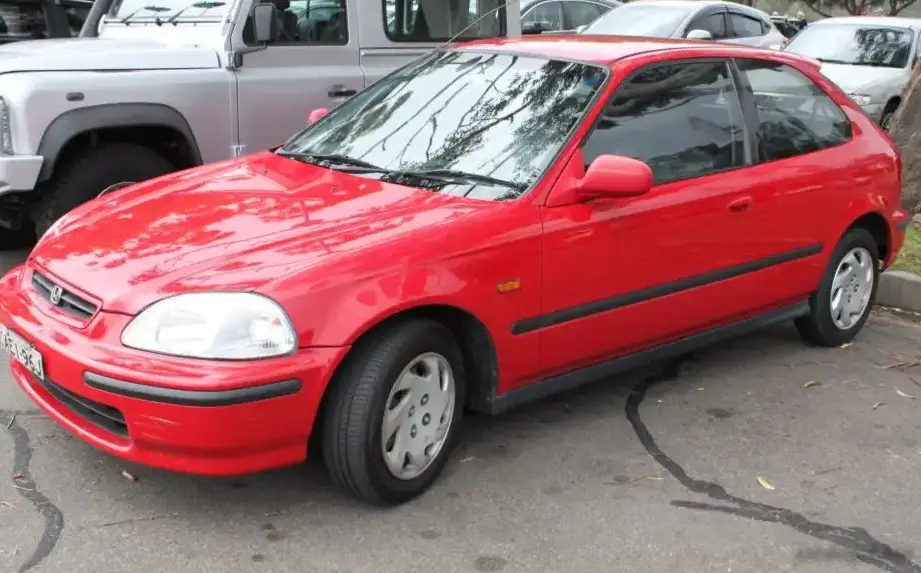
The Honda Civic VI Hatchback 1.5 VTEC-E Automatic, produced between 1995 and 2001, represented a key offering within the sixth generation (EG/EH/EJ) of Honda’s globally successful Civic line. This particular variant, powered by the D15Z6 engine and paired with a four-speed automatic transmission, was primarily aimed at buyers seeking a balance of fuel efficiency, reliability, and ease of use. It occupied a mid-range position in the Civic Hatchback lineup, slotting below the more performance-oriented models and above the base-level trims. The Civic VI generation, sold in various body styles, was a significant model for Honda, solidifying its reputation for quality and innovation in the compact car segment, particularly in North America and Europe.
Technical Specifications
| Brand | Honda |
| Model | Civic |
| Generation | Civic VI Hatchback |
| Type (Engine) | 1.5 VTEC-E (114 Hp) Automatic |
| Start of production | 1995 |
| End of production | 2001 |
| Powertrain Architecture | Internal Combustion engine |
| Body type | Hatchback |
| Seats | 5 |
| Doors | 3 |
| Fuel consumption (urban) | 7.7 l/100 km (30.5 US mpg) |
| Fuel consumption (extra urban) | 5.1 l/100 km (46.1 US mpg) |
| Fuel consumption (combined) | 6.5 l/100 km (36.2 US mpg) |
| Fuel Type | Petrol (Gasoline) |
| Acceleration 0 – 100 km/h | 12.2 sec |
| Acceleration 0 – 62 mph | 12.2 sec |
| Acceleration 0 – 60 mph | 11.6 sec |
| Maximum speed | 177 km/h (109.98 mph) |
| Weight-to-power ratio | 9 kg/Hp |
| Weight-to-torque ratio | 7.7 kg/Nm |
| Power | 114 Hp @ 6500 rpm |
| Torque | 134 Nm @ 5500 rpm (98.83 lb.-ft. @ 5500 rpm) |
| Engine layout | Front, Transverse |
| Engine Model/Code | D15Z6 |
| Engine displacement | 1493 cm3 (91.11 cu. in.) |
| Number of cylinders | 4 |
| Engine configuration | Inline |
| Cylinder Bore | 75 mm (2.95 in.) |
| Piston Stroke | 84.5 mm (3.33 in.) |
| Compression ratio | 9.6:1 |
| Number of valves per cylinder | 4 |
| Fuel injection system | Multi-port manifold injection |
| Engine aspiration | Naturally aspirated |
| Valvetrain | SOHC |
| Engine oil capacity | 3.3 l (3.49 US qt | 2.9 UK qt) |
| Kerb Weight | 1030 kg (2270.76 lbs.) |
| Max. weight | 1475 kg (3251.82 lbs.) |
| Max load | 445 kg (981.06 lbs.) |
| Trunk (boot) space – minimum | 225 l (7.95 cu. ft.) |
| Trunk (boot) space – maximum | 600 l (21.19 cu. ft.) |
| Fuel tank capacity | 45 l (11.89 US gal | 9.9 UK gal) |
| Length | 4190 mm (164.96 in.) |
| Width | 1695 mm (66.73 in.) |
| Height | 1375 mm (54.13 in.) |
| Wheelbase | 2620 mm (103.15 in.) |
| Front track | 1478 mm (58.19 in.) |
| Rear (Back) track | 1488 mm (58.58 in.) |
| Drag coefficient (Cd) | 0.34 |
| Minimum turning circle | 10.0 m (32.81 ft.) |
| Drivetrain Architecture | Front wheel drive |
| Number of gears | 4 |
| Gearbox type | Automatic transmission |
| Front suspension | Double wishbone |
| Rear suspension | Double wishbone |
| Front brakes | Ventilated discs |
| Rear brakes | Drum |
| Assisting systems | ABS (Anti-lock braking system) |
| Steering type | Steering rack and pinion |
| Power steering | Hydraulic |
| Tires size | 175/65 R14 |
| Wheel rims size | 14 |
Powertrain & Engine Architecture
The heart of the Civic 1.5 VTEC-E Automatic is the D15Z6 engine, a 1.5-liter inline-four cylinder powerplant. This engine is a member of Honda’s D-series, known for its reliability and fuel efficiency. The “VTEC-E” designation indicates a variation of Honda’s Variable Valve Timing and Lift Electronic Control system, optimized for economy rather than outright performance. Unlike the more aggressive VTEC systems found in higher-performance Civics, VTEC-E utilizes a milder cam profile switchover to improve fuel economy at lower engine speeds. The D15Z6 features multi-port fuel injection and a single overhead camshaft (SOHC) design. The four-speed automatic transmission, while providing convenient operation, was not known for its sporty characteristics. It prioritized smooth shifts and fuel efficiency over rapid acceleration. The transmission’s gear ratios were geared towards maximizing fuel economy, resulting in a somewhat leisurely driving experience.
Driving Characteristics
The 1.5 VTEC-E Automatic offered a comfortable and predictable driving experience. Acceleration from a standstill to 60 mph took around 11.6 to 12.2 seconds, making it slower than the manual transmission versions or those equipped with larger engines. The automatic transmission’s shift points were programmed for fuel efficiency, meaning the engine often operated at lower RPMs. This contributed to good fuel economy – around 36.2 US mpg combined – but also meant that the engine sometimes felt strained when attempting to accelerate quickly or climb hills. The steering was light and precise, typical of Honda vehicles, and the suspension provided a comfortable ride, although it wasn’t particularly sporty. Overall, this variant was best suited for daily commuting and relaxed driving rather than spirited performance.
Equipment & Trim Levels
The 1.5 VTEC-E Automatic typically came equipped with standard features such as power steering, air conditioning, and an AM/FM radio. Interior upholstery was usually cloth, and the dashboard featured a straightforward layout with easy-to-read gauges. Optional extras included power windows, power locks, and a sunroof. The trim level often dictated the availability of these options. While not as lavishly equipped as some of the higher-end Civic trims, the 1.5 VTEC-E Automatic provided a reasonable level of comfort and convenience for its price point.
Chassis & Braking
The Civic VI Hatchback utilized a front-wheel-drive layout with independent double wishbone suspension at both the front and rear. This suspension design provided a good balance of ride comfort and handling. The front brakes were ventilated discs, offering adequate stopping power, while the rear brakes were drums, a cost-saving measure common in this class of vehicle. Anti-lock Braking System (ABS) was often included as standard equipment, enhancing safety. The chassis was relatively lightweight, contributing to the car’s fuel efficiency and maneuverability.
Market Reception & Comparison
The Civic 1.5 VTEC-E Automatic was generally well-received by critics as a practical and reliable choice for budget-conscious buyers. It was praised for its fuel efficiency and ease of use, but criticized for its lack of performance compared to other Civic variants. Compared to the more powerful 1.6-liter VTEC models, the 1.5 VTEC-E Automatic offered significantly less horsepower and torque. However, it was more affordable and offered better fuel economy. The 1.7-liter diesel models provided better torque but were slower and less refined. The automatic transmission, while convenient, was often seen as a compromise compared to the more engaging manual gearbox.
Legacy
The D15Z6 engine, when properly maintained, proved to be remarkably durable. Many examples of the Civic 1.5 VTEC-E Automatic are still on the road today, a testament to Honda’s engineering quality. While not a particularly sought-after variant by enthusiasts, it remains a popular choice for those seeking an affordable and reliable used car. Parts availability is generally good, and maintenance costs are relatively low. The Civic VI generation, as a whole, is remembered as a well-rounded and dependable vehicle that helped solidify Honda’s position as a leading automotive manufacturer.