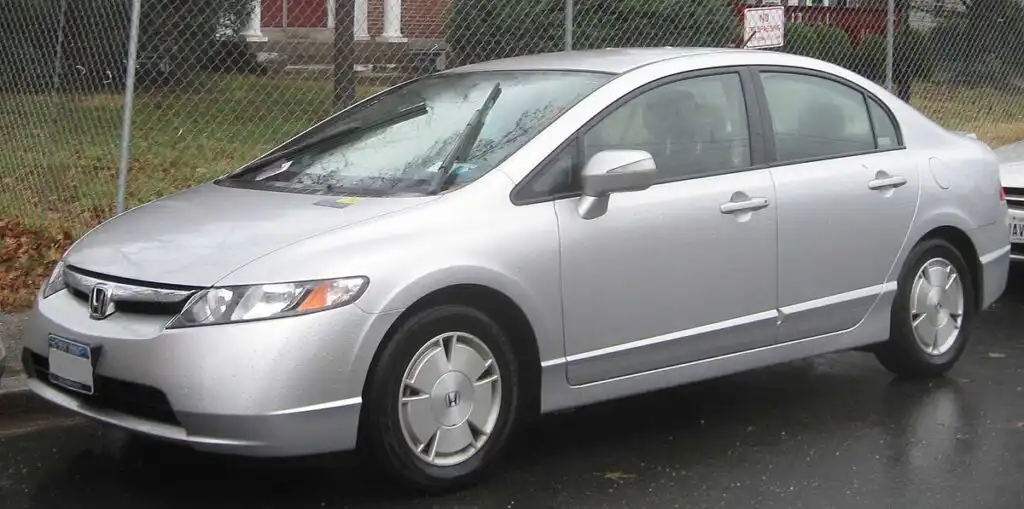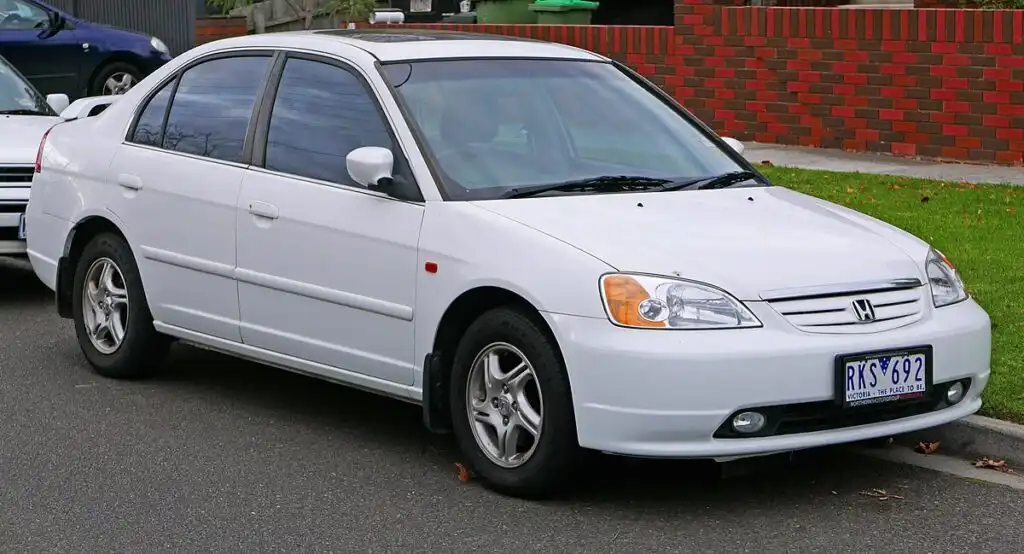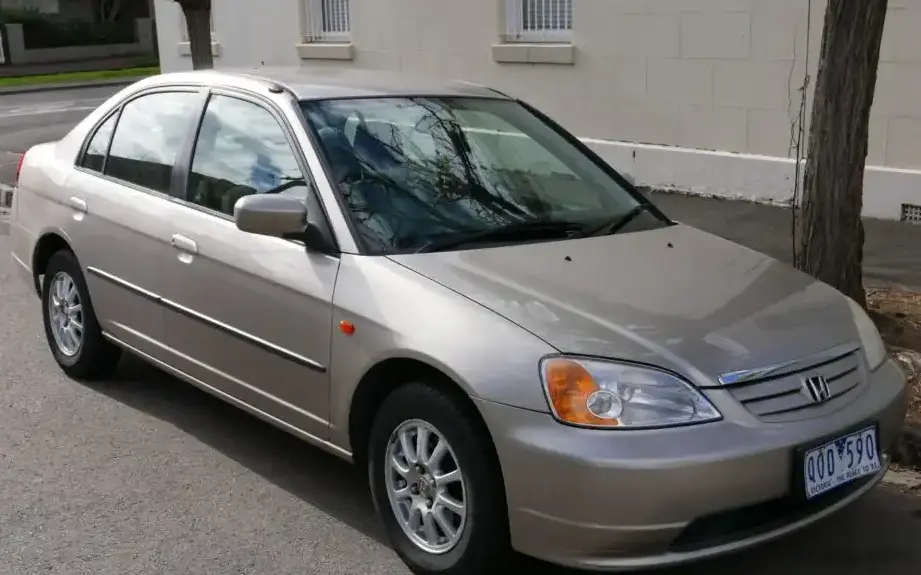
The Honda Civic VII Sedan 1.4 i 16V (90 hp) was a popular entry-level variant of the seventh-generation Civic, produced between 2001 and 2006. Positioned as the base model in many markets, it offered a balance of affordability, fuel efficiency, and Honda’s reputation for reliability. This model played a significant role in maintaining the Civic’s dominance in the compact car segment, particularly in Europe and Asia, where smaller displacement engines were favored due to tax regulations and fuel costs. While not the most powerful Civic available, the 1.4L engine and five-speed manual transmission combination provided adequate performance for daily commuting and urban driving.
Technical Specifications
| Brand | Honda |
| Model | Civic |
| Generation | Civic VII Sedan |
| Type (Engine) | 1.4 i 16V (90 Hp) |
| Start of production | 2001 |
| End of production | 2006 |
| Powertrain Architecture | Internal Combustion engine |
| Body type | Sedan |
| Seats | 5 |
| Doors | 4 |
| Fuel consumption (urban) | 8.2 l/100 km (28.7 US mpg) |
| Fuel consumption (extra urban) | 5.4 l/100 km (43.6 US mpg) |
| Fuel Type | Petrol (Gasoline) |
| Acceleration 0 – 100 km/h | 11.3 sec |
| Acceleration 0 – 62 mph | 11.3 sec |
| Acceleration 0 – 60 mph | 10.7 sec |
| Maximum speed | 185 km/h (114.95 mph) |
| Weight-to-power ratio | 12.1 kg/Hp |
| Weight-to-torque ratio | 9.1 kg/Nm |
| Power | 90 Hp @ 6400 rpm |
| Power per litre | 64.5 Hp/l |
| Torque | 120 Nm @ 4800 rpm (88.51 lb.-ft. @ 4800 rpm) |
| Engine layout | Front, Transverse |
| Engine Model/Code | D14Z6 |
| Engine displacement | 1396 cm3 (85.19 cu. in.) |
| Number of cylinders | 4 |
| Engine configuration | Inline |
| Cylinder Bore | 75 mm (2.95 in.) |
| Piston Stroke | 79 mm (3.11 in.) |
| Compression ratio | 9:1 |
| Number of valves per cylinder | 4 |
| Fuel injection system | Multi-port manifold injection |
| Engine aspiration | Naturally aspirated engine |
| Valvetrain | OHC |
| Engine oil capacity | 3.2 l (3.38 US qt | 2.82 UK qt) |
| Coolant capacity | 4 l (4.23 US qt | 3.52 UK qt) |
| Kerb Weight | 1090 kg (2403.04 lbs.) |
| Max. weight | 1550 kg (3417.17 lbs.) |
| Max load | 460 kg (1014.13 lbs.) |
| Trunk (boot) space – minimum | 450 l (15.89 cu. ft.) |
| Fuel tank capacity | 50 l (13.21 US gal | 11 UK gal) |
| Length | 4458 mm (175.51 in.) |
| Width | 1715 mm (67.52 in.) |
| Height | 1440 mm (56.69 in.) |
| Wheelbase | 2620 mm (103.15 in.) |
| Front track | 1468 mm (57.8 in.) |
| Rear (Back) track | 1462 mm (57.56 in.) |
| Drivetrain Architecture | Front wheel drive |
| Number of gears and type of gearbox | 5 gears, manual transmission |
| Front suspension | Double wishbone |
| Rear suspension | Spring Strut |
| Front brakes | Ventilated discs |
| Rear brakes | Disc |
| Assisting systems | ABS (Anti-lock braking system) |
| Steering type | Steering rack and pinion |
| Tires size | 185/70 R14 |
INTRODUCTION
The Honda Civic VII Sedan, launched in 2001, represented a significant evolution for Honda’s best-selling model. The 1.4 i 16V variant, powered by the D14Z6 engine, was specifically tailored for markets where smaller engines were preferred. It served as the entry point into the Civic range, offering a practical and economical option for buyers. This generation of Civic moved away from the more rounded styling of its predecessor, adopting a sharper, more contemporary design. The 1.4L model was a key component of this strategy, appealing to a broader customer base with its affordability and fuel efficiency.
Powertrain & Engine Architecture
The heart of the Civic 1.4 i 16V is the D14Z6 engine, a 1.4-liter (1396 cc) inline-four cylinder powerplant. This engine features a single overhead camshaft (SOHC) valvetrain operating 16 valves. It utilizes a multi-point fuel injection system for precise fuel delivery, contributing to its relatively good fuel economy. The D14Z6 is a non-VTEC engine, meaning it lacks Honda’s variable valve timing technology found in higher-performance variants. This simplification contributes to its lower cost and increased reliability. The engine produces 90 horsepower at 6400 rpm and 120 Nm (88.51 lb-ft) of torque at 4800 rpm. The engine is transversely mounted, driving the front wheels. The standard transmission for this variant was a five-speed manual gearbox, offering a direct and engaging driving experience. While an automatic transmission was available in some markets, it typically resulted in a slight performance decrease.
Driving Characteristics
The 1.4L Civic Sedan, with its 90 hp output, wasn’t designed for outright speed. Acceleration from 0 to 60 mph took around 10.7 seconds, and its top speed was approximately 115 mph. However, the engine’s torque delivery was reasonably linear, making it suitable for everyday driving. The five-speed manual transmission allowed drivers to keep the engine in its optimal power band, providing adequate performance for merging onto highways and overtaking slower vehicles. Compared to the more powerful 1.6L or 1.7L Civic models, the 1.4L felt noticeably less responsive, particularly when fully loaded. However, its lighter weight and efficient engine contributed to better fuel economy, making it a practical choice for commuters.
Equipment & Trim Levels
The 1.4 i 16V typically came with a fairly basic level of equipment, reflecting its position as the entry-level model. Standard features generally included power steering, central locking, electric front windows, and an AM/FM radio. Air conditioning was often an optional extra. Interior upholstery was typically cloth, and the dashboard featured a simple, functional design. Higher trim levels, available at an additional cost, could add features such as alloy wheels, a CD player, and upgraded interior trim. Safety features included dual airbags and ABS (Anti-lock Braking System) as standard equipment in many markets.
Chassis & Braking
The Civic VII Sedan utilized a front independent suspension with double wishbones, providing a comfortable and controlled ride. The rear suspension employed a spring strut setup. Braking duties were handled by ventilated discs on the front wheels and solid discs on the rear. The ABS system helped to maintain steering control during emergency braking situations. The chassis was designed to be lightweight, contributing to the car’s overall fuel efficiency and handling. The relatively narrow tires (185/70 R14) provided adequate grip for everyday driving conditions.
Market Reception & Comparison
The Civic 1.4 i 16V was generally well-received by critics as a practical and economical choice. It was praised for its reliability, fuel efficiency, and comfortable ride. However, some reviewers noted its lack of power compared to other Civic variants. Compared to the 1.6L or 1.7L models, the 1.4L offered significantly lower running costs but at the expense of performance. Against competitors like the Ford Focus, Volkswagen Golf, and Opel/Vauxhall Astra, the Civic 1.4L held its own in terms of reliability and fuel economy, often proving to be a more dependable option in the long run.
Legacy
The D14Z6 engine, while not known for its high performance, has proven to be remarkably durable and reliable. Civic VII Sedans equipped with this engine are still commonly seen on the roads today, often with high mileage. The engine’s simplicity and robust construction contribute to its longevity. In the used car market, the 1.4L variant remains an affordable option for buyers seeking a dependable and economical compact car. While it may not be a collector’s item, its reputation for reliability ensures continued demand and a relatively stable resale value.