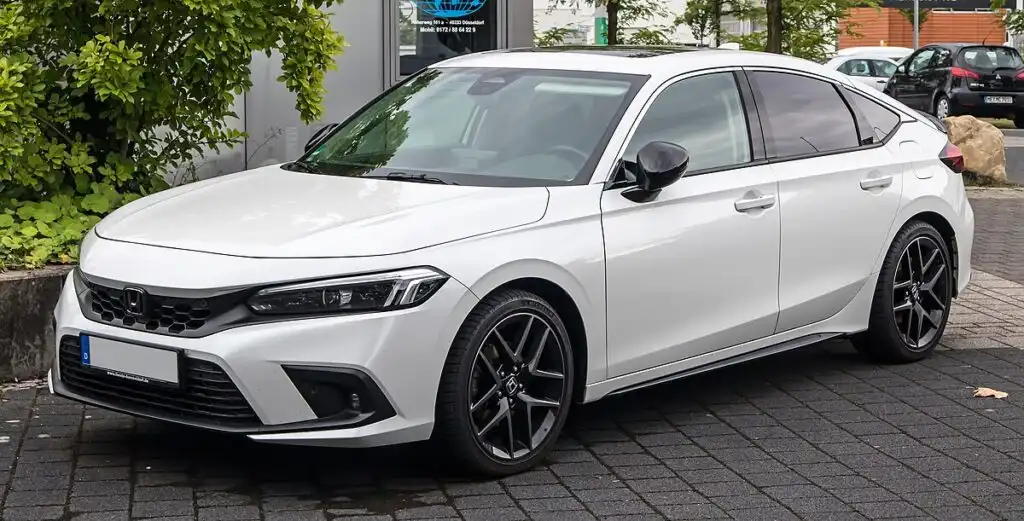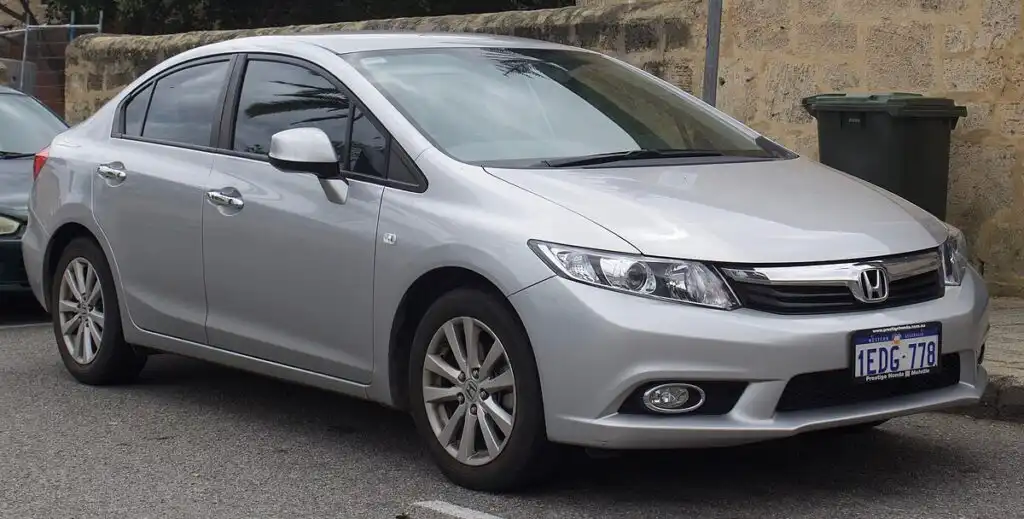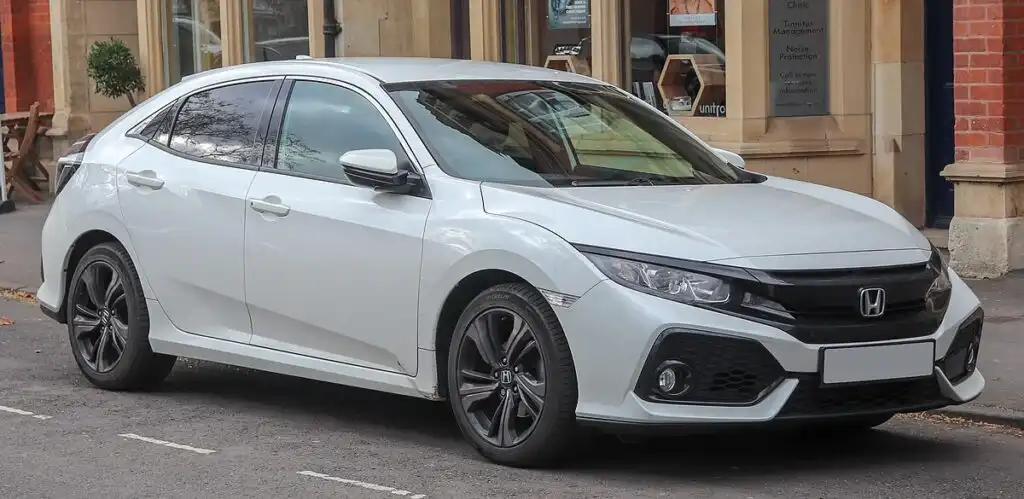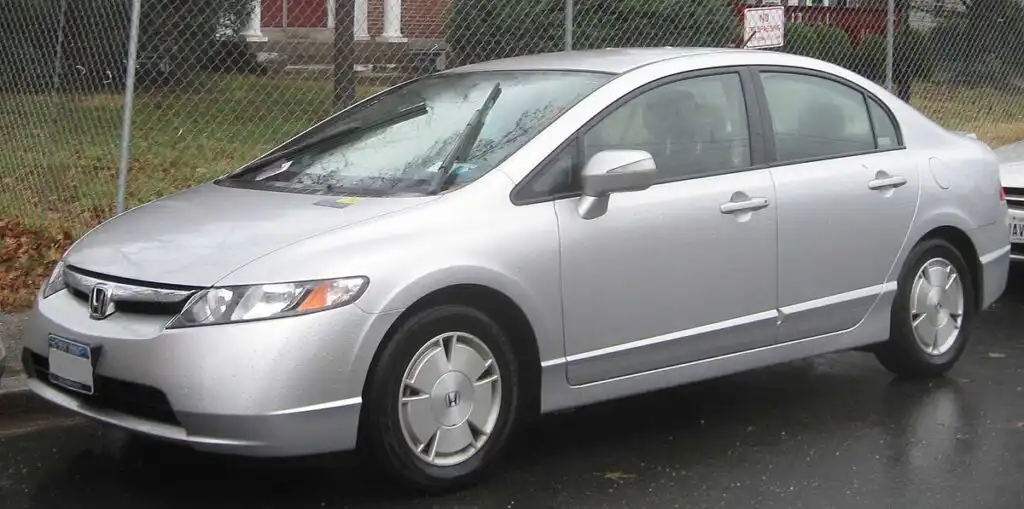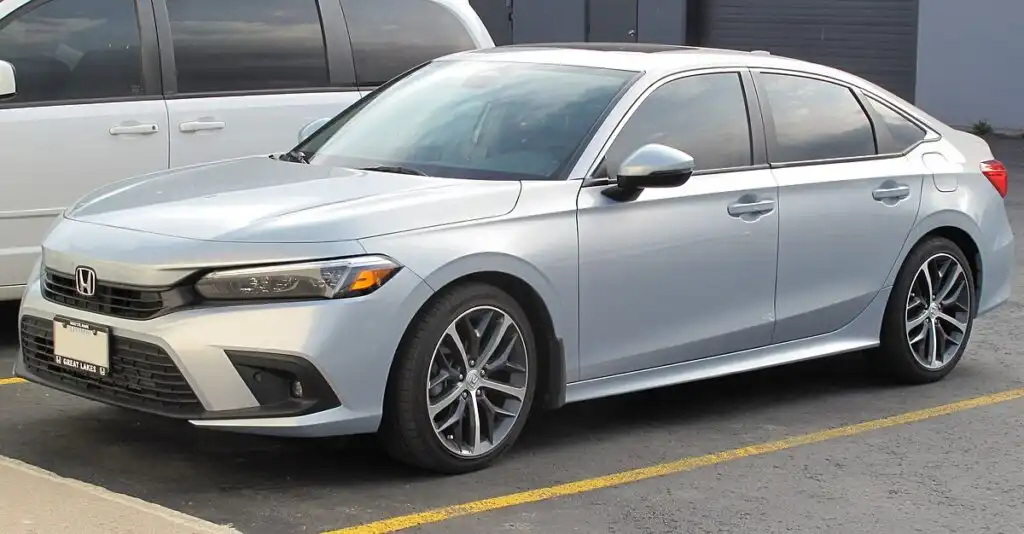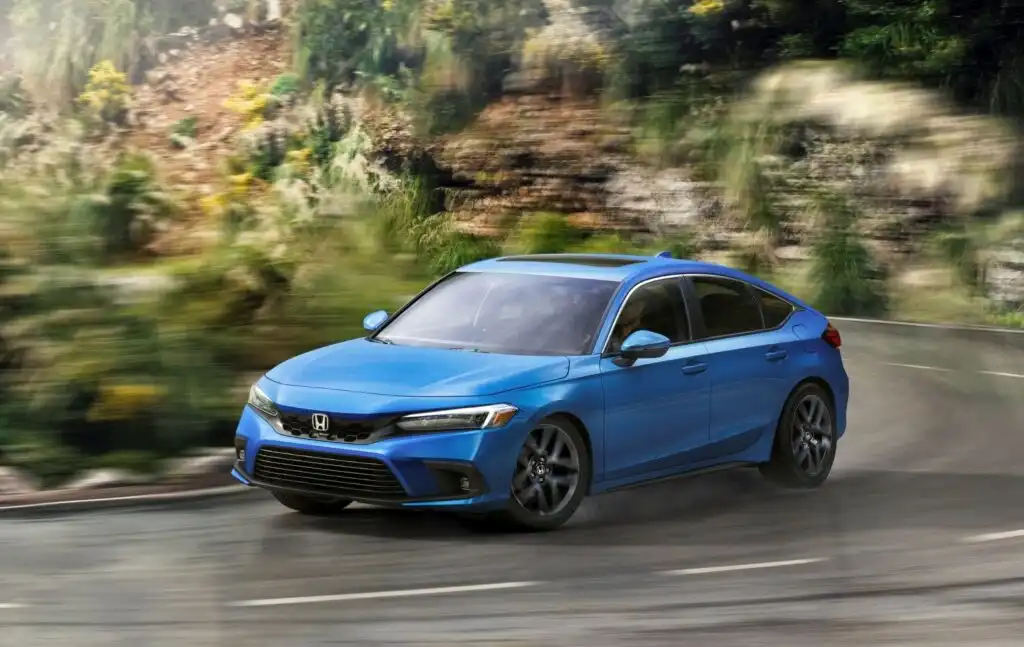
The Honda Civic XI 2.0 i-MMD (184 Hp) e:HEV e-CVT, introduced in October 2022, represents a significant step in Honda’s hybrid technology within the globally popular Civic lineup. This variant is part of the eleventh generation (Civic XI) and utilizes Honda’s innovative e:HEV full hybrid system. Positioned as a mid-range offering, it balances fuel efficiency with respectable performance, appealing to buyers seeking a practical and technologically advanced compact car. The Civic XI platform, designated 1HX0/A3, aimed to deliver a more sophisticated driving experience and improved fuel economy compared to its predecessor.
Technical Specifications
| Brand | Honda |
| Model | Civic |
| Generation | Civic XI |
| Type (Engine) | 2.0 i-MMD (184 Hp) e:HEV e-CVT |
| Start of production | October, 2022 |
| Powertrain Architecture | FHEV (Full Hybrid Electric Vehicle) |
| Body type | Liftback |
| Seats | 5 |
| Doors | 5 |
| Fuel consumption at Low speed (WLTP) | 4.2-4.5 l/100 km (56 – 52.3 US mpg) |
| Fuel consumption at Medium speed (WLTP) | 3.9-4.2 l/100 km (60.3 – 56 US mpg) |
| Fuel consumption at high speed (WLTP) | 4.2-4.5 l/100 km (56 – 52.3 US mpg) |
| Fuel consumption at very high speed (WLTP) | 5.9-6.2 l/100 km (39.9 – 37.9 US mpg) |
| Combined fuel consumption (WLTP) | 4.7-5.0 l/100 km (50 – 47 US mpg) |
| CO2 emissions (WLTP) | 108-114 g/km |
| Fuel Type | Petrol (Gasoline) |
| Acceleration 0 – 100 km/h | 7.8 sec |
| Acceleration 0 – 62 mph | 7.8 sec |
| Acceleration 0 – 60 mph | 7.4 sec |
| Maximum speed | 180 km/h (111.85 mph) |
| Emission standard | Euro 6d |
| Weight-to-power ratio | 7.8 kg/Hp, 127.6 Hp/tonne |
| Weight-to-torque ratio | 4.6 kg/Nm, 218.4 Nm/tonne |
| Battery technology | Lithium-ion (Li-Ion) |
| Battery location | Under the rear seats |
| Electric motor power | 184 Hp |
| Electric motor Torque | 315 Nm (232.33 lb.-ft.) |
| Electric motor location | Integrated into the transmission |
| System power | 184 Hp |
| System torque | 315 Nm (232.33 lb.-ft.) |
| Power | 143 Hp @ 6000 rpm |
| Torque | 186 Nm @ 4500 rpm (137.19 lb.-ft. @ 4500 rpm) |
| Engine layout | Front, Transverse |
| Engine Model/Code | LFC1 |
| Engine displacement | 1993 cm3 (121.62 cu. in.) |
| Number of cylinders | 4 |
| Engine configuration | Inline |
| Cylinder Bore | 81 mm (3.19 in.) |
| Piston Stroke | 96.7 mm (3.81 in.) |
| Number of valves per cylinder | 4 |
| Fuel injection system | Direct injection |
| Engine aspiration | Naturally aspirated engine |
| Valvetrain | DOHC, i-VTEC |
| Engine oil capacity | 4.2 l (4.44 US qt | 3.7 UK qt) |
| Kerb Weight | 1442-1458 kg (3179.07 – 3214.34 lbs.) |
| Max. weight | 1930 kg (4254.92 lbs.) |
| Max load | 472-488 kg (1040.58 – 1075.86 lbs.) |
| Trunk (boot) space – minimum | 404 l (14.27 cu. ft.) |
| Trunk (boot) space – maximum | 1220 l (43.08 cu. ft.) |
| Fuel tank capacity | 40 l (10.57 US gal | 8.8 UK gal) |
| Max. roof load | 65 kg (143.3 lbs.) |
| Permitted trailer load with brakes (12%) | 750 kg (1653.47 lbs.) |
| Permitted trailer load without brakes | 600 kg (1322.77 lbs.) |
| Permitted towbar download | 75 kg (165.35 lbs.) |
| Length | 4551 mm (179.17 in.) |
| Width including mirrors | 2082 mm (81.97 in.) |
| Height | 1408 mm (55.43 in.) |
| Wheelbase | 2734 mm (107.64 in.) |
| Front track | 1537-1547 mm (60.51 – 60.91 in.) |
| Rear (Back) track | 1576-1586 mm (62.05 – 62.44 in.) |
| Ride height (ground clearance) | 128 mm (5.04 in.) |
| Minimum turning circle (turning diameter) | 11-11.6 m (36.09 – 38.06 ft.) |
| Drivetrain Architecture | The Internal combustion engine (ICE) and electric motor drive the front wheels of the car with the ability to work in full electric or mixed mode. |
| Drive wheel | Front wheel drive |
| Number of gears and type of gearbox | automatic transmission e-CVT |
| Front suspension | Independent type McPherson |
| Rear suspension | Independent multi-link suspension |
| Front brakes | Ventilated discs, 293 mm |
| Rear brakes | Disc, 282 mm |
| Assisting systems | ABS (Anti-lock braking system) |
| Steering type | Steering rack and pinion |
| Power steering | Electric Steering |
| Tires size | 215/50 R17; 235/40 R18 |
| Wheel rims size | 17; 18 |
Powertrain & Engine Architecture
The 2.0 i-MMD e:HEV powertrain is a series-parallel hybrid system. It combines a 1.993-liter (121.62 cu. in.) naturally aspirated inline-four cylinder engine (code LFC1) with an electric motor. The engine produces 143 horsepower at 6000 rpm and 137.19 lb-ft of torque at 4500 rpm. However, the system’s total output, including the electric motor, is 184 horsepower and 232.33 lb-ft of torque. The engine utilizes Honda’s i-VTEC variable valve timing and direct injection technology for improved efficiency and performance. The e-CVT (electronic continuously variable transmission) doesn’t have traditional gears; instead, it uses a planetary gearset to seamlessly blend power from the engine and electric motor. The lithium-ion battery, located under the rear seats, provides the electrical energy for the motor. The system intelligently switches between EV mode, hybrid mode, and engine mode depending on driving conditions and battery charge.
Driving Characteristics
The Civic 2.0 i-MMD e:HEV e-CVT delivers a smooth and refined driving experience. The e-CVT provides seamless acceleration without the stepped shifts of a conventional automatic transmission. While the 0-60 mph time of around 7.4 seconds is respectable, it’s not as quick as the 1.5L turbocharged Civic models. The focus is on efficiency and linear power delivery. The hybrid system prioritizes electric drive at lower speeds, resulting in quiet and fuel-efficient city driving. During highway cruising, the engine operates more frequently, but the e-CVT keeps the engine in its optimal efficiency range. Compared to manual transmission versions, the e-CVT offers greater convenience, especially in stop-and-go traffic. However, it lacks the driver engagement of a manual gearbox.
Equipment & Trim Levels
The 2.0 i-MMD e-HEV trim typically includes standard features such as Honda Sensing suite of safety and driver-assistive technologies (including adaptive cruise control, lane keeping assist, and collision mitigation braking system), a 7-inch touchscreen infotainment system with Apple CarPlay and Android Auto compatibility, automatic climate control, and LED headlights. Higher trim levels add features like a larger touchscreen, premium audio system, leather upholstery, and a sunroof. Interior upholstery is typically cloth on base trims, with leather options available on higher grades. Dashboard configuration is modern and minimalist, with a focus on user-friendliness.
Chassis & Braking
The Civic XI utilizes a MacPherson strut front suspension and a multi-link rear suspension, providing a comfortable and controlled ride. The suspension is tuned to balance handling and ride quality. Braking duties are handled by ventilated discs at the front and solid discs at the rear. ABS (Anti-lock Braking System) is standard. The chassis is designed to be lightweight yet rigid, contributing to improved handling and fuel efficiency. Stabilizer bars are fitted front and rear to reduce body roll during cornering.
Market Reception & Comparison
The Civic XI 2.0 i-MMD e:HEV e-CVT has been well-received by critics for its fuel efficiency, smooth ride, and advanced technology. It offers a compelling alternative to traditional gasoline-powered compact cars. Compared to the 1.5L turbocharged Civic models, the hybrid version prioritizes fuel economy over outright performance. The hybrid also generally commands a higher price tag. However, its superior fuel efficiency and lower emissions make it an attractive option for environmentally conscious buyers. Reliability reports suggest that Honda’s hybrid systems are generally very reliable, with few major issues reported.
Legacy
The Honda Civic XI 2.0 i-MMD e:HEV e-CVT represents a significant step forward in Honda’s hybrid technology. The e:HEV system is expected to be a mainstay in the Civic lineup for years to come. On the used car market, these models are likely to hold their value well due to their fuel efficiency and reputation for reliability. The powertrain’s long-term durability is expected to be excellent, given Honda’s track record with hybrid systems. As fuel prices continue to rise and environmental concerns grow, the demand for efficient and eco-friendly vehicles like the Civic 2.0 i-MMD e:HEV e-CVT is likely to increase.