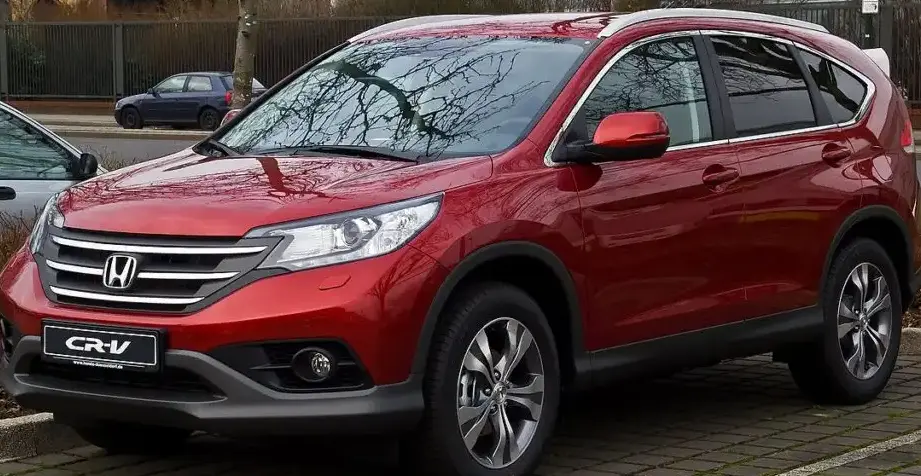
Technical Specifications
| Brand | Honda |
| Model | CR-V |
| Generation | CR-V I (RD) |
| Type (Engine) | 2.0 16V (147 Hp) Automatic |
| Start of production | 1999 year |
| End of production | 2002 year |
| Powertrain Architecture | Internal Combustion engine |
| Body type | SUV |
| Seats | 5 |
| Doors | 5 |
| Fuel consumption (urban) | 12.7 l/100 km (18.5 US mpg, 22.2 UK mpg, 7.9 km/l) |
| Fuel consumption (extra urban) | 8.4 l/100 km (28 US mpg, 33.6 UK mpg, 11.9 km/l) |
| Fuel Type | Petrol (Gasoline) |
| Acceleration 0 – 100 km/h | 12.5 sec |
| Acceleration 0 – 62 mph | 12.5 sec |
| Acceleration 0 – 60 mph | 11.9 sec |
| Maximum speed | 170 km/h (105.63 mph) |
| Weight-to-power ratio | 10.1 kg/Hp, 98.7 Hp/tonne |
| Weight-to-torque ratio | 8.2 kg/Nm, 122.1 Nm/tonne |
| Power | 147 Hp @ 5500 rpm |
| Power per litre | 74.5 Hp/l |
| Torque | 182 Nm @ 4200 rpm (134.24 lb.-ft. @ 4200 rpm) |
| Engine layout | Front, Transverse |
| Engine Model/Code | B20Z1 |
| Engine displacement | 1973 cm3 (120.4 cu. in.) |
| Number of cylinders | 4 |
| Engine configuration | Inline |
| Cylinder Bore | 84 mm (3.31 in.) |
| Piston Stroke | 89 mm (3.5 in.) |
| Compression ratio | 9.6:1 |
| Number of valves per cylinder | 4 |
| Fuel injection system | Multi-port manifold injection |
| Engine aspiration | Naturally aspirated engine |
| Engine oil capacity | 3.8 l (4.02 US qt, 3.34 UK qt) |
| Coolant capacity | 3.9 l (4.12 US qt, 3.43 UK qt) |
| Kerb Weight | 1490 kg (3284.89 lbs.) |
| Max. weight | 1900 kg (4188.78 lbs.) |
| Max load | 410 kg (903.9 lbs.) |
| Trunk (boot) space – minimum | 375 l (13.24 cu. ft.) |
| Trunk (boot) space – maximum | 670 l (23.66 cu. ft.) |
| Fuel tank capacity | 58 l (15.32 US gal, 12.76 UK gal) |
| Length | 4520 mm (177.95 in.) |
| Width | 1750 mm (68.9 in.) |
| Height | 1675 mm (65.94 in.) |
| Wheelbase | 2620 mm (103.15 in.) |
| Front track | 1535 mm (60.43 in.) |
| Rear (Back) track | 1535 mm (60.43 in.) |
| Drive wheel | All wheel drive (4×4) |
| Number of gears and type of gearbox | 4 gears, automatic transmission |
| Front suspension | Double wishbone |
| Rear suspension | Coil spring |
| Front brakes | Disc |
| Rear brakes | Drum |
| Assisting systems | ABS (Anti-lock braking system) |
| Steering type | Steering rack and pinion |
| Power steering | Hydraulic Steering |
| Tires size | 205/70 R15 |
| Wheel rims size | 6J x 15 |
The Honda CR-V first generation (RD series), produced from 1997 to 2001 (with some markets continuing into 2002), represented Honda’s initial foray into the rapidly expanding compact SUV market. Originally launched in Japan in 1995, the CR-V aimed to combine the practicality of a station wagon with the appealing aesthetics of an SUV. The North American market received the CR-V in 1997 as a 1997 model year vehicle, and it quickly gained traction due to its spacious interior, fuel efficiency, and Honda’s well-established reputation for reliability. The 2.0 16V (147 hp) Automatic variant, available from 1999-2002, occupied a mid-range position within the first-generation CR-V lineup, situated between the base models and any limited-edition offerings. It was specifically designed to attract buyers seeking a comfortable and practical SUV with sufficient power for everyday transportation needs.
Powertrain & Engine Architecture
The 1999-2002 Honda CR-V 2.0 16V Automatic was powered by the B20Z1 engine, a 1.973-liter (120.4 cubic inches) inline-four cylinder gasoline engine. This engine employed a single overhead camshaft (SOHC) design with four valves per cylinder – the “16V” designation refers to this valvetrain configuration. The B20Z1 utilized a multi-point fuel injection system, precisely delivering fuel to each intake port to optimize efficiency and performance. The engine block was constructed from durable cast iron, while the cylinder head was made of lightweight aluminum. The accompanying automatic transmission was a four-speed unit, engineered for smooth and comfortable operation. This transmission featured electronic control, dynamically adjusting shift points based on throttle input and vehicle speed. The B20Z1 engine was renowned for its inherent reliability and relatively uncomplicated design, contributing significantly to the CR-V’s overall reputation for longevity.
Driving Characteristics
The 2.0L automatic CR-V delivered a comfortable, though not particularly exhilarating, driving experience. Producing 147 horsepower and 134 lb-ft of torque, acceleration was adequate for routine driving, but lacked a sense of urgency. The four-speed automatic transmission, while smooth in operation, didn’t offer the responsiveness of a manual gearbox or a more modern automatic with a greater number of gears. The gear ratios were optimized for fuel economy and ease of driving, rather than maximizing performance. In comparison to the five-speed manual transmission version of the same engine, the automatic CR-V felt noticeably slower, particularly when attempting overtaking maneuvers. The standard all-wheel-drive system enhanced traction in adverse weather conditions, making it a capable vehicle in a variety of environments. The suspension was tuned for ride comfort, effectively absorbing bumps and road imperfections, but at the expense of some handling precision.
Equipment & Trim Levels
The 1999-2002 CR-V 2.0 16V Automatic typically included standard features such as air conditioning, power windows and door locks, and an AM/FM stereo system. Higher trim levels, often designated as “LX” or “EX,” added enhancements like a sunroof, upgraded audio systems, alloy wheels, and keyless entry. Interior upholstery was generally cloth, with options for more premium materials available on the higher trim levels. The dashboard layout was functional and user-friendly, featuring clear and easily readable gauges and controls. Optional extras included a rear cargo organizer, a trailer hitch, and a range of accessories designed to enhance the vehicle’s practicality and convenience.
Chassis & Braking
The first-generation CR-V boasted a robust chassis featuring a double wishbone suspension at the front and a coil spring suspension in the rear. This suspension configuration provided a comfortable ride quality and respectable handling characteristics. The front brakes were disc brakes, offering strong stopping power, while the rear brakes utilized drum brakes – a cost-saving measure common in this vehicle class during that era. An anti-lock braking system (ABS) was standard on most trim levels, improving safety by preventing wheel lockup during hard braking situations. The steering system was rack and pinion, providing precise and responsive steering feel. The CR-V’s all-wheel-drive system was a real-time system, automatically engaging the rear wheels when wheel slippage was detected.
Market Reception & Comparison
The CR-V 2.0 16V Automatic received generally positive reviews from both automotive critics and consumers. It was consistently praised for its spacious interior, fuel efficiency, and overall reliability. However, some reviewers pointed out that the automatic transmission could feel somewhat sluggish, and the engine’s power output wasn’t as strong as some of its competitors. When compared to other compact SUVs available at the time, such as the Toyota RAV4 and the Subaru Forester, the CR-V offered a well-rounded package of practicality, comfort, and value. The automatic transmission version proved particularly popular among buyers who prioritized ease of use over sporty performance. Fuel economy figures were competitive for the class, averaging around 22 miles per gallon in city driving and 28 miles per gallon on the highway.
Legacy
The B20Z1 engine, when subjected to regular and proper maintenance, proved to be an exceptionally durable and reliable powertrain. Numerous CR-Vs equipped with this engine have exceeded 200,000 miles of operation with minimal major repairs. The four-speed automatic transmission, while not as technologically advanced as modern transmissions, also demonstrated a commendable level of reliability. Today, first-generation CR-Vs are often sought after by budget-conscious buyers and those seeking a dependable and practical vehicle. While corrosion can be a concern in regions with harsh winter conditions, well-maintained examples can continue to provide years of reliable service. The CR-V’s initial success established Honda as a significant competitor in the compact SUV segment, paving the way for subsequent generations of the vehicle.