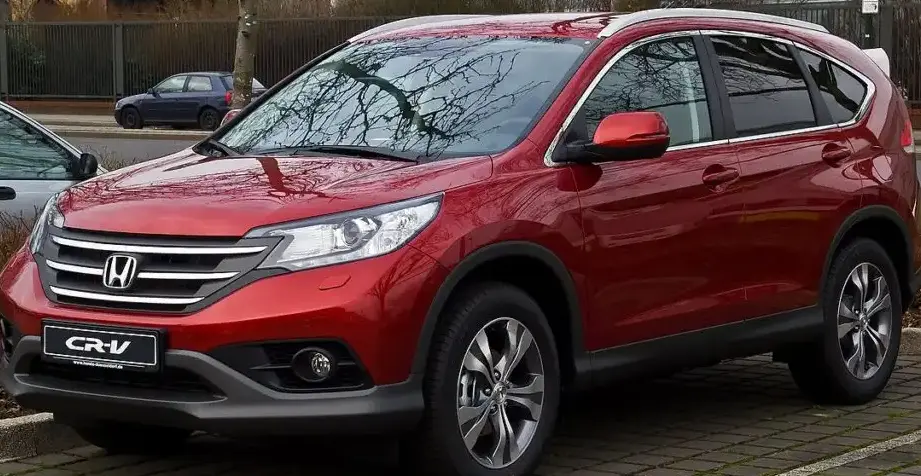
The Honda CR-V III 2.4 i-VTEC Automatic, produced from 2006 to 2009, represented a significant evolution in Honda’s popular compact SUV lineup. Positioned as a mid-range offering within the third-generation CR-V (RE series), this variant combined a 2.4-liter inline-four engine with a five-speed automatic transmission, aiming to deliver a balance of fuel efficiency, practicality, and comfortable driving experience. It was a key model for Honda in the North American market, where the CR-V had established itself as a leading contender in the burgeoning compact SUV segment. This generation CR-V moved towards a more car-like unibody construction, enhancing ride quality and handling compared to its body-on-frame predecessors.
Technical Specifications
| Brand | Honda |
| Model | CR-V |
| Generation | CR-V III |
| Type (Engine) | 2.4 i-VTEC (166 Hp) Automatic |
| Start of production | 2006 |
| End of production | September, 2009 |
| Powertrain Architecture | Internal Combustion engine |
| Body type | SUV |
| Seats | 5 |
| Doors | 5 |
| Fuel consumption (economy) – urban (EPA) | 11.8 l/100 km (19.9 US mpg) |
| Fuel consumption (economy) – extra urban (EPA) | 8.7 l/100 km (27 US mpg) |
| Fuel Type | Petrol (Gasoline) |
| Emission standard | ULEV-2 |
| Weight-to-power ratio | 9.3 kg/Hp |
| Weight-to-torque ratio | 7.1 kg/Nm |
| Power | 166 Hp @ 5800 rpm |
| Power per litre | 70.5 Hp/l |
| Torque | 218 Nm @ 4200 rpm (160.79 lb.-ft. @ 4200 rpm) |
| Engine layout | Front, Transverse |
| Engine Model/Code | K24Z1 |
| Engine displacement | 2354 cm3 (143.65 cu. in.) |
| Number of cylinders | 4 |
| Engine configuration | Inline |
| Cylinder Bore | 87 mm (3.43 in.) |
| Piston Stroke | 99 mm (3.9 in.) |
| Compression ratio | 9.7:1 |
| Number of valves per cylinder | 4 |
| Fuel injection system | Multi-port manifold injection |
| Engine aspiration | Naturally aspirated engine |
| Valvetrain | DOHC, i-VTEC |
| Engine oil capacity | 4.2 l (4.44 US qt | 3.7 UK qt) |
| Coolant | 5 l (5.28 US qt | 4.4 UK qt) |
| Kerb Weight | 1537 kg (3388.5 lbs.) |
| Max. weight | 2068 kg (4559.16 lbs.) |
| Max load | 531 kg (1170.65 lbs.) |
| Trunk (boot) space – minimum | 524 l (18.5 cu. ft.) |
| Trunk (boot) space – maximum | 1532 l (54.1 cu. ft.) |
| Fuel tank capacity | 58 l (15.32 US gal | 12.76 UK gal) |
| Permitted trailer load with brakes (12%) | 680 kg (1499.14 lbs.) |
| Length | 4519 mm (177.91 in.) |
| Width | 1820 mm (71.65 in.) |
| Height | 1679 mm (66.1 in.) |
| Wheelbase | 2620 mm (103.15 in.) |
| Front track | 1565 mm (61.61 in.) |
| Rear (Back) track | 1565 mm (61.61 in.) |
| Ride height (ground clearance) | 185 mm (7.28 in.) |
| Minimum turning circle (turning diameter) | 11.5 m (37.73 ft.) |
| Approach angle | 28° |
| Departure angle | 23.2° |
| Ramp-over (brakeover) angle | 18° |
| Drivetrain Architecture | The Internal combustion engine (ICE) drives the front wheels of the vehicle. |
| Drive wheel | Front wheel drive |
| Number of gears and type of gearbox | 5 gears, automatic transmission |
| Front suspension | Independent, type McPherson with coil spring and anti-roll bar |
| Rear suspension | Independent multi-link spring suspension with stabilizer |
| Front brakes | Ventilated discs, 296 mm |
| Rear brakes | Disc, 305 mm |
| Assisting systems | ABS (Anti-lock braking system) |
| Steering type | Steering rack and pinion |
| Power steering | Hydraulic Steering |
| Tires size | 225/65 R17 |
| Wheel rims size | 6.5J x 17 |
Powertrain & Engine Architecture
At the heart of the CR-V 2.4 i-VTEC Automatic lies the K24Z1 engine, a 2.4-liter inline-four cylinder powerplant. This engine is a member of Honda’s renowned K-series family, known for its reliability and efficiency. The K24Z1 features a single overhead camshaft (SOHC) design, although it incorporates Honda’s innovative i-VTEC (intelligent Variable Valve Timing and Lift Electronic Control) system. This system allows for variable control of both valve timing and lift, optimizing engine performance across a wide range of engine speeds. Fuel delivery is managed by a multi-point fuel injection system. The engine produces 166 horsepower at 5800 rpm and 160.79 lb-ft of torque at 4200 rpm. The five-speed automatic transmission was chosen for its smooth operation and ease of use, catering to a broader customer base than the available manual transmission. The transmission utilizes a conventional torque converter and electronic controls for shift scheduling.
Driving Characteristics
The 2.4-liter i-VTEC engine paired with the five-speed automatic provided adequate, though not exhilarating, performance. Acceleration from 0 to 60 mph typically took around 9-10 seconds. The automatic transmission was tuned for comfort and fuel economy, resulting in relatively conservative shift points. Compared to the available manual transmission, the automatic offered less driver engagement but greater convenience, particularly in urban driving conditions. The gear ratios were optimized for everyday driving, prioritizing smooth cruising and fuel efficiency over outright speed. While the engine had sufficient power for highway merging and passing maneuvers, it lacked the punch of higher-output engines found in some competing SUVs.
Equipment & Trim Levels
The CR-V 2.4 i-VTEC Automatic typically came standard with features such as air conditioning, power windows and locks, a CD player with auxiliary input, and anti-lock brakes (ABS). Higher trim levels, such as the EX and EX-L, added features like a sunroof, alloy wheels, upgraded audio systems, and leather upholstery. Interior materials were generally durable and practical, reflecting the CR-V’s focus on functionality. Optional extras included a navigation system and rear entertainment system.
Chassis & Braking
The CR-V III utilized a unibody construction, contributing to its improved ride quality and handling. The front suspension featured independent MacPherson struts with coil springs and an anti-roll bar, while the rear suspension employed an independent multi-link setup with a stabilizer bar. This configuration provided a comfortable and controlled ride. Braking duties were handled by ventilated discs at the front and solid discs at the rear. The ABS system helped to maintain steering control during hard braking.
Market Reception & Comparison
The CR-V 2.4 i-VTEC Automatic was generally well-received by automotive critics. It was praised for its practicality, fuel efficiency, and comfortable ride. However, some reviewers noted that the engine lacked the power of some competitors, and the automatic transmission could feel somewhat sluggish. Compared to the 2.0-liter four-cylinder version, the 2.4-liter offered a noticeable improvement in performance. Compared to the manual transmission version, the automatic traded some performance for convenience. Fuel economy was competitive for its class, averaging around 22 mpg in combined driving.
Legacy
The K24Z1 engine, when properly maintained, has proven to be remarkably reliable. The CR-V III 2.4 i-VTEC Automatic remains a popular choice in the used car market due to its reputation for dependability and practicality. Common maintenance items include regular oil changes, timing belt replacement (typically around 100,000 miles), and inspection of the automatic transmission fluid. While not a performance standout, this variant of the CR-V continues to offer a compelling blend of value, efficiency, and Honda’s renowned build quality.