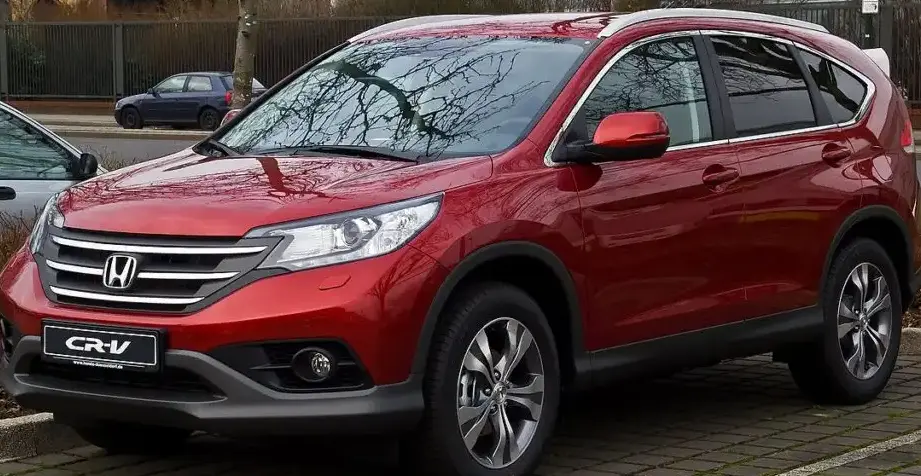
The Honda CR-V III (facelift, 2009) 2.0 i-VTEC (150 hp) AWD represents a mid-cycle refresh of the third-generation CR-V, produced from 2010 to 2012. This variant occupied a key position in the CR-V lineup, offering a balance between fuel efficiency, practicality, and all-weather capability. It was designed to appeal to families and individuals seeking a versatile compact SUV with Honda’s reputation for reliability. The facelift brought styling updates, improved interior materials, and refinements to the engine and transmission. This model continued the CR-V’s success as a popular choice in the compact SUV segment, particularly in North America and Europe.
Technical Specifications
| Brand | Honda |
| Model | CR-V |
| Generation | CR-V III (facelift 2009) |
| Type (Engine) | 2.0 i-VTEC (150 Hp) AWD |
| Start of production | 2010 |
| End of production | 2012 |
| Powertrain Architecture | Internal Combustion engine |
| Body type | SUV |
| Seats | 5 |
| Doors | 5 |
| Fuel consumption (economy) – urban (NEDC) | 10.5 l/100 km (22.4 US mpg, 26.9 UK mpg, 9.5 km/l) |
| Fuel consumption (economy) – extra urban (NEDC) | 6.9 l/100 km (34.1 US mpg, 40.9 UK mpg, 14.5 km/l) |
| Fuel consumption (economy) – combined (NEDC) | 8.2 l/100 km (28.7 US mpg, 34.4 UK mpg, 12.2 km/l) |
| CO2 emissions (NEDC) | 190 g/km |
| Fuel Type | Petrol (Gasoline) |
| Acceleration 0 – 100 km/h | 10.2 sec |
| Acceleration 0 – 62 mph | 10.2 sec |
| Acceleration 0 – 60 mph | 9.7 sec |
| Maximum speed | 190 km/h (118.06 mph) |
| Emission standard | Euro 5 |
| Weight-to-power ratio | 10 kg/Hp, 100.3 Hp/tonne |
| Weight-to-torque ratio | 7.8 kg/Nm, 128.4 Nm/tonne |
| Power | 150 Hp @ 6200 rpm |
| Power per litre | 75.1 Hp/l |
| Torque | 192 Nm @ 4200 rpm (141.61 lb.-ft. @ 4200 rpm) |
| Engine layout | Front, Transverse |
| Engine Model/Code | R20A2 |
| Engine displacement | 1997 cm3 (121.86 cu. in.) |
| Number of cylinders | 4 |
| Engine configuration | Inline |
| Cylinder Bore | 81 mm (3.19 in.) |
| Piston Stroke | 96.9 mm (3.81 in.) |
| Compression ratio | 10.5:1 |
| Number of valves per cylinder | 4 |
| Fuel injection system | Multi-port manifold injection |
| Engine aspiration | Naturally aspirated engine |
| Valvetrain | SOHC, i-VTEC |
| Engine oil capacity | 3.7 l (3.91 US qt, 3.26 UK qt) |
| Coolant | 6.2 l (6.55 US qt, 5.46 UK qt) |
| Kerb Weight | 1495-1607 kg (3295.91 – 3542.83 lbs.) |
| Max. weight | 2050 kg (4519.48 lbs.) |
| Max load | 443-555 kg (976.65 – 1223.57 lbs.) |
| Trunk (boot) space – minimum | 524 l (18.5 cu. ft.) |
| Trunk (boot) space – maximum | 1532 l (54.1 cu. ft.) |
| Fuel tank capacity | 58 l (15.32 US gal, 12.76 UK gal) |
| Max. roof load | 80 kg (176.37 lbs.) |
| Permitted trailer load with brakes (12%) | 1600 kg (3527.4 lbs.) |
| Permitted trailer load without brakes | 600 kg (1322.77 lbs.) |
| Permitted towbar download | 100 kg (220.46 lbs.) |
| Length | 4574 mm (180.08 in.) |
| Width | 1820 mm (71.65 in.) |
| Width including mirrors | 2091 mm (82.32 in.) |
| Height | 1675 mm (65.94 in.) |
| Wheelbase | 2620 mm (103.15 in.) |
| Front track | 1565-1570 mm (61.61 – 61.81 in.) |
| Rear (Back) track | 1565-1585 mm (61.61 – 62.4 in.) |
| Ride height (ground clearance) | 185 mm (7.28 in.) |
| Minimum turning circle (turning diameter) | 11.8 m (38.71 ft.) |
| Drivetrain Architecture | The Internal combustion engine (ICE) drives the front wheels permanently, and the rear wheels are driven through an electrically or mechanically operated clutch if necessary. |
| Drive wheel | All wheel drive (4×4) |
| Number of gears and type of gearbox | 6 gears, manual transmission |
| Front suspension | Independent, type McPherson with coil spring and anti-roll bar |
| Rear suspension | Independent multi-link spring suspension with stabilizer |
| Front brakes | Ventilated discs, 293 mm |
| Rear brakes | Disc, 302 mm |
| Assisting systems | ABS (Anti-lock braking system) |
| Steering type | Steering rack and pinion |
| Power steering | Electric Steering |
| Tires size | 225/65 R17; 225/60 R18; 245/45 R19 |
| Wheel rims size | 6.5J x 17; 7J x 18; 7.5J x 19 |
Powertrain & Engine Architecture
The 2.0-liter i-VTEC engine, designated R20A2, is a naturally aspirated inline-four cylinder powerplant. It features Honda’s intelligent Variable Valve Timing and Lift Electronic Control (i-VTEC) system, which optimizes valve timing and lift for improved performance and fuel efficiency across the engine’s operating range. The engine utilizes a multi-point fuel injection system. The engine’s architecture is relatively simple, contributing to its reliability. The 6-speed manual transmission was standard, offering precise shifts and a direct connection to the engine. The transmission’s gear ratios were tuned for a balance of acceleration and fuel economy, with a relatively tall sixth gear for highway cruising.
Driving Characteristics
The 150 hp and 192 Nm (141.61 lb-ft) of torque delivered by the 2.0 i-VTEC engine provided adequate performance for everyday driving. Acceleration from 0-60 mph took around 9.7 seconds, which was competitive within its class. While not particularly sporty, the engine offered a linear power delivery, making it easy to modulate. Compared to higher-output CR-V variants, such as those with larger engines, this version felt less eager to accelerate, especially when fully loaded. The manual transmission allowed for greater driver control, but the gear ratios were spaced to prioritize fuel efficiency over outright performance. The all-wheel-drive system provided enhanced traction in inclement weather conditions.
Equipment & Trim Levels
The 2.0 i-VTEC AWD typically came with a reasonable level of standard equipment. This included air conditioning, power windows and locks, a basic audio system, and alloy wheels. Higher trim levels offered features such as a sunroof, upgraded audio systems, leather upholstery, and automatic climate control. Safety features like ABS and multiple airbags were standard across the range. The interior design was functional and durable, with a focus on practicality rather than luxury.
Chassis & Braking
The CR-V III utilized an independent suspension system, with McPherson struts at the front and a multi-link setup at the rear. This configuration provided a comfortable ride quality and decent handling characteristics. The front brakes were ventilated discs, while the rear brakes were solid discs. The braking system was adequate for the vehicle’s weight and performance, with ABS providing additional safety. Stabilizer bars were fitted to both the front and rear axles to reduce body roll during cornering.
Market Reception & Comparison
The 2.0 i-VTEC AWD CR-V was generally well-received by critics and consumers. It was praised for its practicality, reliability, and fuel efficiency. However, some reviewers noted that the engine lacked the punch of larger-displacement alternatives. Compared to the 2.4-liter engine option, the 2.0-liter version offered better fuel economy but less performance. The 2.0L was often seen as the entry-level choice, appealing to buyers prioritizing value and efficiency over outright speed. Its fuel economy figures were competitive with other compact SUVs in its class.
Legacy
The R20A2 engine, when properly maintained, has proven to be a durable and reliable unit. The CR-V III, in general, has a strong reputation for longevity. On the used car market, these models are often sought after for their affordability and dependability. Common maintenance items include regular oil changes, timing belt replacement (if applicable), and inspection of the suspension components. The 2.0 i-VTEC AWD variant remains a viable option for buyers seeking a practical and reliable compact SUV, offering a good balance of features and affordability.