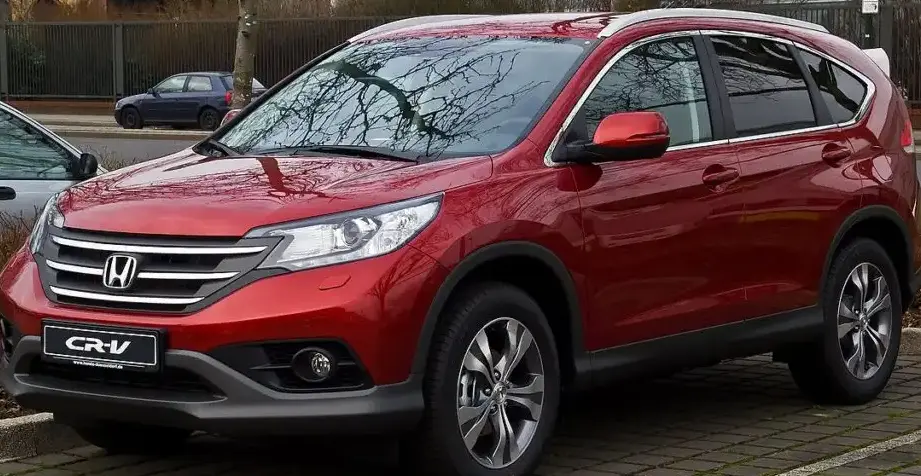
The Honda CR-V III (facelift, produced from September 2009 to November 2011) 2.4 i-VTEC with an automatic transmission represents a significant iteration of Honda’s popular compact SUV. This version, part of the third-generation CR-V (introduced in 2006), received styling updates and refinements aimed at enhancing its appeal in the North American and global markets. The 2.4-liter engine and automatic gearbox combination was positioned as a mainstream offering within the CR-V lineup, balancing performance with convenience and fuel efficiency. It served as a step up from the base 2.0-liter engine, while remaining more accessible than potential future performance-oriented trims.
Technical Specifications
| Brand | Honda |
| Model | CR-V |
| Generation | CR-V III (facelift 2009) |
| Type (Engine) | 2.4 i-VTEC (180 Hp) Automatic |
| Start of production | September, 2009 |
| End of production | November, 2011 |
| Powertrain Architecture | Internal Combustion engine |
| Body type | SUV |
| Seats | 5 |
| Doors | 5 |
| Fuel consumption (urban) | 11.2 l/100 km (21 US mpg) |
| Fuel consumption (extra urban) | 8.4 l/100 km (28 US mpg) |
| Fuel consumption (combined) | 9.8 l/100 km (24 US mpg) |
| Fuel Type | Petrol (Gasoline) |
| Emission standard | ULEV-2 |
| Weight-to-power ratio | 8.5 kg/Hp |
| Weight-to-torque ratio | 7 kg/Nm |
| Power | 180 Hp @ 6800 rpm |
| Power per litre | 76.5 Hp/l |
| Torque | 218 Nm @ 4400 rpm (160.79 lb.-ft. @ 4400 rpm) |
| Engine layout | Front, Transverse |
| Engine Model/Code | K24Z6 |
| Engine displacement | 2354 cm3 (143.65 cu. in.) |
| Number of cylinders | 4 |
| Engine configuration | Inline |
| Cylinder Bore | 87 mm (3.43 in.) |
| Piston Stroke | 99 mm (3.9 in.) |
| Compression ratio | 10.5:1 |
| Number of valves per cylinder | 4 |
| Fuel injection system | Multi-port manifold injection |
| Engine aspiration | Naturally aspirated engine |
| Valvetrain | DOHC, i-VTEC |
| Engine oil capacity | 4.2 l (4.44 US qt | 3.7 UK qt) |
| Coolant capacity | 7 l (7.4 US qt | 6.16 UK qt) |
| Kerb Weight | 1536-1556 kg (3386.3 – 3430.39 lbs.) |
| Trunk (boot) space – minimum | 1011 l (35.7 cu. ft.) |
| Trunk (boot) space – maximum | 2064 l (72.89 cu. ft.) |
| Fuel tank capacity | 58 l (15.32 US gal | 12.76 UK gal) |
| Permitted trailer load with brakes (12%) | 680 kg (1499.14 lbs.) |
| Length | 4555 mm (179.33 in.) |
| Width | 1820 mm (71.65 in.) |
| Height | 1680 mm (66.14 in.) |
| Wheelbase | 2620 mm (103.15 in.) |
| Front track | 1565 mm (61.61 in.) |
| Rear track | 1565 mm (61.61 in.) |
| Ride height (ground clearance) | 170 mm (6.69 in.) |
| Minimum turning circle | 11.5 m (37.73 ft.) |
| Drivetrain Architecture | Front wheel drive |
| Number of gears | 5 |
| Gearbox type | Automatic transmission |
| Front suspension | Independent, McPherson with coil spring and anti-roll bar |
| Rear suspension | Independent multi-link with stabilizer |
| Front brakes | Ventilated discs, 297 mm |
| Rear brakes | Disc, 305 mm |
| Assisting systems | ABS |
| Steering type | Steering rack and pinion |
| Power steering | Hydraulic |
| Tires size | 225/65 R17 |
| Wheel rims size | 6.5J x 17 |
INTRODUCTION
The 2009-2011 Honda CR-V 2.4 i-VTEC Automatic was a key model in Honda’s North American lineup, building upon the success of the second-generation CR-V by offering increased space, refinement, and a more powerful engine option. The facelift brought subtle cosmetic changes, including a revised front grille and bumper, as well as interior enhancements. This variant was designed to appeal to families and individuals seeking a practical, reliable, and comfortable SUV for daily use. It was built on the Honda Civic’s platform (1HX0/A3 platform) and shared many components with the Civic and Acura CSX.
Powertrain & Engine Architecture
At the heart of this CR-V variant lies the K24Z6 2.4-liter inline-four cylinder engine. This engine is a naturally aspirated powerplant featuring Honda’s innovative i-VTEC (intelligent Variable Valve Timing and Lift Electronic Control) system. The i-VTEC system allows for variable valve timing and lift, optimizing engine performance and fuel efficiency across a wide range of engine speeds. Fuel delivery is managed by a multi-point fuel injection system. The K24Z6 produces 180 horsepower at 6800 rpm and 218 Nm (160.79 lb-ft) of torque at 4400 rpm. Paired with the engine is a 5-speed automatic transmission, chosen for its smooth operation and ease of use. This transmission features Honda’s Grade Logic Control, which automatically selects the appropriate gear based on driving conditions and vehicle load, further enhancing fuel efficiency and driveability.
Driving Characteristics
The 2.4-liter i-VTEC engine and 5-speed automatic transmission provide adequate performance for everyday driving. Acceleration is reasonably brisk, though not particularly sporty. The automatic transmission is tuned for comfort and efficiency, with smooth shifts and a willingness to downshift when needed. Compared to the available manual transmission, the automatic offers less driver engagement but greater convenience, particularly in urban traffic. The automatic’s gear ratios are optimized for fuel economy, resulting in a slightly less responsive feel than the manual version. The CR-V’s front-wheel-drive configuration contributes to good fuel economy but limits traction in adverse weather conditions.
Equipment & Trim Levels
The 2.4 i-VTEC Automatic CR-V typically came standard with features such as air conditioning, power windows and locks, a CD player with auxiliary input, and cruise control. Higher trim levels added features like alloy wheels, a sunroof, a premium audio system, and leather upholstery. Safety features included anti-lock brakes (ABS) and front airbags. Optional extras included a navigation system and rear entertainment system. Interior upholstery was typically cloth, with higher trims offering leather options. The dashboard layout was functional and straightforward, prioritizing ease of use.
Chassis & Braking
The CR-V utilizes an independent McPherson strut suspension in the front and an independent multi-link suspension in the rear, providing a comfortable ride and predictable handling. Stabilizer bars are fitted to both axles to reduce body roll during cornering. Braking duties are handled by ventilated discs in the front and solid discs in the rear. ABS is standard, enhancing braking performance and stability. The suspension tuning is geared towards comfort rather than sporty handling, making it well-suited for everyday driving and long road trips.
Market Reception & Comparison
The 2009-2011 Honda CR-V 2.4 i-VTEC Automatic was generally well-received by automotive critics. It was praised for its spacious interior, comfortable ride, and strong reliability record. Fuel economy was considered average for its class. Compared to the base 2.0-liter engine, the 2.4-liter offered a noticeable improvement in performance. However, some reviewers noted that the automatic transmission could feel somewhat sluggish at times. Compared to competitors like the Toyota RAV4 and Nissan Rogue, the CR-V offered a compelling combination of practicality, reliability, and value.
Legacy
The K24Z6 engine, when properly maintained, is known for its durability and longevity. The 5-speed automatic transmission is also generally reliable, although some units may experience issues with the torque converter over time. Today, these CR-Vs are readily available on the used car market and continue to be popular choices for buyers seeking a dependable and affordable SUV. Their reputation for reliability and low maintenance costs makes them a practical option for budget-conscious consumers. Parts availability is excellent, and the CR-V’s simple design makes it relatively easy to repair.