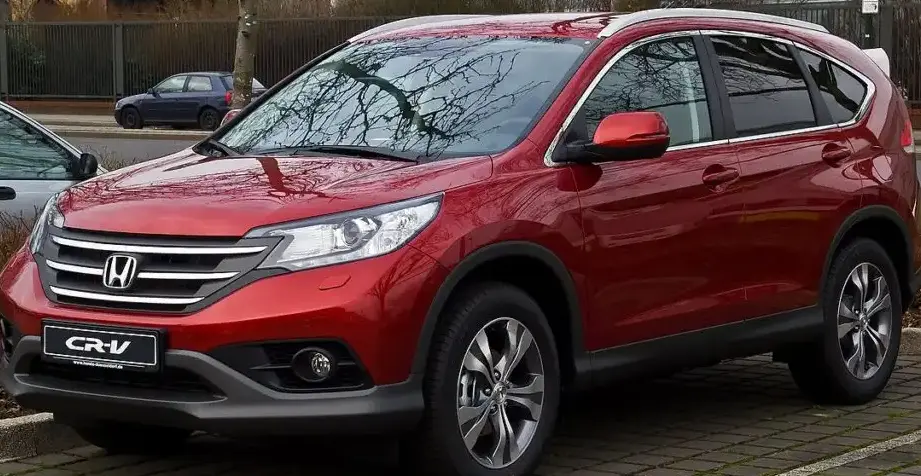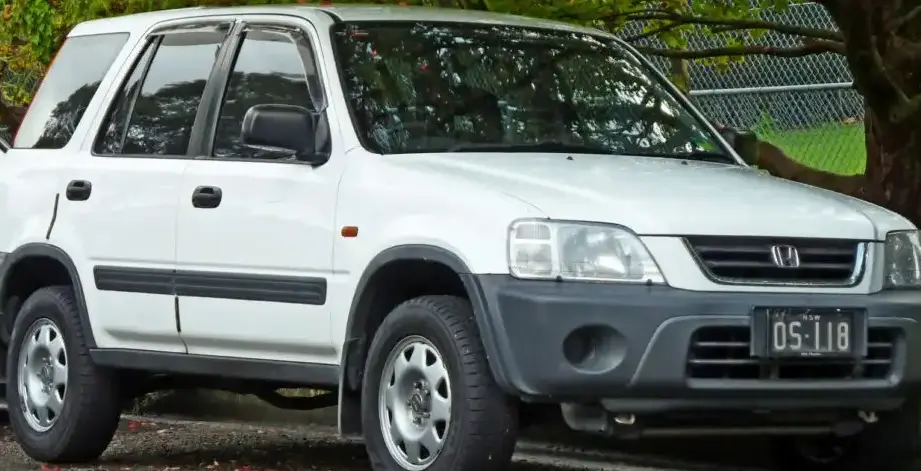
Technical Specifications
| Brand | Honda |
| Model | CR-V |
| Generation | CR-V III (facelift 2009) |
| Type (Engine) | 2.4 i-VTEC (180 Hp) AWD Automatic |
| Start of production | September, 2009 |
| End of production | November, 2011 |
| Powertrain Architecture | Internal Combustion engine |
| Body type | SUV |
| Seats | 5 |
| Doors | 5 |
| Fuel consumption (economy) – urban (EPA) | 11.2 l/100 km (21 US mpg, 25.2 UK mpg, 8.9 km/l) |
| Fuel consumption (economy) – extra urban (EPA) | 8.7 l/100 km (27 US mpg, 32.5 UK mpg, 11.5 km/l) |
| Fuel consumption (economy) – combined (EPA) | 10.2 l/100 km (23.1 US mpg, 27.7 UK mpg, 9.8 km/l) |
| Fuel Type | Petrol (Gasoline) |
| Emission standard | ULEV-2 |
| Weight-to-power ratio | 8.8 kg/Hp, 113.3 Hp/tonne |
| Weight-to-torque ratio | 7.3 kg/Nm, 137.2 Nm/tonne |
| Power | 180 Hp @ 6800 rpm |
| Power per litre | 76.5 Hp/l |
| Torque | 218 Nm @ 4400 rpm (160.79 lb.-ft. @ 4400 rpm) |
| Engine layout | Front, Transverse |
| Engine Model/Code | K24Z6 |
| Engine displacement | 2354 cm3 (143.65 cu. in.) |
| Number of cylinders | 4 |
| Engine configuration | Inline |
| Cylinder Bore | 87 mm (3.43 in.) |
| Piston Stroke | 99 mm (3.9 in.) |
| Compression ratio | 10.5:1 |
| Number of valves per cylinder | 4 |
| Fuel injection system | Multi-port manifold injection |
| Engine aspiration | Naturally aspirated engine |
| Valvetrain | DOHC, i-VTEC |
| Engine oil capacity | 4.2 l (4.44 US qt | 3.7 UK qt) |
| Coolant | 7 l (7.4 US qt | 6.16 UK qt) |
| Kerb Weight | 1589-1612 kg (3503.15 – 3553.85 lbs.) |
| Trunk (boot) space – minimum | 1011 l (35.7 cu. ft.) |
| Trunk (boot) space – maximum | 2064 l (72.89 cu. ft.) |
| Fuel tank capacity | 58 l (15.32 US gal | 12.76 UK gal) |
| Permitted trailer load with brakes (12%) | 680 kg (1499.14 lbs.) |
| Length | 4555 mm (179.33 in.) |
| Width | 1820 mm (71.65 in.) |
| Height | 1680 mm (66.14 in.) |
| Wheelbase | 2620 mm (103.15 in.) |
| Front track | 1565 mm (61.61 in.) |
| Rear (Back) track | 1565 mm (61.61 in.) |
| Ride height (ground clearance) | 170 mm (6.69 in.) |
| Minimum turning circle (turning diameter) | 11.5 m (37.73 ft.) |
| Drivetrain Architecture | The Internal combustion engine (ICE) drives the front wheels permanently, and the rear wheels are driven through an electrically or mechanically operated clutch if necessary. |
| Drive wheel | All wheel drive (4×4) |
| Number of gears and type of gearbox | 5 gears, automatic transmission |
| Front suspension | Independent, type McPherson with coil spring and anti-roll bar |
| Rear suspension | Independent multi-link spring suspension with stabilizer |
| Front brakes | Ventilated discs, 297 mm |
| Rear brakes | Disc, 305 mm |
| Assisting systems | ABS (Anti-lock braking system) |
| Steering type | Steering rack and pinion |
| Power steering | Hydraulic Steering |
| Tires size | 225/65 R17 |
| Wheel rims size | 6.5J x 17 |
The Honda CR-V III (facelift, produced from September 2009 to November 2011) 2.4 i-VTEC AWD Automatic represents a mid-cycle refresh of the third-generation CR-V, a compact SUV that solidified Honda’s position in the burgeoning crossover market. This particular variant, equipped with the K24Z6 engine and a five-speed automatic transmission, was positioned as a well-rounded option offering a balance of power, practicality, and all-weather capability. It served as a step up from the base 2.0-liter engine option, targeting buyers who desired more robust performance without the added cost and complexity of a potential future V6 offering. The facelift brought subtle styling updates, improved interior materials, and refinements to the vehicle’s overall driving experience.
Powertrain & Engine Architecture
The heart of this CR-V variant is the 2.4-liter K24Z6 inline-four cylinder engine. This engine is a member of Honda’s K-series family, known for its reliability and relatively high output for its displacement. The K24Z6 utilizes a single overhead camshaft (SOHC) design, but incorporates Honda’s innovative i-VTEC (Variable Valve Timing and Lift Electronic Control) system. This system allows for variable control of both valve timing and lift, optimizing engine performance across a wide range of engine speeds. Fuel delivery is managed by a multi-point fuel injection system. The engine produces 180 horsepower at 6800 rpm and 218 Nm (160.79 lb-ft) of torque at 4400 rpm. The five-speed automatic transmission, while providing smooth shifts, wasn’t known for being particularly sporty or fuel-efficient compared to some contemporary automatic transmissions. It featured standard torque converter lock-up for improved highway fuel economy.
Driving Characteristics
The 2.4-liter i-VTEC engine paired with the five-speed automatic provided adequate, though not exhilarating, performance. Acceleration from 0-60 mph was typically in the 9-10 second range. The automatic transmission’s gear ratios were tuned for comfort and fuel economy rather than aggressive acceleration. Compared to the available manual transmission, the automatic resulted in a noticeable decrease in responsiveness. However, the AWD system provided enhanced traction in inclement weather, making it a practical choice for drivers in regions with snow or rain. The power delivery was linear, with a usable amount of torque available throughout the rev range, making it suitable for everyday driving and highway cruising.
Equipment & Trim Levels
The 2.4 i-VTEC AWD Automatic CR-V typically came standard with features such as air conditioning, power windows and locks, a CD player with auxiliary input, and cruise control. Higher trim levels, such as the EX-L, added features like leather upholstery, a sunroof, and a premium audio system. Optional extras included navigation, a backup camera, and alloy wheels. The interior design was functional and durable, prioritizing practicality over luxury. The rear seats offered ample legroom for passengers, and the cargo area was generously sized, especially with the rear seats folded down.
Chassis & Braking
The CR-V III utilized a MacPherson strut front suspension and an independent multi-link rear suspension. This setup provided a comfortable ride quality, absorbing bumps and irregularities in the road surface effectively. Stabilizer bars were fitted to both the front and rear axles to reduce body roll during cornering. The braking system consisted of ventilated discs at the front and solid discs at the rear. Anti-lock brakes (ABS) were standard. The steering was hydraulically assisted, providing a reasonably direct feel. The all-wheel-drive system was primarily front-wheel drive, with power automatically sent to the rear wheels when slippage was detected.
Market Reception & Comparison
The 2.4 i-VTEC AWD Automatic CR-V was generally well-received by automotive critics. It was praised for its practicality, reliability, and spacious interior. However, some reviewers noted that the automatic transmission could feel sluggish and that the fuel economy wasn’t class-leading. Compared to the base 2.0-liter engine, the 2.4-liter offered a significant performance boost. Compared to competitors like the Toyota RAV4 and Nissan Rogue, the CR-V offered a compelling combination of features and value. The ULEV-2 emissions standard indicated a relatively low environmental impact for its time.
Legacy
The K24Z6 engine, when properly maintained, has proven to be remarkably durable. Common issues are relatively minor, often related to routine maintenance items like spark plugs, oxygen sensors, and valve adjustments. The five-speed automatic transmission, while not known for its refinement, is generally reliable. Today, these CR-Vs are readily available on the used car market at affordable prices. They remain a popular choice for buyers seeking a dependable and practical compact SUV. Their reputation for reliability and relatively low maintenance costs continues to make them a desirable option, even after many years of service.