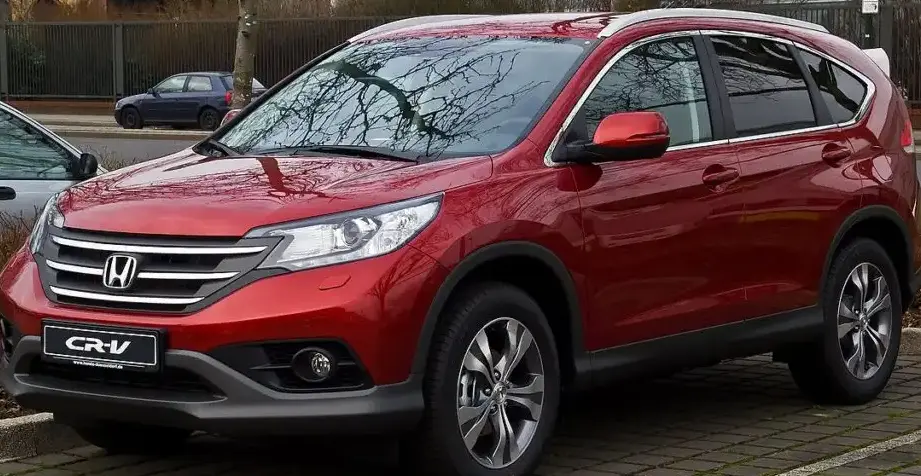
The Honda CR-V IV 2.2 i-DTEC AWD, produced between 2012 and 2015, represents a significant iteration of Honda’s popular compact SUV. This variant, powered by the N22B4 2.2-liter diesel engine producing 150 horsepower, was primarily aimed at the European market where diesel engines held a substantial share of the SUV segment. Positioned as a mid-range offering within the fourth-generation CR-V lineup, it provided a balance between fuel efficiency, torque for towing and everyday driving, and all-weather capability thanks to Honda’s Real Time AWD system. It sat above the entry-level 1.6 i-DTEC models and below the petrol-powered 2.4L variants in terms of price and performance.
Technical Specifications
| Brand | Honda |
| Model | CR-V |
| Generation | CR-V IV |
| Type (Engine) | 2.2 i-DTEC (150 Hp) AWD |
| Start of production | 2012 |
| End of production | 2015 |
| Powertrain Architecture | Internal Combustion engine |
| Body type | SUV |
| Seats | 5 |
| Doors | 5 |
| Fuel consumption (urban) | 6.7 l/100 km (35.1 US mpg, 42.2 UK mpg, 14.9 km/l) |
| Fuel consumption (extra urban) | 5.3 l/100 km (44.4 US mpg, 53.3 UK mpg, 18.9 km/l) |
| Fuel consumption (combined) | 5.8 l/100 km (40.6 US mpg, 48.7 UK mpg, 17.2 km/l) |
| Fuel Type | Diesel |
| Acceleration 0 – 100 km/h | 9.7 sec |
| Acceleration 0 – 62 mph | 9.7 sec |
| Acceleration 0 – 60 mph | 9.2 sec |
| Maximum speed | 190 km/h (118.06 mph) |
| Emission standard | Euro 5 |
| Weight-to-power ratio | 11 kg/Hp, 90.7 Hp/tonne |
| Weight-to-torque ratio | 4.7 kg/Nm, 211.7 Nm/tonne |
| Power | 150 Hp @ 4000 rpm |
| Power per litre | 68.2 Hp/l |
| Torque | 350 Nm @ 2000 rpm (258.15 lb.-ft. @ 2000 rpm) |
| Engine layout | Front, Transverse |
| Engine Model/Code | N22B4 |
| Engine displacement | 2199 cm3 (134.19 cu. in.) |
| Number of cylinders | 4 |
| Engine configuration | Inline |
| Compression ratio | 16.3:1 |
| Number of valves per cylinder | 4 |
| Fuel injection system | Diesel Commonrail |
| Engine aspiration | Turbocharger, Intercooler |
| Engine oil capacity | 5.5 l (5.81 US qt | 4.84 UK qt) |
| Coolant capacity | 6.8 l (7.19 US qt | 5.98 UK qt) |
| Kerb Weight | 1653 kg (3644.24 lbs.) |
| Trunk (boot) space – minimum | 589 l (20.8 cu. ft.) |
| Trunk (boot) space – maximum | 1669 l (58.94 cu. ft.) |
| Fuel tank capacity | 58 l (15.32 US gal | 12.76 UK gal) |
| Length | 4570 mm (179.92 in.) |
| Width | 1820 mm (71.65 in.) |
| Height | 1685 mm (66.34 in.) |
| Wheelbase | 2630 mm (103.54 in.) |
| Minimum turning circle | 11.8 m (38.71 ft.) |
| Drive wheel | All wheel drive (4×4) |
| Number of gears | 6 gears, manual transmission |
| Front suspension | Independent, type McPherson with coil spring and anti-roll bar |
| Rear suspension | Independent multi-link suspension |
| Front brakes | Ventilated discs |
| Rear brakes | Disc |
| Tires size | 225/65 R17; 225/60 R18 |
| Wheel rims size | 17; 18 |
INTRODUCTION
The CR-V IV, launched in 2012, represented a significant step forward for Honda’s CR-V line, moving towards a more refined and spacious interior, and improved ride quality. The 2.2 i-DTEC AWD variant was a key model for European markets, capitalizing on the demand for efficient diesel SUVs. Built on the Honda global compact platform, it offered a practical and reliable option for families and individuals seeking a versatile vehicle. Production of this specific configuration ran from 2012 to 2015, before being superseded by updated models within the CR-V IV range.
Powertrain & Engine Architecture
At the heart of the CR-V 2.2 i-DTEC AWD lies the N22B4 engine, a 2.2-liter inline-four cylinder diesel. This engine utilizes a common-rail direct injection system, delivering fuel at extremely high pressure for optimized combustion. A turbocharger with an intercooler further enhances performance, boosting power and torque. The N22B4 features a 16.3:1 compression ratio and four valves per cylinder, contributing to its efficiency and power output. The engine is transversely mounted in the front of the vehicle. The 6-speed manual transmission was the only gearbox option available with this engine, providing a good balance between fuel economy and driver control. The transmission’s gear ratios were tuned to maximize the engine’s torque, providing strong acceleration in everyday driving situations.
Driving Characteristics
The 150 horsepower and 350 Nm (258 lb-ft) of torque delivered by the 2.2 i-DTEC engine provided adequate performance for the CR-V IV. While not a particularly sporty vehicle, the engine offered sufficient power for highway cruising and overtaking maneuvers. The 0-60 mph time of around 9.2 seconds is respectable for a diesel SUV of this class. The manual transmission allowed for precise control, and the gear ratios were well-matched to the engine’s torque curve. Compared to the lower-powered 1.6 i-DTEC, the 2.2 offered a more relaxed driving experience, particularly when fully loaded or towing. Compared to the petrol 2.4L, the diesel offered significantly better fuel economy but lacked the petrol engine’s higher-revving character.
Equipment & Trim Levels
The 2.2 i-DTEC AWD typically came equipped with a reasonable level of standard features. These included air conditioning, power windows, power mirrors, a CD/MP3 audio system, and alloy wheels. Higher trim levels, such as the ES and EX, added features like climate control, a touchscreen infotainment system, rear parking sensors, and leather upholstery. Optional extras included a panoramic sunroof, navigation system, and advanced safety features like lane departure warning and collision mitigation braking system. Interior upholstery was typically cloth on lower trims, with leather available on higher-spec models. The dashboard layout was functional and user-friendly, with a clear instrument cluster and logically placed controls.
Chassis & Braking
The CR-V IV utilized an independent suspension system on both the front and rear axles. The front suspension employed McPherson struts with coil springs and an anti-roll bar, while the rear featured a multi-link setup. This configuration provided a comfortable ride and good handling characteristics. The AWD system was a Real Time AWD system, automatically engaging the rear wheels when traction was lost. Braking duties were handled by ventilated discs on the front wheels and solid discs on the rear. Anti-lock Braking System (ABS) was standard, enhancing safety during emergency braking situations. Stabilizer bars were fitted to both axles to reduce body roll during cornering.
Market Reception & Comparison
The CR-V IV 2.2 i-DTEC AWD was generally well-received by automotive critics. It was praised for its spacious interior, comfortable ride, and fuel efficiency. The diesel engine was considered a good compromise between performance and economy. However, some critics noted that the interior design was somewhat conservative and that the handling wasn’t as engaging as some of its rivals. Compared to competitors like the Nissan Qashqai and Kia Sportage, the CR-V offered a more refined driving experience and a reputation for reliability. Fuel economy was a key selling point, with the 2.2 i-DTEC consistently achieving around 40-48 mpg in real-world driving conditions. Reliability was generally good, although some owners reported issues with the diesel particulate filter (DPF).
Legacy
The Honda CR-V IV 2.2 i-DTEC AWD has proven to be a reliable and durable vehicle. The N22B4 engine, while not without its potential issues (such as DPF clogging if not driven on longer journeys), is generally considered robust. Today, these vehicles are readily available on the used car market at reasonable prices. They continue to be a popular choice for buyers seeking a practical, fuel-efficient, and reliable SUV. The combination of all-wheel drive and a diesel engine makes them well-suited for a variety of driving conditions, and their spacious interior makes them ideal for families. Maintenance costs are generally reasonable, and parts availability is good, ensuring that these vehicles can continue to provide years of reliable service.