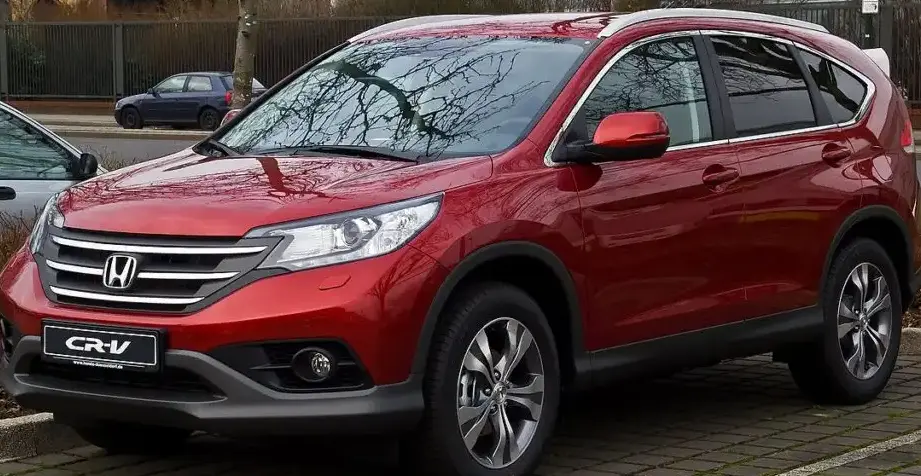
The Honda CR-V IV (facelift 2014) 1.6 i-DTEC (160 hp) AWD represents a significant iteration of Honda’s popular compact SUV, introduced for the 2015 and 2016 model years. This variant was primarily aimed at the European market, where demand for fuel-efficient diesel SUVs was high. It slotted into the CR-V lineup as a mid-range offering, balancing performance with economy and all-weather capability thanks to its all-wheel-drive system. The facelift brought styling updates and, crucially, the introduction of the new Earth Dreams Technology diesel engine.
Technical Specifications
| Brand | Honda |
| Model | CR-V |
| Generation | CR-V IV (facelift 2014) |
| Type (Engine) | 1.6 i-DTEC (160 Hp) AWD |
| Start of production | 2015 |
| End of production | 2016 |
| Powertrain Architecture | Internal Combustion engine |
| Body type | SUV |
| Seats | 5 |
| Doors | 5 |
| Fuel consumption (urban) | 5.3 – 5.5 l/100 km (44.4 – 42.8 US mpg) |
| Fuel consumption (extra urban) | 4.7 l/100 km (50 US mpg) |
| Fuel consumption (combined) | 4.9 – 5.1 l/100 km (48 – 46.1 US mpg) |
| CO2 emissions | 129 – 133 g/km |
| Fuel Type | Diesel |
| Acceleration 0 – 100 km/h | 9.6 sec |
| Acceleration 0 – 62 mph | 9.6 sec |
| Acceleration 0 – 60 mph | 9.1 sec |
| Maximum speed | 202 km/h (125.52 mph) |
| Emission standard | Euro 6b |
| Weight-to-power ratio | 10.2 kg/Hp |
| Weight-to-torque ratio | 4.7 kg/Nm |
| Power | 160 Hp @ 4000 rpm |
| Torque | 350 Nm @ 2000 rpm (258.15 lb.-ft. @ 2000 rpm) |
| Engine layout | Front, Transverse |
| Engine Model/Code | N16A4 |
| Engine displacement | 1597 cm3 (97.45 cu. in.) |
| Number of cylinders | 4 |
| Engine configuration | Inline |
| Compression ratio | 16:1 |
| Number of valves per cylinder | 4 |
| Fuel injection system | Diesel Commonrail |
| Engine aspiration | Turbocharger, Intercooler |
| Engine oil capacity | 4.7 l (4.97 US qt | 4.14 UK qt) |
| Coolant capacity | 5.7 l (6.02 US qt | 5.02 UK qt) |
| Kerb Weight | 1630 kg (3593.53 lbs.) |
| Trunk (boot) space – minimum | 589 l (20.8 cu. ft.) |
| Trunk (boot) space – maximum | 1669 l (58.94 cu. ft.) |
| Fuel tank capacity | 58 l (15.32 US gal | 12.76 UK gal) |
| Length | 4605 mm (181.3 in.) |
| Width | 2096 mm (82.52 in.) |
| Height | 1685 mm (66.34 in.) |
| Wheelbase | 2630 mm (103.54 in.) |
| Ride height (ground clearance) | 165 mm (6.5 in.) |
| Minimum turning circle | 11.7 m (38.39 ft.) |
| Drive wheel | All wheel drive (4×4) |
| Number of gears | 6 |
| Gearbox type | Manual transmission |
| Front suspension | Independent, McPherson with coil spring and anti-roll bar |
| Rear suspension | Independent multi-link suspension |
| Front brakes | Ventilated discs |
| Rear brakes | Disc |
| Assisting systems | ABS (Anti-lock braking system) |
| Steering type | Steering rack and pinion |
| Tires size | 225/65 R17; 225/60 R18 |
| Wheel rims size | 17; 18 |
Introduction
The CR-V IV, launched in 2012, was a crucial model for Honda in Europe, representing a shift towards a more sophisticated and refined SUV. The 2014 facelift brought with it the introduction of the 1.6 i-DTEC engine, part of Honda’s Earth Dreams Technology series. This engine was designed to offer a compelling blend of performance and fuel efficiency, appealing to buyers seeking a practical and economical SUV. The 1.6 i-DTEC AWD variant was positioned as a versatile option, suitable for both urban driving and occasional off-road excursions. It was a direct response to the growing popularity of diesel-powered SUVs in the European market.
Powertrain & Engine Architecture
The heart of this CR-V variant is the N16A4 1.6-liter inline-four cylinder diesel engine. This engine utilizes a common-rail direct injection system, delivering fuel at extremely high pressure for optimized combustion. The engine features a single turbocharger with an intercooler, boosting power output and improving torque delivery. The engine code ‘N16A4’ signifies its position within Honda’s engine family. It produces 160 horsepower at 4000 rpm and a substantial 350 Nm (258 lb-ft) of torque at just 2000 rpm. This torque peak, available at relatively low engine speeds, contributes to strong acceleration and effortless cruising. The engine also incorporates a particulate filter to meet stringent Euro 6b emission standards. The engine is paired with a six-speed manual transmission, chosen for its efficiency and driver engagement. While an automatic transmission was available on other CR-V trims, it wasn’t offered with the 1.6 i-DTEC engine.
Driving Characteristics
The 1.6 i-DTEC AWD CR-V offers a composed and refined driving experience. While not a performance-oriented SUV, the engine provides adequate power for everyday driving and overtaking maneuvers. The 9.6-second 0-62 mph acceleration time is respectable for a diesel SUV of this class. The six-speed manual transmission allows for precise gear selection, and the engine’s strong low-end torque makes it easy to drive in various conditions. The all-wheel-drive system provides enhanced traction and stability, particularly on slippery surfaces. Compared to the 2.0-liter petrol CR-V, the 1.6 i-DTEC offers significantly better fuel economy, but with slightly less overall power. Compared to the 1.6 i-DTEC 2WD version, the AWD model experiences a slight decrease in fuel efficiency due to the added weight and drivetrain complexity.
Equipment & Trim Levels
The 1.6 i-DTEC AWD typically came equipped with a good level of standard features. These included air conditioning, a touchscreen infotainment system with Bluetooth connectivity, alloy wheels, and a comprehensive suite of safety features such as ABS, stability control, and multiple airbags. Higher trim levels offered additional features such as leather upholstery, a sunroof, and a more advanced navigation system. Interior upholstery was typically cloth, with options for partial leather. The dashboard layout was functional and well-designed, with clear instrumentation and intuitive controls.
Chassis & Braking
The CR-V IV utilizes a MacPherson strut front suspension and a multi-link rear suspension, providing a comfortable and controlled ride. The suspension is tuned to prioritize comfort over outright sportiness. The all-wheel-drive system employs a real-time system, automatically distributing torque between the front and rear wheels as needed. Braking duties are handled by ventilated discs at the front and solid discs at the rear. The ABS system provides effective stopping power and prevents wheel lockup during emergency braking.
Market Reception & Comparison
The 1.6 i-DTEC AWD CR-V was generally well-received by automotive critics. It was praised for its fuel efficiency, comfortable ride, and practical interior. However, some reviewers noted that the engine could be a bit noisy under hard acceleration. Compared to competitors such as the Nissan Qashqai and Kia Sportage, the CR-V offered a more refined driving experience and a reputation for reliability. Fuel economy figures of 48-46.1 US mpg combined were competitive within its segment. The 1.6 i-DTEC offered a compelling alternative to the petrol-powered CR-V, particularly for drivers who covered long distances.
Legacy
The 1.6 i-DTEC engine proved to be a reliable unit, although, like any diesel engine, it requires regular maintenance, including oil changes and filter replacements. The CR-V IV, in general, has a good reputation for long-term durability. On the used car market, the 1.6 i-DTEC AWD variant represents a good value proposition, offering a blend of practicality, economy, and all-weather capability. However, potential buyers should be aware of the potential for diesel particulate filter (DPF) issues, particularly if the vehicle has been primarily used for short journeys. Overall, the 1.6 i-DTEC AWD CR-V remains a popular and well-regarded SUV, offering a compelling package for buyers seeking a versatile and economical vehicle.