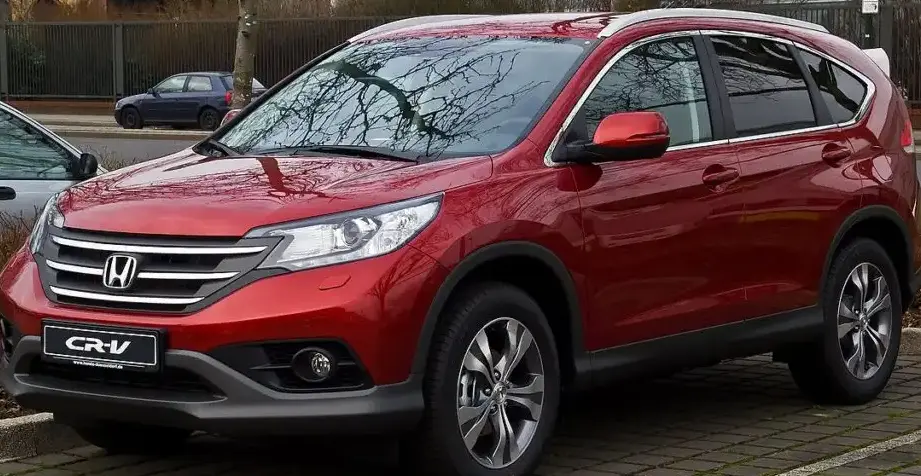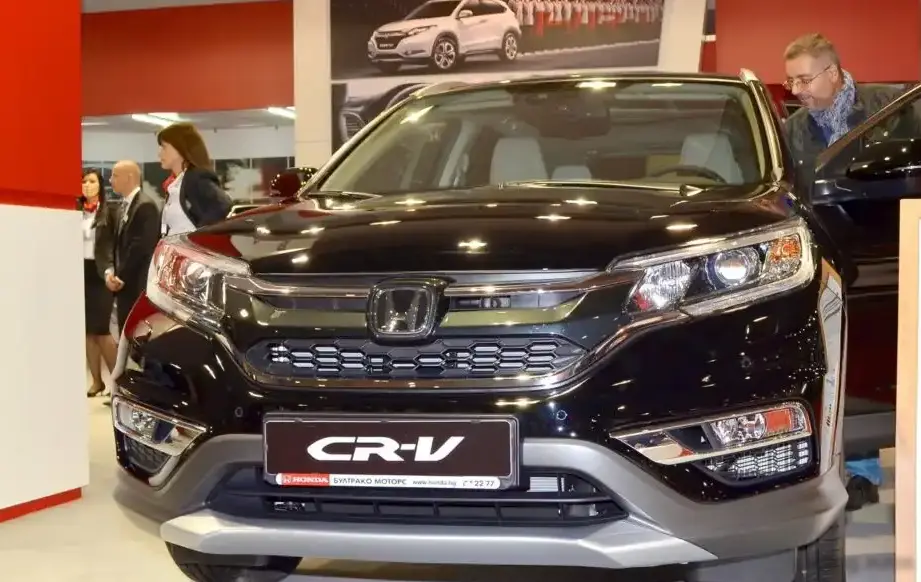
The Honda CR-V IV (facelift, introduced in 2014) 2.0 i-VTEC (155 hp) Automatic All-Wheel Drive represents a significant iteration of Honda’s popular compact SUV. Produced from 2015 to 2016, this variant occupied a middle ground within the CR-V lineup, offering a balance between affordability, fuel efficiency, and all-weather capability. It was primarily aimed at families and individuals seeking a practical and reliable vehicle for daily commuting and weekend adventures. This model was sold primarily in markets outside of North America, where the CR-V was offered with different engine options.
| Brand | Honda |
| Model | CR-V |
| Generation | CR-V IV (facelift 2014) |
| Type (Engine) | 2.0 i-VTEC (155 Hp) Automatic AWD |
| Start of production | 2015 |
| End of production | 2016 |
| Powertrain Architecture | Internal Combustion engine |
| Body type | SUV |
| Seats | 5 |
| Doors | 5 |
| Fuel consumption (urban) | 10.0 – 10.1 l/100 km (23.5 – 23.3 US mpg) |
| Fuel consumption (extra urban) | 6.0 – 6.2 l/100 km (39.2 – 37.9 US mpg) |
| Fuel consumption (combined) | 7.5 – 7.7 l/100 km (31.4 – 30.5 US mpg) |
| CO2 emissions | 175 – 179 g/km |
| Fuel Type | Petrol (Gasoline) |
| Acceleration 0 – 100 km/h | 12.3 sec |
| Acceleration 0 – 62 mph | 12.3 sec |
| Acceleration 0 – 60 mph | 11.7 sec |
| Maximum speed | 182 km/h (113.09 mph) |
| Emission standard | Euro 5 |
| Weight-to-power ratio | 10 kg/Hp |
| Weight-to-torque ratio | 8 kg/Nm |
| Power | 155 Hp @ 6500 rpm |
| Torque | 192 Nm @ 4300 rpm (141.61 lb.-ft. @ 4300 rpm) |
| Engine layout | Front, Transverse |
| Engine Model/Code | R20A5, R20A9 |
| Engine displacement | 1997 cm3 (121.86 cu. in.) |
| Number of cylinders | 4 |
| Engine configuration | Inline |
| Compression ratio | 10.6:1 |
| Number of valves per cylinder | 4 |
| Fuel injection system | Multi-port manifold injection |
| Engine aspiration | Naturally aspirated |
| Engine oil capacity | 3.7 l (3.91 US qt | 3.26 UK qt) |
| Coolant capacity | 6.04 l (6.38 US qt | 5.31 UK qt) |
| Kerb Weight | 1543 kg (3401.73 lbs) |
| Trunk (boot) space – minimum | 589 l (20.8 cu. ft.) |
| Trunk (boot) space – maximum | 1669 l (58.94 cu. ft.) |
| Fuel tank capacity | 58 l (15.32 US gal | 12.76 UK gal) |
| Length | 4605 mm (181.3 in) |
| Width | 2096 mm (82.52 in) |
| Height | 1685 mm (66.34 in) |
| Wheelbase | 2630 mm (103.54 in) |
| Ride height (ground clearance) | 165 mm (6.5 in) |
| Minimum turning circle | 11.7 m (38.39 ft) |
| Drive wheel | All wheel drive (4×4) |
| Number of gears | 9 |
| Gearbox type | Automatic transmission |
| Front suspension | Independent, McPherson with coil spring and anti-roll bar |
| Rear suspension | Independent multi-link |
| Front brakes | Ventilated discs |
| Rear brakes | Disc |
| Assisting systems | ABS (Anti-lock braking system) |
| Steering type | Steering rack and pinion |
| Tires size | 225/65 R17; 225/60 R18 |
| Wheel rims size | 17; 18 |
Powertrain & Engine Architecture
At the heart of the CR-V 2.0 i-VTEC AWD lies the Honda R20A5 or R20A9 engine, a 1.997-liter (121.86 cubic inches) inline-four cylinder gasoline engine. This engine is part of Honda’s K20 family, known for its reliability and relatively simple design. The “i-VTEC” system (Intelligent Variable Valve Timing and Lift Electronic Control) optimizes valve timing and lift based on engine speed and load, improving both fuel efficiency and performance. The engine utilizes multi-point fuel injection, delivering fuel directly to the intake ports. The 9-speed automatic transmission, a relatively new technology at the time, was designed to improve fuel economy and provide smoother shifts compared to traditional automatic transmissions. It features a wider range of gear ratios, allowing the engine to operate more efficiently at various speeds.
Driving Characteristics
The 155 hp and 192 Nm (141.61 lb-ft) of torque produced by the 2.0 i-VTEC engine, coupled with the 9-speed automatic, resulted in a comfortable, but not particularly sporty, driving experience. Acceleration from 0-60 mph took approximately 11.7 seconds, and 0-100 km/h in 12.3 seconds. The automatic transmission, while offering smooth shifts, could sometimes feel hesitant during quick acceleration. The all-wheel-drive system provided enhanced traction in slippery conditions, making it a suitable vehicle for regions with inclement weather. Compared to the more powerful 2.4-liter engine option available in some markets, this variant offered less outright performance, but it compensated with improved fuel economy. The gear ratios were tuned for efficiency, prioritizing fuel savings over rapid acceleration.
Equipment & Trim Levels
The CR-V 2.0 i-VTEC Automatic AWD typically came equipped with a respectable level of standard features. These included air conditioning, power windows and locks, a basic audio system with USB connectivity, and alloy wheels. Higher trim levels offered upgrades such as a sunroof, leather upholstery, a more advanced infotainment system with navigation, and automatic climate control. Safety features such as ABS, electronic stability control, and multiple airbags were standard across all trims. The interior design was functional and practical, with a focus on durability and ease of use. The dashboard layout was straightforward, and the seats provided adequate comfort for long journeys.
Chassis & Braking
The CR-V IV utilized a MacPherson strut front suspension and an independent multi-link rear suspension, providing a comfortable ride quality. The suspension was tuned to prioritize comfort over sporty handling. The braking system consisted of ventilated discs on the front wheels and solid discs on the rear. ABS (Anti-lock Braking System) was standard, enhancing braking performance and stability. The vehicle’s weight of 1543 kg (3401.73 lbs) contributed to its stable handling characteristics. Stabilizer bars were fitted to both the front and rear axles to reduce body roll during cornering.
Market Reception & Comparison
The CR-V 2.0 i-VTEC Automatic AWD was generally well-received by automotive critics as a practical and reliable family SUV. It was praised for its spacious interior, comfortable ride, and fuel efficiency. However, some critics noted that the engine lacked the power of its larger counterparts, and the automatic transmission could occasionally feel sluggish. Compared to other compact SUVs in its class, the CR-V offered a competitive combination of features, fuel economy, and reliability. Its fuel consumption figures of 7.5 – 7.7 l/100 km (31.4 – 30.5 US mpg) were respectable for its size and class.
Legacy
The Honda R20A5/R20A9 engine, when paired with the 9-speed automatic transmission, has proven to be a relatively reliable powertrain. While not without its minor issues (such as occasional transmission software glitches), it generally requires routine maintenance to remain in good working order. In the used car market, this variant of the CR-V IV represents a good value proposition for buyers seeking a dependable and fuel-efficient SUV. Its reputation for reliability and Honda’s strong brand image contribute to its continued popularity. Parts availability is generally good, and maintenance costs are reasonable, making it an attractive option for budget-conscious buyers.