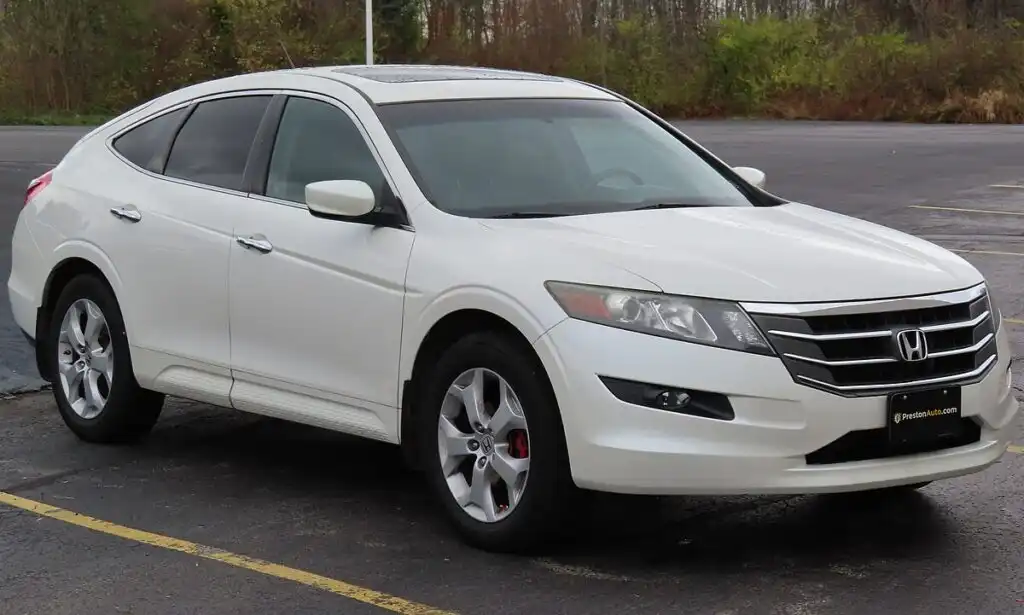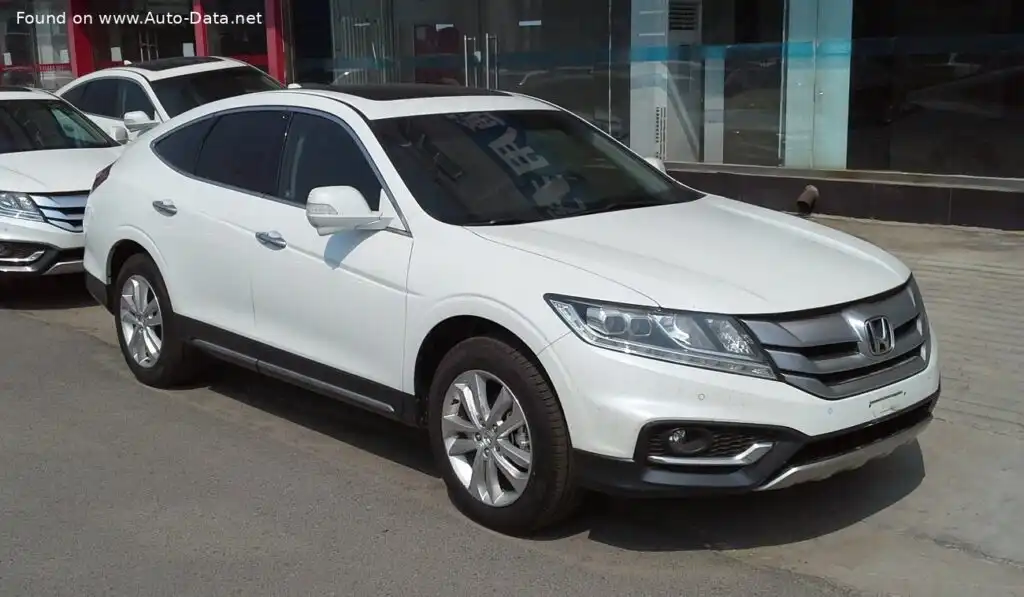
The Honda Crosstour, specifically the facelifted model produced from 2012 to 2015, represented Honda’s attempt to enter the burgeoning crossover market with a vehicle blending coupe-like styling with the practicality of an SUV. The 2.4 i-VTEC variant with an automatic transmission was a core offering within the Crosstour lineup, positioned as a mainstream, comfortable, and fuel-efficient option. It was based on the Honda Accord platform, sharing many components but offering a unique body style aimed at attracting buyers seeking something different from the traditional SUV aesthetic. The Crosstour was primarily marketed in North America, where the demand for crossovers was particularly strong.
Technical Specifications
| Brand | Honda |
| Model | Crosstour |
| Generation | Crosstour (facelift 2012) |
| Type (Engine) | 2.4 i-VTEC (192 Hp) Automatic |
| Start of production | 2012 |
| End of production | 2015 |
| Powertrain Architecture | Internal Combustion engine |
| Body type | Coupe, SUV |
| Seats | 5 |
| Doors | 5 |
| Fuel consumption (economy) – urban (EPA) | 10.7 l/100 km (22 US mpg, 26.4 UK mpg, 9.3 km/l) |
| Fuel consumption (economy) – extra urban (EPA) | 7.6 l/100 km (30.9 US mpg, 37.2 UK mpg, 13.2 km/l) |
| Fuel consumption (economy) – combined (EPA) | 9.4 l/100 km (25 US mpg, 30.1 UK mpg, 10.6 km/l) |
| Fuel Type | Petrol (Gasoline) |
| Emission standard | ULEV-2 |
| Weight-to-power ratio | 8.8 kg/Hp, 114.3 Hp/tonne |
| Weight-to-torque ratio | 7.6 kg/Nm, 131 Nm/tonne |
| Power | 192 Hp @ 7000 rpm |
| Power per litre | 81.6 Hp/l |
| Torque | 220 Nm @ 4400 rpm (162.26 lb.-ft. @ 4400 rpm) |
| Maximum engine speed | 7100 rpm |
| Engine layout | Front, Transverse |
| Engine Model/Code | K24Y2 |
| Engine displacement | 2354 cm3 (143.65 cu. in.) |
| Number of cylinders | 4 |
| Engine configuration | Inline |
| Cylinder Bore | 87 mm (3.43 in.) |
| Piston Stroke | 99 mm (3.9 in.) |
| Compression ratio | 10:1 |
| Number of valves per cylinder | 4 |
| Fuel injection system | Multi-port manifold injection |
| Engine aspiration | Naturally aspirated engine |
| Valvetrain | DOHC, i-VTEC |
| Engine oil capacity | 4 l (4.23 US qt | 3.52 UK qt) |
| Coolant | 7.6 l (8.03 US qt | 6.69 UK qt) |
| Kerb Weight | 1680-1693 kg (3703.77 – 3732.43 lbs.) |
| Max. weight | 2170 kg (4784.03 lbs.) |
| Max load | 477-490 kg (1051.6 – 1080.27 lbs.) |
| Trunk (boot) space – minimum | 728 l (25.71 cu. ft.) |
| Trunk (boot) space – maximum | 1453 l (51.31 cu. ft.) |
| Fuel tank capacity | 70 l (18.49 US gal | 15.4 UK gal) |
| Permitted trailer load with brakes (12%) | 454 kg (1000.9 lbs.) |
| Length | 4994 mm (196.61 in.) |
| Width | 1897 mm (74.69 in.) |
| Height | 1562 mm (61.5 in.) |
| Wheelbase | 2797 mm (110.12 in.) |
| Front track | 1648 mm (64.88 in.) |
| Rear (Back) track | 1648 mm (64.88 in.) |
| Minimum turning circle (turning diameter) | 12.3 m (40.35 ft.) |
| Drivetrain Architecture | The Internal combustion engine (ICE) drives the front wheels of the vehicle. |
| Drive wheel | Front wheel drive |
| Number of gears and type of gearbox | 5 gears, automatic transmission |
| Front suspension | Coil spring, Double wishbone, Transverse stabilizer |
| Rear suspension | Independent multi-link spring suspension with stabilizer |
| Front brakes | Ventilated discs, 297 mm |
| Rear brakes | Disc, 305 mm |
| Assisting systems | ABS (Anti-lock braking system) |
| Steering type | Steering rack and pinion |
| Power steering | Electric Steering |
| Tires size | 225/65 R17 |
| Wheel rims size | 6.5J x 17 |
Powertrain & Engine Architecture
The 2012-2015 Honda Crosstour 2.4 i-VTEC utilized the K24Y2 engine, a 2.4-liter inline-four cylinder powerplant. This engine is part of Honda’s K-series family, known for its reliability and efficiency. The K24Y2 features a single overhead camshaft (SOHC) design with Honda’s i-VTEC (intelligent Variable Valve Timing and Lift Electronic Control) system. This system allows for variable valve timing and lift, optimizing engine performance and fuel efficiency across a wide range of engine speeds. Fuel delivery is managed by a multi-point fuel injection system. The engine produces 192 horsepower at 7000 rpm and 220 Nm (162 lb-ft) of torque at 4400 rpm. The engine is transversely mounted in the front of the vehicle.
The automatic transmission paired with the K24Y2 is a 5-speed unit. While not the most advanced transmission available at the time, it was chosen for its smoothness and reliability. The gear ratios were tuned for comfortable cruising and adequate acceleration, prioritizing fuel economy over outright performance. The transmission lacks manual shift capabilities.
Driving Characteristics
The 2.4L automatic Crosstour delivers adequate, but not exhilarating, performance. Acceleration is sufficient for everyday driving, but the 0-60 mph time is around 9.2 seconds. The automatic transmission provides smooth shifts, but can feel somewhat hesitant during quick acceleration or when attempting to pass on the highway. Compared to the available manual transmission, the automatic version sacrifices some responsiveness. The power delivery is linear, with the peak torque arriving at a relatively moderate 4400 rpm. This makes it a comfortable daily driver, but less engaging for enthusiasts. The weight of the vehicle, around 3700 lbs, contributes to the less sporty feel.
Equipment & Trim Levels
The 2.4 i-VTEC Crosstour typically came standard with features such as air conditioning, power windows and locks, a rearview camera, and a basic audio system. Higher trim levels added features like leather upholstery, a sunroof, navigation system, and upgraded audio. Interior materials were generally of good quality, but not luxurious. The dashboard layout was functional and easy to use. Optional extras included alloy wheels, heated front seats, and a premium sound system.
Chassis & Braking
The Crosstour utilizes a front-wheel-drive layout. The front suspension consists of coil springs and a double wishbone setup, while the rear suspension employs an independent multi-link design. Both ends feature a stabilizer bar to reduce body roll. The braking system consists of ventilated discs at the front and solid discs at the rear. Anti-lock brakes (ABS) were standard. The steering is electrically assisted, providing a light and easy steering feel.
Market Reception & Comparison
The Crosstour received mixed reviews from automotive critics. While its unique styling was appreciated by some, others found it awkward and polarizing. The 2.4L engine and automatic transmission combination was generally considered adequate for most drivers, but lacked the performance of competing models with larger engines or more advanced transmissions. Fuel economy was a strong point, with the Crosstour achieving around 25 mpg in combined driving. Compared to the V6-powered Crosstours, the 2.4L version offered better fuel economy but significantly less power. Reliability was generally good, consistent with Honda’s reputation.
Legacy
The Honda Crosstour was discontinued after the 2015 model year. While it didn’t achieve massive sales success, it remains a relatively reliable and affordable used car option. The K24Y2 engine is known for its longevity, and with proper maintenance, can easily exceed 200,000 miles. The 5-speed automatic transmission is also generally reliable, although it may require fluid changes at recommended intervals. Today, the Crosstour is often seen as a practical and spacious crossover, appealing to buyers looking for a comfortable and fuel-efficient vehicle with a distinctive design.