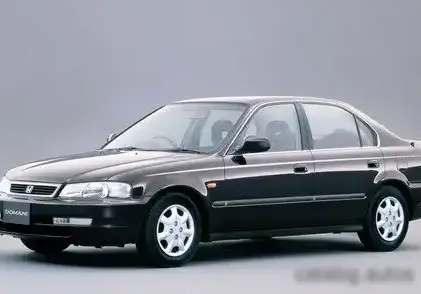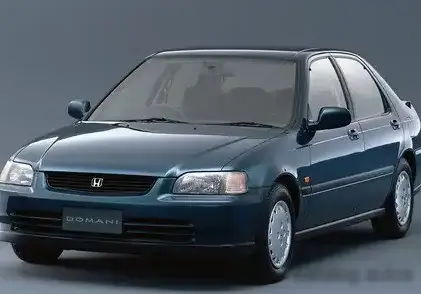
The Honda Domani 1.6 16V, produced between 1993 and 1996, was a compact sedan aimed at the Japanese domestic market (JDM). Positioned as a more stylish and refined alternative to the Civic, the Domani sought to appeal to buyers desiring a slightly more upscale experience. It was based on a dedicated platform, distinct from the Civic, and offered a range of engines, with the 1.6-liter 16-valve engine producing 130 horsepower being a popular choice. The Domani never received a significant direct export to North America, contributing to its relative obscurity outside of Japan and limited grey-market imports.
Technical Specifications
| Brand | Honda |
| Model | Domani |
| Generation | Domani |
| Type (Engine) | 1.6 16V (130 Hp) |
| Start of production | 1993 |
| End of production | 1996 |
| Powertrain Architecture | Internal Combustion engine |
| Body type | Sedan |
| Seats | 5 |
| Doors | 4 |
| Fuel consumption (combined) | 6.4 l/100 km (36.8 US mpg, 44.1 UK mpg, 15.6 km/l) |
| Fuel Type | Petrol (Gasoline) |
| Maximum speed | 190 km/h (118.06 mph) |
| Weight-to-power ratio | 8.1 kg/Hp, 123.8 Hp/tonne |
| Weight-to-torque ratio | 7.2 kg/Nm, 138.1 Nm/tonne |
| Power | 130 Hp @ 6600 rpm |
| Power per litre | 81.8 Hp/l |
| Torque | 145 Nm @ 5200 rpm (106.95 lb.-ft. @ 5200 rpm) |
| Engine layout | Front, Transverse |
| Engine displacement | 1590 cm3 (97.03 cu. in.) |
| Number of cylinders | 4 |
| Engine configuration | Inline |
| Cylinder Bore | 75 mm (2.95 in.) |
| Piston Stroke | 90 mm (3.54 in.) |
| Compression ratio | 9.2:1 |
| Number of valves per cylinder | 4 |
| Fuel injection system | Multi-port manifold injection |
| Engine aspiration | Naturally aspirated engine |
| Valvetrain | OHC |
| Kerb Weight | 1050 kg (2314.85 lbs.) |
| Fuel tank capacity | 45 l (11.89 US gal | 9.9 UK gal) |
| Length | 4415 mm (173.82 in.) |
| Width | 1695 mm (66.73 in.) |
| Height | 1390 mm (54.72 in.) |
| Wheelbase | 2620 mm (103.15 in.) |
| Front track | 1475 mm (58.07 in.) |
| Rear track | 1465 mm (57.68 in.) |
| Drivetrain Architecture | The Internal combustion engine (ICE) drives the front wheels of the vehicle. |
| Drive wheel | Front wheel drive |
| Number of gears and type of gearbox | 5 gears, manual transmission |
| Front suspension | Coil spring |
| Rear suspension | Coil spring |
| Front brakes | Ventilated discs |
| Rear brakes | Drum |
| Assisting systems | ABS (Anti-lock braking system) |
| Steering type | Steering rack and pinion |
| Power steering | Hydraulic Steering |
| Tires size | 175/65 R14 H |
Powertrain & Engine Architecture
The Domani 1.6 16V utilized Honda’s SOHC (Single Overhead Cam) 1.6-liter inline-four engine, designated as part of the D16 series. Specifically, this engine was closely related to the D16Z6 found in some Japanese and North American Civic models, but with subtle differences in tuning and specification. The multi-port fuel injection system, a hallmark of Honda engines of this era, delivered precise fuel metering for optimal combustion. The 16 valves (four per cylinder) contributed to the engine’s relatively high specific output for its displacement. The engine’s design prioritized smooth operation and reasonable fuel efficiency over outright performance. The five-speed manual transmission was the standard offering, providing a direct and engaging driving experience. The transmission featured typical Honda robustness and precise shift quality.
Driving Characteristics
The Domani 1.6 16V offered a balanced driving experience. While not a sports car, the 130 horsepower engine provided adequate power for everyday driving and even some spirited acceleration. The five-speed manual transmission allowed drivers to fully utilize the engine’s powerband, with peak torque arriving at 5200 rpm. Compared to the lower-powered 1.5-liter engine option available in the Domani, the 1.6-liter provided a noticeable improvement in responsiveness. The Domani’s suspension, tuned for comfort, absorbed bumps effectively, making it a pleasant cruiser. However, it wasn’t particularly sporty, with some body roll evident during cornering. The steering, while hydraulically assisted, lacked the direct feel of some contemporary European sedans.
Equipment & Trim Levels
The Domani 1.6 16V typically came equipped with features considered standard for a compact sedan in the early 1990s. This included power steering, air conditioning, and a basic audio system. Interior upholstery was typically cloth, with a relatively simple dashboard layout. Higher trim levels offered options such as alloy wheels, upgraded audio systems, and power windows. The Domani aimed for a clean, functional interior design rather than luxurious appointments. The focus was on providing a comfortable and practical cabin for both driver and passengers.
Chassis & Braking
The Domani’s chassis featured a MacPherson strut front suspension and a coil spring rear suspension. This configuration provided a good balance of ride comfort and handling. The front brakes were ventilated discs, offering good stopping power, while the rear brakes were drums, a cost-saving measure common in this class of vehicle. ABS (Anti-lock Braking System) was available as an option, enhancing safety by preventing wheel lockup during hard braking. The Domani’s relatively light weight (1050 kg) contributed to its nimble handling characteristics.
Market Reception & Comparison
The Honda Domani was generally well-received in Japan as a stylish and practical compact sedan. Critics praised its comfortable ride, refined engine, and attractive design. However, it wasn’t considered a particularly exciting car to drive, and its price positioned it slightly above some of its competitors, such as the Toyota Corolla and Nissan Sunny. Compared to the Civic, the Domani offered a more mature and sophisticated image, but at the expense of some of the Civic’s sporty character. Fuel economy was competitive for its class, averaging around 36.8 US mpg in combined driving.
Legacy
The Honda Domani, while not a widely known model outside of Japan, has gained a following among enthusiasts of JDM cars. Its relatively simple mechanical design and Honda’s reputation for reliability have made it a popular choice for restoration and modification projects. The D16 engine is known for its durability and ease of maintenance. Today, well-maintained Domani 1.6 16V models are becoming increasingly collectible, particularly those in original condition. The car represents a unique chapter in Honda’s history, showcasing the company’s ability to create stylish and refined compact sedans for a discerning market.