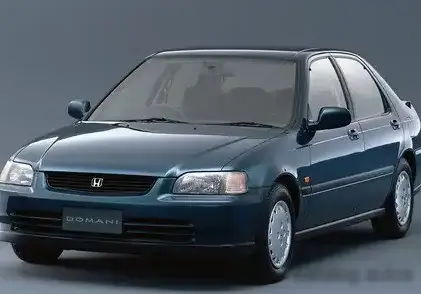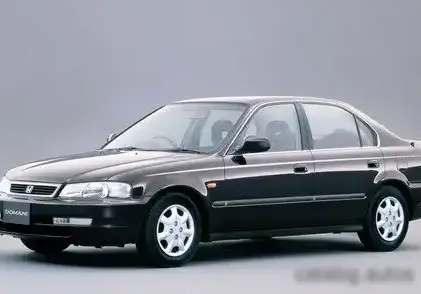
The Honda Domani II 1.5, produced between 1997 and 2000, represented a refined iteration of Honda’s compact sedan, primarily aimed at the Japanese domestic market (JDM). Positioned as a more stylish and comfortable alternative to the Civic, the Domani II offered a blend of practicality and a slightly more upscale experience. This particular 1.5-liter, 105 horsepower variant served as a core offering within the Domani II lineup, providing a balance between fuel efficiency and adequate performance for everyday driving. It was part of the broader Domani (MCV) series, which aimed to provide a more mature and sophisticated option within Honda’s portfolio.
Technical Specifications
| Brand | Honda |
| Model | Domani |
| Generation | Domani II |
| Type (Engine) | 1.5 (105 Hp) |
| Start of production | 1997 |
| End of production | 2000 |
| Powertrain Architecture | Internal Combustion engine |
| Body type | Sedan |
| Seats | 5 |
| Doors | 4 |
| Fuel Type | Petrol (Gasoline) |
| Weight-to-power ratio | 9.8 kg/Hp, 101.9 Hp/tonne |
| Weight-to-torque ratio | 7.7 kg/Nm, 129.1 Nm/tonne |
| Power | 105 Hp @ 6500 rpm |
| Power per litre | 70.3 Hp/l |
| Torque | 133 Nm @ 3600 rpm, 98.1 lb.-ft. @ 3600 rpm |
| Engine layout | Front, Transverse |
| Engine Model/Code | D15B |
| Engine displacement | 1493 cm3, 91.11 cu. in. |
| Number of cylinders | 4 |
| Engine configuration | Inline |
| Cylinder Bore | 75 mm, 2.95 in. |
| Piston Stroke | 84.5 mm, 3.33 in. |
| Compression ratio | 9:1 |
| Number of valves per cylinder | 4 |
| Fuel injection system | Multi-port manifold injection |
| Engine aspiration | Naturally aspirated engine |
| Valvetrain | SOHC |
| Kerb Weight | 1030 kg, 2270.76 lbs |
| Fuel tank capacity | 45 l, 11.89 US gal | 9.9 UK gal |
| Length | 4480 mm, 176.38 in. |
| Width | 1695 mm, 66.73 in. |
| Height | 1390 mm, 54.72 in. |
| Wheelbase | 2620 mm, 103.15 in. |
| Minimum turning circle | 10 m, 32.81 ft |
| Drivetrain Architecture | The Internal combustion engine (ICE) drives the front wheels of the vehicle. |
| Drive wheel | Front wheel drive |
| Number of gears | 4 gears, manual transmission |
| Front suspension | Double wishbone |
| Rear suspension | Double wishbone |
| Front brakes | Disc |
| Rear brakes | Drum |
| Tires size | 175/ 70R13 82S |
Powertrain & Engine Architecture
The heart of the Domani II 1.5 was the D15B engine, a 1.5-liter inline-four cylinder powerplant. This engine utilized a single overhead camshaft (SOHC) valvetrain, operating four valves per cylinder. Fuel delivery was managed by a multi-point fuel injection system, contributing to improved fuel efficiency and smoother operation compared to earlier carburetor-equipped engines. The D15B produced 105 horsepower at 6500 rpm and 133 Nm (98.1 lb-ft) of torque at 3600 rpm. The engine’s relatively modest output was characteristic of the era’s focus on fuel economy and emissions regulations. The Domani II 1.5 was exclusively offered with a four-speed automatic transmission in many markets, designed for ease of use and comfort. This transmission featured typical torque converter technology, prioritizing smooth shifts over outright performance.
Driving Characteristics
The Domani II 1.5 with the four-speed automatic transmission offered a comfortable, if not particularly sporty, driving experience. Acceleration was adequate for typical urban and highway driving, but the engine lacked the punch of higher-spec variants. The automatic transmission’s gear ratios were tuned for fuel efficiency, resulting in a somewhat leisurely pace. Compared to the five-speed manual transmission available on some Domani II models, the automatic version felt less responsive. The automatic transmission did, however, provide a more relaxed driving experience, particularly in stop-and-go traffic. The power delivery was linear, with peak torque arriving at a relatively accessible 3600 rpm, making it easy to maintain speed on inclines.
Equipment & Trim Levels
The Domani II 1.5 typically came equipped with a reasonable level of standard features. Interior appointments included cloth upholstery, a basic audio system, and power windows. Air conditioning was a common inclusion, though not always standard. Higher trim levels offered upgrades such as alloy wheels, a more sophisticated audio system, and optional features like a sunroof. The dashboard layout was functional and straightforward, prioritizing ease of use. The Domani II aimed for a slightly more refined interior ambiance than the Civic, with a focus on comfort and practicality.
Chassis & Braking
The Domani II utilized a front-engine, front-wheel-drive layout. Suspension consisted of a double wishbone setup at both the front and rear, providing a comfortable ride quality. The front brakes were disc brakes, offering adequate stopping power, while the rear brakes were drum brakes, a cost-saving measure common in this class of vehicle. The steering was typically power-assisted, making it easy to maneuver in tight spaces. The Domani II’s chassis was designed to prioritize ride comfort and stability over sporty handling.
Market Reception & Comparison
The Honda Domani II 1.5 was generally well-received in the Japanese market as a practical and reliable compact sedan. Critics praised its comfortable ride, fuel efficiency, and spacious interior. However, some reviewers noted that the 1.5-liter engine lacked the performance of larger-displacement engines offered in competing models. Compared to the higher-spec Domani II variants (often featuring a 1.8-liter engine), the 1.5-liter model offered a more affordable entry point into the Domani lineup. It appealed to buyers who prioritized fuel economy and ease of use over outright performance. Against competitors like the Toyota Corolla and Nissan Sunny, the Domani II offered a slightly more stylish and refined alternative.
Legacy
The Honda Domani II, including the 1.5-liter variant, has developed a reputation for long-term reliability. The D15B engine is known for its durability and relatively low maintenance costs. In the used car market, Domani II models are often sought after for their affordability and Honda’s reputation for build quality. While not a particularly collectible vehicle, well-maintained examples are becoming increasingly rare. The Domani II represents a significant step in Honda’s evolution of compact sedans, bridging the gap between the utilitarian Civic and more upscale offerings. The 1.5L automatic configuration remains a popular choice for those seeking a dependable and economical used car.